MAKING A MAN OF GOD

8%

MAKING A MAN OF GOD.

MOSES the meek above all men; Moses, the prince of Egypt; Moses, "learned in all the wisdom of the Egyptians;" "Moses, the man of God, who was faithful in all his house." By such terms is the great leader of God's host from Egypt to Canaan designated.
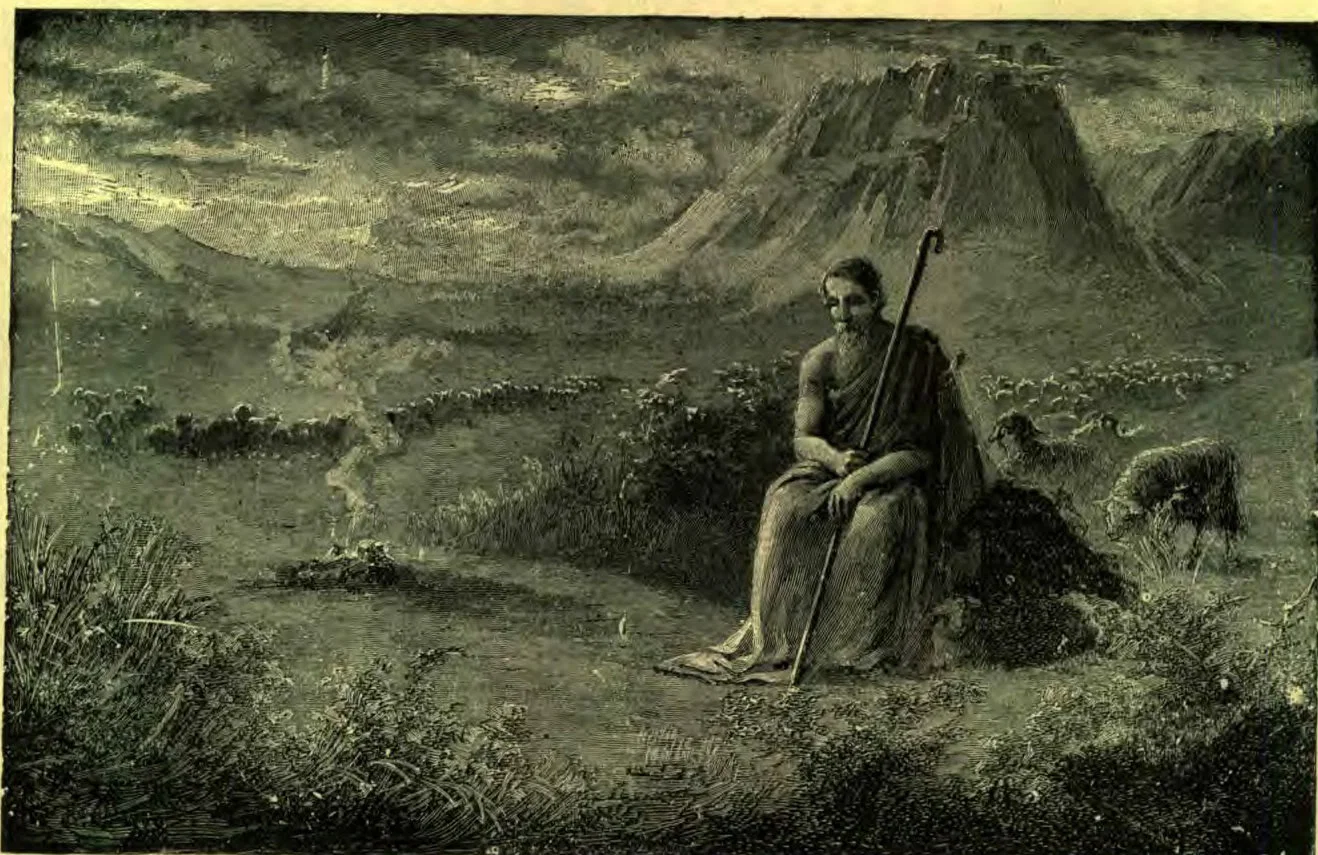
Estrated originally for "Patriarchs and Prophets." MOSES A SHEPHERD.
BORN in Egyptian slavery of a noble mother who feared God; born when the ban of tyranny was resting the most heavily upon his oppressed people; born under royal decree immediately to die; yet by God's providence Moses was preserved by the very royal family who sought to forever subjugate his people and destroy him.
At a wonderful time in the history of his race did he first see the light. About thirty-seven centuries ago found the seed of Abraham, the Hebrew, in Egypt. For over two hundred years they dwelt in its moral darkness, and much of the time were they in hard bondage of servitude, which grew more galling as the Hebrews increased. Finally the royal decree went forth to slay all the infants of two years old and under, in order that the race of Hebrews might not become too numerous, and take the kingdom.
IN such time Moses was born. Hidden by his mother as long as she dared to conceal him, she placed him in a little ark of bulrushes and committed him to the goodness of God, placing the little boat where the princess royal came down to bathe in the sacred Nile. The little babe was brought to her, excited the pity and mother love of
her heart, and she adopted the doomed Hebrew child as her son, employing, unwittingly, yet in God's providence, Moses' own mother to act as his nurse in whose care he was placed for twelve years. During this time we may well believe that the history, traditions, and prophecies relating to his own people were faithfully and prayerfully taught him; and this teaching of the providential dealing of God shut his soul forever against the corrupting influences of abominable Egyptian idolatry.
AT the end of this period he entered upon his education as king. He was taught art and science, literature, engineering, and warfare; in short, he was educated in all the wisdom of the Egyptians, and was mighty in word and deed. Tradition tells us that he was a great warrior, and waged active warfare in successful campaigns. He was heir to the throne of Egypt, at that time the mightiest and greatest throne of the entire world.
BUT what was all this to the noble youth who had chosen otherwise. How his mission as the deliverer of God's chosen people came to him, we do not know. It was to some extent a matter of general knowledge. It fired him with zeal, and when the test came to decide between the nation of slaves and the throne of Egypt, he did not hesitate, "choosing rather to share ill-treatment with the people of God, than to enjoy the pleasures of sin for a season; accounting the reproach of Christ greater riches than the treasures of Egypt, for he looked unto the recompense of the reward. . . . He endured as seeing Him who is invisible." Heb. 11: 25-27.
YET notwithstanding his purpose, he was not yet where God could use him. With faith in his mission, Moses had not yet learned his own insufficiency. He was a warrior by training. Why could not the numerous and hardy Hebrews be mobilized and led against Egypt? His heart burned to redress the wrongs of his people. So when he saw an Egyptian smiting a Hebrew, he promptly killed him, buried the body in the sand, and passed on. The next day he found two fighting Hebrews, and endeavoring to pacify them, the oppressor referred to his slaying the Egyptian the day before, and spurned his interference and leadership. Moses turns away disappointed, for "he supposed that his brethren understood that God by his hand was giving them deliverance." Ex. 2: 11-14; Acts 7: 25-27. Ungrateful and unappreciative doubtless his people were; but Moses was too self-sufficient for God to use.
MOSES, having identified himself with the Israelites who responded not to his efforts to help them, was forced to flee from Egypt. Discouraged and alone, he went to Midian, a related tribe, and settled down to a shepherd life. Forty years later God called him, sent him to Egypt, wrought through him great deliverance for his people, humbled the proudest nation then on earth, by him led a whole people from bondage to freedom, and gave to the world a code of laws which has been the wonder and the wisdom of the ages.
WHAT made him the man he became?—Chiefly two things: First, his purpose, inwrought into his very being by a godly, faithful mother, manifested in his decision to do what he deemed the right at any cost to himself.As soon as he came to the years of understanding, his purpose was manifest. Heb. 11:24. With the dazzling prospect of Egypt's throne before him, he refused it as a matter of principle. He might have argued that upon the throne he could have delivered his people, but he knew its corrupting influences. Therefore chose he the reproaches of Christ rather than "the treasures of Egypt." No young man will achieve success in life of any kind without a purpose. That purpose may seem to lead him to defeat and misfortune and loss, but it makes character; and if it be a righteous purpose, it will survive all diseases of earth. The weakness of the age is the great mass of purposeless young men and women. So many are creatures of impulse, now and then a good impulse, but impulse without purpose. The constant yielding to impulse unsettles the mind, and opens the way to the indulgence of all worldly lusts. Young men, young women, have a purpose in life; have a purpose for the day, for the hour. Let the purpose control the impulse.
The second great element in the making of "Moses the man of God" was the post-graduate course of forty years in Midian. Amid the throngs of men, we forget God. In the gilded courts of life we are constantly subject to deception. We see nearly always the better side, not the true inwardness. We ever walk over whited sepulchers filled with corruption. Man is ever prone to put the best outward, to hide the poor, the corrupt, the false, the base. God called Moses out into the country, amid all the glorious surroundings of nature. Brook and bird and mountain and tree stood for what they were, and made stronger and truer his purpose. The bright shining sun on its daily round, the paler moon in her ever-constant change, and the myriads of brilliant stars, garnishing the clear heavens, revealed day and night the glory of God. In God's providence, Moses was given the care of the foolish, the helpless. The sheep is not a wise animal. There is little in them to appeal to our sympathy but their gentleness, their defenselessness. Peculiarly helpless and tender are the young lambs of the flock; and surrounded as they were in that eastern country by the fierce Syrian wolves or the prowling jackals, they became a constant source of care and anxiety on the part of the faithful shepherd. Here Moses learned his great lesson of man's littleness and helplessness, and God's greatness and majesty and wisdom and love. Here, as shepherd of Jethro's flock, he learned to care for the flock of God in the weary, wilderness wandering of forty years. It developed patience, tenderness, love for the foolish and erring. It was the germ of love that developed the soul of the mediator, "Yet now, if Thou wilt forgive their sin—; and if not, blot me, I pray Thee, out of Thy book which Thou hast written." Ex. 32: 32. He had, like his divine Master, identified himself with the flock. Such an one God could call. He saw God's revelation in the burning bush. Distrusting himself, he ever sought God, and talked with the Majesty of heaven, face to face, as man talketh to his friend. Having looked upon God, he feared not the face of man. Meek, but mighty; for he walked with God. Let the lesson, merely suggested, sink into our hearts. Let a holy purpose rule our lives. Let the education which God would give to all be paramount to all else. "The fear of the Lord is the beginning of wisdom."