(Reported for the SIGNS OF THE TIMES by John S. Wightman.)
SEEING the advantage of Federal Catholic action and Confederated Protestant co-operation, if united in purpose and agreed as to plans, Bishop McFaul declared, “I say to you that if the Catholic and Protestants will unite to do something, there is no great wrong in this country that we can not right.” It is fully apparent to these leaders of federation that vast organizations, confederated and closely linked together, may, under proper conditions, see the realization of their hopes—“great wrongs of the country” righted, and civil power dominated and controlled by the unreasoning and combined forces of bigotry and intolerance!
Is not federation, in fact, a factor that will exert a powerful influence in the political sphere, and in the last analysis of its operation even shape and control the destiny of the nations? None are more quick to see that it will than those who occupy and desire to secure public offices of public trust. It was President Roosevelt who expressed his “highest sympathy with the movement” for Protestant federation of churches, and it was President Roosevelt who addressed the Catholic Federation Convention at Detroit last year in these words: “I believe most heartily in the work you are doing in your American Federation of Catholic Societies.”
Rulers and politicians are not slow to observe the mighty influence these vast bodies are ultimately bound to exercise in politics, and that they must be reckoned with, and consulted and assisted, by those who would secure and continue in official positions, depending upon the decisions rendered by the ballot!
Touching the Sabbath question, Bishop Canevin said:
“The disregard of the Lord’s day is one of the signs of the materialistic spirit and godlessness of our times. It is a subject worthy of serious consideration. Thousands of Catholic men employed in iron and steel mills, in mines and factories, on railroads, street-cars, docks, and wharves, in different departments under city governments, on many large contracts, have no opportunity, I will not say to rest, but even to worship God for one hour by attending mass on Sundays. If they have a day, or a half day, of rest during the week, it usually is on Saturday. Work and pleasure and material progress are made of supreme importance, and the mad sacrifice to mammon proceeds on Sundays, as if laboring men had no sabbath, no public worship, to offer, no souls to save. Against this unnecessary labor, this atheistic profanation of the Lord’s day, this paganizing and brutalizing of the laboring man, and shutting out from his life all religious light and grace, this federation should resolutely use its power, in civic as well as in social and private life.”
It is worthy of note here that it was Bishop Colton who, in a public sermon delivered in Buffalo on Sunday, Jan. 23, 1904, said:
“It is the spirit of the Catholic Church to keep the Lord’s day for rest and spiritual observance, and anything that would be against the religious observance of the day is something that the Catholic Church in this country would be opposed to.”
A week later Dr. Hunter of the Presbyterian Church, Buffalo, assented to the foregoing statement in the following expression:
“The words uttered by Bishop Colton last Sunday were strong and patriotic. This is a common danger to public welfare and it is one against which Roman Catholics and Protestants should join [[FIGURE]] hands in fighting. The Bishop is right. I would like to see the Catholics and Protestants unite on this proposition.”
The Catholic Union and Times, in its issue of August 2, observed:
“Federation is a magnificent organization that is bound to root out prevailing and ruining national evils—a patriotic undertaking in which Catholic and non-Catholic may join hands.”
It was the Protestant Federationists in New York City that voiced an earnest and ardent desire upon their part to unite their combined forces with that of the Roman Catholic Church, and the desire of the Catholic Federation being identical with that of the Protestant body, we are bound to conclude that these two great religious bodies will sooner or later unite for the success of their plans and the carrying out of their common purposes.
Chief of prevailing national evils will then, if not before, be found to be sabbath (Sunday) breaking. While the American principle of government is utterly against the application of religious laws, and the United States Constitution is directly opposed to legislation upon the subject, yet, notwithstanding all this to the contrary, Federation will succeed in forcing religious legislation in the matter of compulsory Sunday observance. Under the combined influence and overtowering power of stupendous combinations, government will bend to the work. Federation may easily succeed in this age of giant corruption, injustice, bribery, graft, and iniquity in both the judicial and legislative spheres.
In general this is universally acknowledged. The newspapers and magazines are literally teeming with the disgusting and disgraceful details of corruption everywhere and upon every hand. One writer has well said: “Political corruption is destroying love of justice and regard for truth; and even in free America rulers and legislators will yield to a popular demand for a law-enforcing Sunday observance.”
The combined influence of the federated churches is what, beyond all question, will cause legislators, corrupt and cringing, to bend to the unjust work of enforcing upon a free people an institution altogether religious—a sabbath day, a particular day of the week, an institution peculiarly pagan in origin, and papal in character, a movement to the power and influence of an apostate church!
In a masterly sermon to the delegates, Bishop Canevin said: “Never in the history of the country was there a better opportunity for Catholic laymen to prove the value and power of religion in citizenship, and to show how religion alone can conceive the majesty of law and the stability of the State.”
Need the writer state that from the view-point of Bishop Canevin, and every other speaker and delegate in this great congress of representative Catholics, it is the Roman Catholic Church, and the Roman Catholic Church alone, that can “conceive the majesty of law” and secure “the stability of the state!”
Again Bishop Canevin said: “There are members of our Catholic societies in all the trades and labor unions of the United States. Let this Federation be a school to prepare these men to be the apostles of honesty and respect for the law, of truth and morality to those about them, so that we may count every member of this union an opponent to the anti-Christian, materialistic, and socialistic doctrines of all sects and societies which rise up against religion and just government.”
The Catholic Federation, the Protestant Inter-Church Conference, and the National Reform Association entertain a similar unanimity of opinion, not only as to what is wrong, and how to remedy the existing evil, but as to when the application of the remedy may be successfully made; a unanimity of opinion and plan and agreement, in general, that is startlingly significant and absolutely beyond the hypothesis of coincidence!
It seems as tho the statements, “to apply the law of Christ to every relation of human life,” upon the part of the Protestants, and, “to renovate public and private life according to the teachings of Jesus Christ,” upon the part of the Catholics, must have had their origin and birth in that fundamental statement found in Art. 2 of the National Reform Constitution, which reads:
“To secure such an amendment to the Constitution of the United States as will declare the nation’s allegiance to Jesus Christ, and its acceptance of the moral laws of the Christian religion, and to indicate that this is a Christian nation, and place all the Christian laws, institutions, and usages of our government on an undeniable legal basis in the fundamental laws of the land.”
They are, at least, the crystallization of the latter. And it, in turn, is the very apotheosis of all that ever has been written and authoritatively laid down for the firm foundation for church-and-state government and in support of the principle of “the divine right of kings,” and all the baneful and abhorrent consequences that result of their adoption in practise!
After the stormy and acrimonious general debate upon many questions, on the last day of the convention, and the election of officers for the ensuing year, the convention adjourned to meet one year hence in the city of Indianapolis.
(To be continued.)
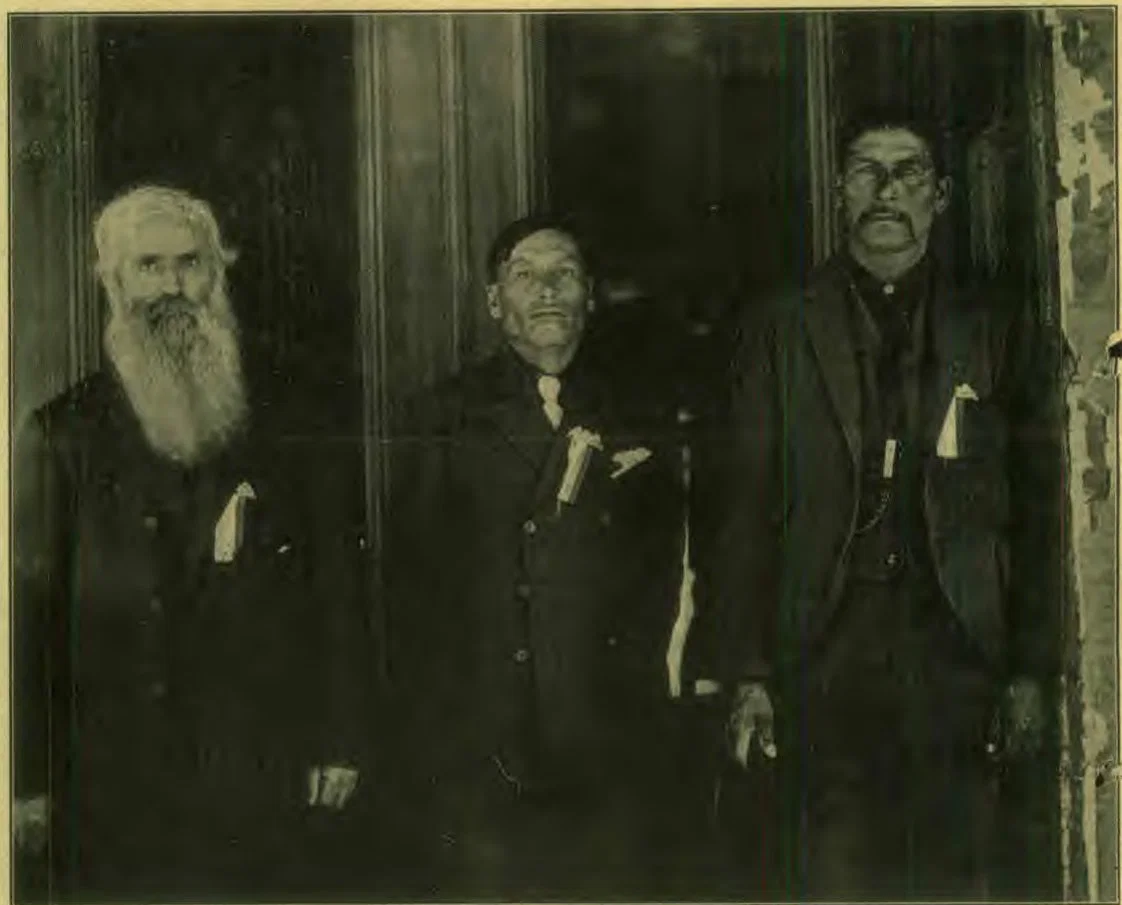
CHIEFS HORN CLOUD AND EUGENE LITTLE, INDIAN DELEGATES TO THE AMERICAN FEDERATION OF CATHOLIC SOCIETIES AND REPRESENTING 10,000 INDIANS OF THE SOUIX TRIBES, AND REV. S. DIGMANN, 20 YEARS A CATHOLIC MISSIONARY TO THE INDIANS.