OUR ROME LETTER

6%

OUR ROME LETTER

From Our Own Correspondent.

THE JESUITS AND GERMANY.

The head of the Jesuitical order is commonly designated by the title "the black pope," on account of the tremendous influence that he wields in the Catholic Church. The reason for the word "black" is that the habit of the order is black. The pope himself wears white, and is therefore called "the white pope."
By the suppression of the Jesuits in 1773, the order suffered keenly, but since then it has re-acquired much of its lost power; and at present it is making wonderful strides. Under the administration of the late General Martin, the order increased from 11,000 to 16,000 members.
The Jesuits are the educators of the Catholic Church, and consequently are really the bone and sinew of Catholicism. For the church depends almost wholly on its educational forces for retaining its prestige in Catholic countries as well as in its endeavor to propagate its faith in other places.
The new general of the Jesuits, Father Wernz, is a German by birth, but has for many years held his residence at Rome. He is the rector of the Gregorian University at Rome, which is the leading Jesuit college, having been founded as early as 1582. He is councilor of the Inquisition, and is highly esteemed by the Roman Curia on account of his conservative views on education. He has no sympathy with the modern tendency in education. During his twenty-three years' residence as professor of the leading Jesuit college, we may be well persuaded that he has become a Jesuit of the Jesuits.
The nationality of the new general has been the subject of much comment by the European press. I was well persuaded that a German would be chosen before the result of the election was announced.
The German emperor was manifesting an intense interest in the election of the new general, as Germany had recently been opened to the Jesuits. The Catholic leaders knew that the election of a German to the position of general of the Jesuits would give that order a much freer hand in Germany, and would add another link to the chain that the Vatican is forging for the purpose of tying the German Empire to its chariot wheels. The election of a general of the Jesuits may be held in secret, and may be said to be by the consent of the members present, but, after all, the Vatican names the man.
As the Papacy is losing ground in Latin countries, she is working with a new zeal to acquire a foothold among the Teutonic nations. The sphere of operation, therefore, has been transferred from France to Germany. The Germans and the French have very little love for one another, and the Vatican is taking advantage of this national hatred to ingratiate herself into the good-will of Germany, now that France is making a fierce fight upon her.
The Papacy is allowing the Teutonic nations a large say in its affairs at present, but they will pay dearly for these favors when the Vatican's time comes to reap. Austria's word decided the election of the "white pope," and the influence of Germany predominated in the selection of the "black pope."
The German emperor has shown himself exceedingly friendly to the Vatican. He went to visit the late pope with a gorgeous display of pomp and ceremony; to a convent near Rome he made a magnificent gift; and the German Catholic church of Rome was presented a beautiful organ by the German monarch. His zeal for the German Catholic missions in Asia Minor has given great delight to the Papacy.
The Papacy in turn has counseled the Catholic party of the Reichstag to hold a favorable attitude toward the financial and military schemes of the emperor. The Catholic representatives, therefore, are among the warmest supporters of the emperor's policy. In the German church at Rome, to which the emperor donated an organ, mass is celebrated in his honor on special occasions.
With the present attitude of the Vatican toward France, and with a German as the general of the Jesuits, it is quite certain that the places previously dominated by the French missions will soon fall under German influence.
With a free hand in the affairs of Germany at home and abroad, the Jesuits will soon make their power felt in Germany. Germany is certainly in danger; for, with a Protestantism honeycombed with "higher criticism" and skepticism, where is the power to resist the inroads made by the present onslaughts of Jesuitism? C. E. MILTON.
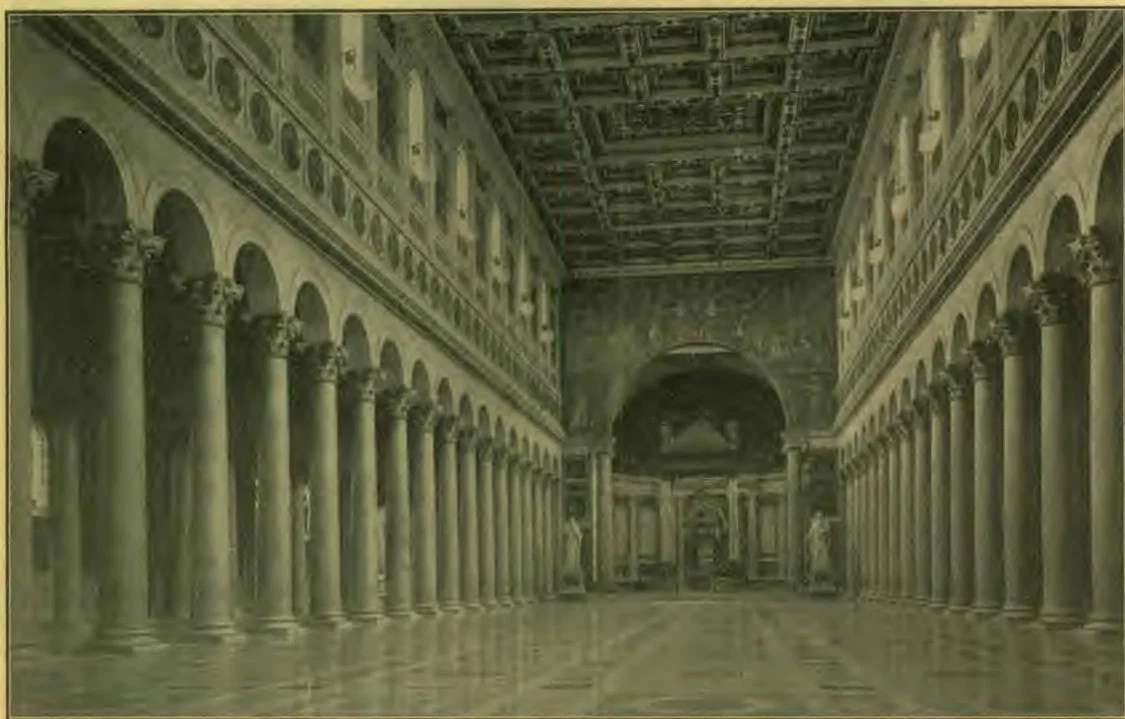
Interior of St. Paul’s Church, Rome.