Our London Letter

3%

Our London Letter

From Our Own Correspondent.
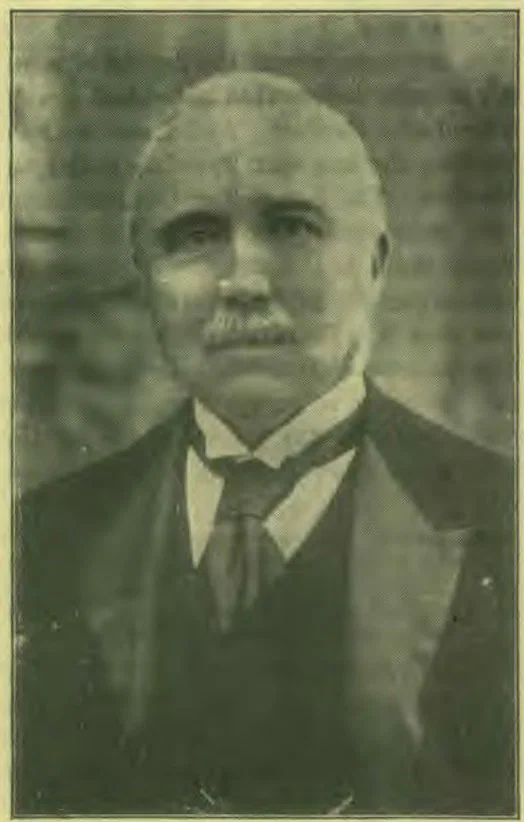
Sir Henry Campbell-Bannerman.
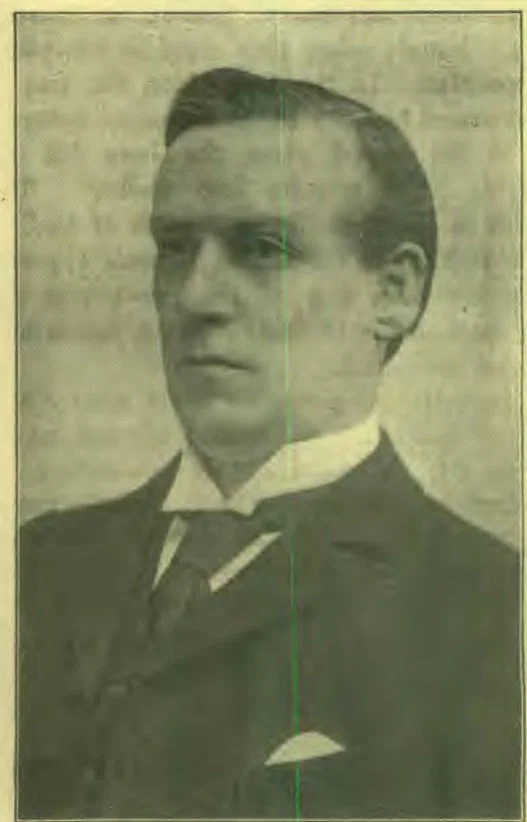
Mr. H. H. Asquith, K. C.
THE year 1907 was rather a quiet one in British politics. The government was, so to speak, marking time. The legislation put thru was for the most part either non-controversial, as in the case of the Army Bill, or of comparatively slight importance. The present session is evidently to be a fighting one, the government having already brought forward two bills of far-reaching importance, which are awakening most uncompromising opposition.

The Education Bill.

First in order, tho not in wide-spread interest, is the Education Bill, which differs from its ill-fated predecessor of two years ago in being considerably shorter as well as less complicated. In some respects it is less distasteful to churchmen than Mr. Birrell's Bill, in other respects, perhaps, more so. The chief provisions of the new bill which Mr. McKenna brought before a crowded house the other day are as follows:
"There shall be but one type of public elementary school which shall be managed, controlled, and provided for by the public, and no child shall be compelled to attend any other school.
"Religious instruction of an undenominational kind shall be given in such schools. There shall be no religious tests for teachers.
"Voluntary schools [really, church schools, owned and controlled by the Church of England] will receive grants from the national exchequer, if shown to be efficient, but will not receive financial support from the local rates, the latter being reserved for the public elementary schools proper.
"In parishes where there is but a single school, no public money will be devoted to its support unless it is conducted along the lines of a public elementary school.
"Any parent can call upon the local authorities to provide accommodation for his children in a non-denominational school.
"Denominational schools in single school parishes may be transferred to the local authorities for use as public elementary schools and yet the use of the buildings be retained for denominational instruction on ordinary week-days after school hours, and altogether on Saturday and Sunday."
It will be seen at a glance that this bill completely removes the grievances of passive resisters, since there will be no further use of the rates to support denominational teaching. Some of the radicals object, however, to granting any state aid to the voluntary, or denominational, schools. Churchmen are vigorously opposed to the bill because it weakens the hold of the church on the rising generation. The Established Church regards itself as responsible for the religious training of the children, and utterly refuses to see any inconsistency in a system which calls for Non-conformist parents to pay a teacher to instruct their children as to the errors of Non-conformity and the absolute necessity of loyal obedience to the church in order to obtain acceptance with God.
There is indeed one real weakness in Mr. McKenna's bill; namely, this: It abolishes religious tests; hence there is nothing to hinder an agnostic or out-and-out infidel from accepting a position as teacher. But what sort of religious instruction could such a person give? Would it be anything less than a mockery? The logical thing would be the secular solution, but the country is not ready for that yet. It will probably come by and by, and the insistence of the churchmen that their peculiar creed shall be taught to the school children of this country, irrespective of the wishes of the parents, is likely to hasten on the time when religious teaching will be entirely excluded from the public elementary schools.
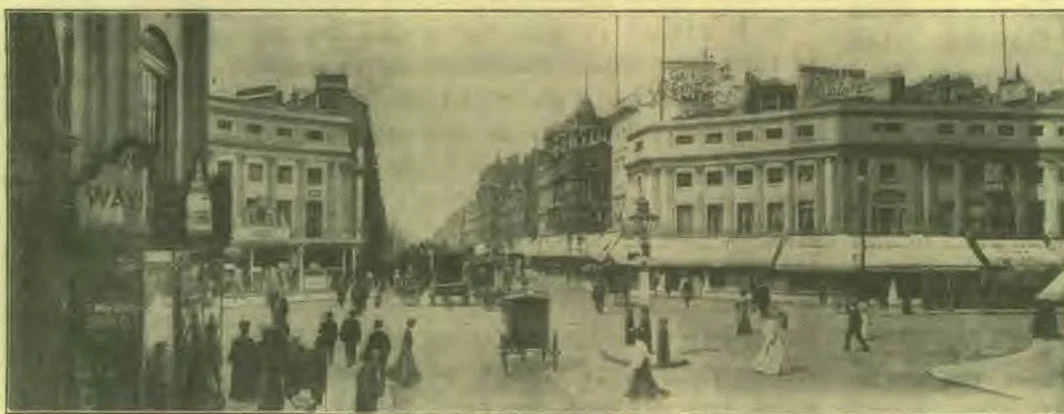
Oxford Circus on Which Queen's Hall Feasts.

The Licensing Bill.

The educational question has been before the country so long that public interest in it has somewhat slackened. Not so with the Licensing Bill, which has taken the country as it were by storm, and has aroused the most vigorous and outspoken opposition. The power of the drink trade in British politics is enormous. It has had things pretty much its own way the last few years, especially since 1904 when Mr. Balfour's new Act providing compensation in the case of refusal to renew license passed into law. That Act was a backward step, and did much to discredit the ex-Prime Minister with thinking people of all parties. The new bill proposes to recover public control over the drink traffic, and to reduce materially the number of licensed premises in the United Kingdom. The following are some of its most vital provisions:
"After fourteen years no further compensation shall be paid for unrenewed licenses. In other words, after that time, a license will be definitely understood to be given for one year only.
"From 30,000 to 32,000 licenses are to be extinguished within the fourteen years.
"The discretion of the magistrates as to renewals of licenses, which was withdrawn by the Act of 1904, is to be restored.
"Magistrates are furthermore to have power to forbid the employment of barmaids or children.
"There is to be Local Option in the cases of new licenses, and in Wales and Monmouthshire also in the matter of further reduction of licenses, a bare majority deciding the question.
"Public houses—saloons—[outside London] are to be open on Sundays only one hour at midday and two hours in the evening; bona-fide travelers can not be served with drink unless they have traveled at least six miles.
"There is to be a stricter supervision of clubs."

Fierce Opposition.

Americans who are familiar with temperance legislation of a far more drastic character, including in some states absolute prohibition, will find nothing at all startling in this bill; but here the situation is different. This is the first really serious attempt in recent years to deal with a great and growing evil. We have had a bill forbidding the sending of little children to public houses to get beer and strong drink, and another one providing for the blacklisting of notorious drunkards, but these measures achieved practically nothing toward remedying the drink evil. In fact, publicans (saloon-keepers) were in favor of them, knowing they would not interfere in the least with the sales of strong drink. But now we have a bill which gives promise of really lessening the power of this great octopus, and the rage of brewer and publican knows no bounds. An enormous mass meeting is convened in Queen's Hall, hundreds being unable to get in, and the platform utterances denounce "this iniquitous bill as an attempt to plunder and ruin all who are connected with the trade." "Robbery," "revolution," "confiscation," "Socialism," are other terms which are used freely in the huge, flaring posters which are displayed in every public house in the land. "Your beer will cost you more" is a significant statement which appears again and again. No denunciations are too strong for the ministry which has dared to bring in such a bill. Everywhere the friends of the trade foretell the rapid demise of the government.
There is one hopeful sign. The Bishops have decided in favor of the bill, and the leading workers in the Church of England Temperance Society will support it. Of course the brewers and publicans threaten great things against the Bishops. Some think all charitable donations should be withheld, and others advocate bringing the Bishops to terms by working for the disestablishment of the church.
It must be confessed that the enemies that this bill has stirred up to do their worst are many and powerful. In every by-election from now on, the government will have to count on the unrelenting and virulent opposition of the trade and its sympathizers. It is to be feared, moreover, that the support of temperance people will not be of sufficient warmth and heartiness to offset fully the attack of the drink legions. Temperance workers sometimes forget that half a loaf is better than none, and do little to promote a measure which comes short of their desires. Moreover, the government is severely handicapped by the serious illness of the Prime Minister, whose full recovery is a matter of some doubt. Sir Henry Campbell-Bannerman wields a very strong unifying influence. He has guided the destinies of the government with excellent tact and foresight, and his being detained on a sick-bed just now when wise leadership is so all-important, is nothing less than a calamity. Mr. Asquith, who, as Chancellor of the Exchequer, is deputy-leader of the House of Commons and would become Premier if failing health should compel Sir Henry to resign, is a very able man, but has few of those winning social qualities which make the present head of the government so popular. Keen, logical, incisive, a splendid debater, and possessing no mean oratorical powers, he gave an excellent account of himself in presenting this much-berated Licensing Bill. Indeed, he is regarded as one of the ablest men in a ministry unusually rich in talent; but he also has very many enemies, and it is doubtful whether the present government, even with its magnificent majority, would long survive the retirement of its honored chief.

The London "Times."

It is becoming increasingly manifest that the wealth of the country is held by the Conservatives. Take the newspaper press; there are at least three great London morning dailies, selling at a penny per copy, all being conservative. The Liberals had one penny daily, the "Tribune", but it had to be discontinued early this year for lack of support. The "Times" selling at threepence has been for many years the stronghold of middle-class Conservatism; but recently it has been going thru some very trying experiences which have diminished its prestige. There has been great disagreement among the stockholders as to the business management of the paper, making it necessary for the famous publishing house to be in the hands of the court, and for a time it looked as if this great asset of the empire might be knocked down to the highest bidder. The matter is about settled now, and the "Times" will probably continue on the old lines, but it is doubtful if it will ever again wield the influence it once had. The recent incident having to do with the letter of the German Kaiser to Lord Tweedmouth, showed the "Times" in rather a ludicrous light, and nearly all the Liberal papers took the occasion to have a kick at the old lion. One went so far as to say that had the "Times" exerted the influence it once enjoyed, England and Germany might have gone to war.
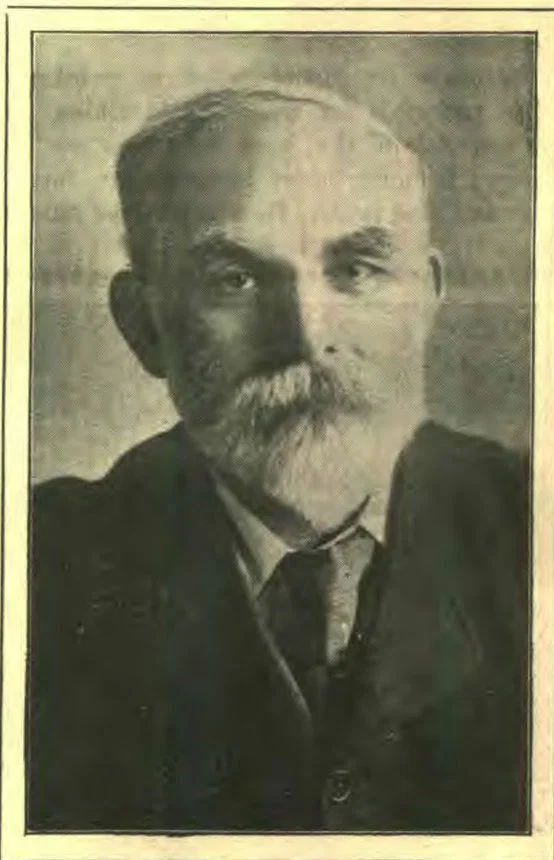
Mr. John Burns.
Mr. John Burns.

Socialism.

The government is having trouble with the Labor Party, which is frankly Socialistic, bringing in again this year its bill for the unemployed, in which local authorities are required to provide work off-hand for the workless at standard wages, or support them and their families until such work is forthcoming. As Mr. John Burns, the head of the Local Government Board, pointed out, the trouble with such measures is that they do more harm than good. The standard wages in the country being considerably less than in the city, the flocking of people into the large cities would be very greatly increased under such a regime.
Congregationalism has at length pronounced against the New Theology; at least to this extent that a number of her leading ministers have signed a declaration of belief which contradicts some of the principal teachings of Mr. R. J. Campbell. They have been careful, however, to take middle ground on certain questions, so that a keen observer can not but notice in this warning against the new heresy some symptoms of the heresy itself. As long as the conclusions of the so-called Higher Criticism are accepted, so long will the leaven of the New Theology continue to permeate the churches.
M. ELLSWORTH OLSEN. London, England, March 20.