WITNESSES IN STONE

5%

WITNESSES IN STONE

By the Rev. A. H. Sayce, LL.D., Author of "Ancient Empires of the East," etc.
WE have heard a good deal of late years about the "untrustworthiness" of Old Testament history. "Criticism," it is said, has shown that the traditional views in regard to the authorship and historical credibility of the Hebrew Scriptures are untenable; that the Pentateuch was written, not by Moses, but by a variety of authors, some of whom lived after the beginning of the Babylonish exile, and that no belief is to be placed either in the historical events it professes to record or in the miracles which it recounts. The history of the patriarchs and of the wanderings in the wilderness is based, we are told, on mere popular tradition and legends for which no contemporaneous evidence ever existed; that a large part of the Levitical legislation is little else than the fabrication of post-exilic writers; for in the age of Moses the Israelites were but a horde of illiterate barbarians, who could neither read nor write.
The results of this negative criticism have found their way at second, or, more commonly, third hand into much of the popular literature of the day. Anonymous contributors to daily and weekly papers refer to them as of unquestionable authority, forgetful or ignorant of the fact that the criticism is of a purely subjective character, unchecked by external testimony, and that it has proved itself to be almost as shifting and uncertain as a quicksand. The conclusions which were announced as incontrovertible twenty years ago are reversed to-day, and what the critic once declared to be the oldest part of the Pentateuch is now asserted with an equal amount of assurance to be the latest.
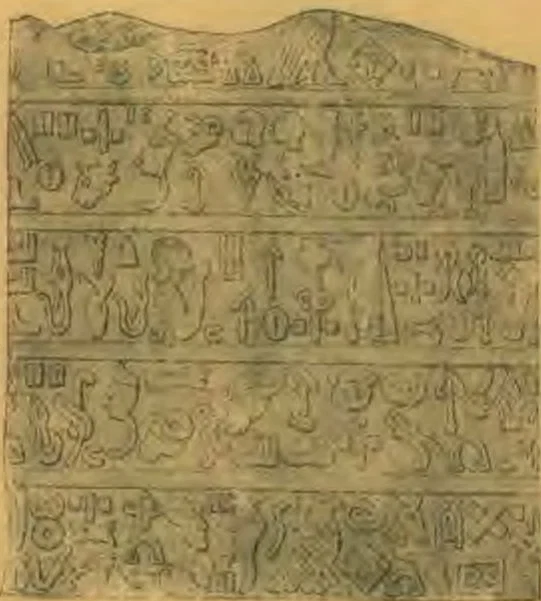
A Bittite Inscription.—Says Argueta in his "Story of Assyria," in referring to recent discoveries concerning the Hittites.—It is said that A. H. Sayce, of Ireland—to his wonderful ingenuity, his starting industry, and passionate persevering and in opening new holds of Investigation—that we owe a revelation which even now may be termed a revelation, so startling in the light it has unexpectedly thrown us a vast tract of ancient history hitherto obscure and utterly neglected.
While subjective criticism has thus been endeavoring to make bricks without straw, the excavator and the decipherer of the monuments of antiquity have been working patiently, and, as it were, in silence, recovering the buried history of the past from its sleep of centuries, looking for facts instead of theories, and doing their best to reconstruct history, not to destroy it. Instead of making their own theories the test of truth, and rejecting a part if it does not square with their assumptions, they have loyally followed the facts whithersoever they might lead, and have given up their most cherished convictions as soon as the progress of discovery has demanded it.
But the results of oriental archæology are not as widely known as those which the negative criticism claims to have obtained. They are largely hidden away in a variety of learned periodicals which are read only by specialists, and the archæologists have been so busy in making and recording the discoveries which have come crowding upon them that they seldom have had time to throw them into a systematic, much less into a popular, form. Moreover, the archæologists have no theories to fight for, no system to maintain, and consequently the popular attention is not arrested by the voice of controversy or the spirit of propagandism. We can not help hearing about the "higher criticism" of the Bible, and its supposed results. Oriental archæology appeals chiefly to the student of history, and the scholars who are making archæological discoveries have little leisure for discussing its bearings on the Old Testament.
Nevertheless, archæological research has been slowly but surely rebuilding what subjective criticism had attempted to destroy, and has restored credit to those Old Testament narratives which the critic had declared to be the distorted myths and legends of a later day. It has shown that the age of Moses, instead of being illiterate, was one in which the whole oriental world was engaged in writing and reading; and that Moses, therefore, not only could have written the Pentateuch, but that if he was trained in the "wisdom of the Egyptians," he was bound to have done so. It has shown that the age, even of Abraham, was also literary, and that the government and culture of Babylonia extended over Syria and Canaan to the shores of the Mediterranean Sea. It has shown, too, that this culture involved the existence of libraries and archive chambers, where the records of the past were stored, and the materials out of which trustworthy history is compiled were preserved.
It was in 1887 that one of the most unexpected and important archæological discoveries was made. At Tel-el-Amarna, in Upper Egypt, on the eastern bank of the Nile, and about midway between the towns of Minia and Siût, there was found the record office of a Pharaoh who lived about a century before the Exodus. This Pharaoh is generally known to the students of Egyptian history as the heretic king. Under the tutelage of his mother, who seems to have been of Asiatic extraction, he endeavored to reform the ancient religion of Egypt, of which he was the official head; to replace the worship of the supreme Theban god, Amon, by that of the solar disk, and to substitute a sort of pantheistic monotheism for the polytheism of his subjects. For the first time in history a religious persecution broke out. The worship of Amon was proscribed, and the very name of the Egyptian deity erased from the monuments. The king changed his own name from Amon-hotep to Khu-n-Aten, "the glory of the solar disk," the visible symbol of the god of the new faith.
Along with the introduction of the new religion went the introduction of a new art which aimed at substituting an extreme realism for the conventionalities of Egyptian art, as well as an influx of foreigners from Asia, and more especially from Canaan, into the country and the government. The high offices of state were filled by Canaanites; even the prime minister bore the Hebrew name of Dodo. Naturally the priests of Thebes objected to the religious innovations of the king, and the usurpation of political power by the foreigners; and in the struggle which ensued between them and the Pharaoh, they proved too strong for Khu-n-Aten. He left Thebes, the capital of his fathers, and built another capital for himself further north, where the ruins of Tel-el-Amarna now stand. Here he surrounded himself with the adherents of the new creed and his Asiatic officials, before whom he delivered lectures, or rather sermons, morning after morning, on the principles of his religious system. But his reign did not last long; and when he died, civil and religious war was already breaking out. His tomb was violated, and his body hacked to pieces; the city he had built, with its temple and palace, was leveled to the ground; and a new dynasty arose, the nineteenth, which represented the triumph of the national faith and the national cry of "Egypt for the Egyptians." The foreigners were driven out or massacred, those who remained, like the Israelites in the land of Goshen, being reduced to the condition of public slaves, and further decimated by the destruction of their male offspring.
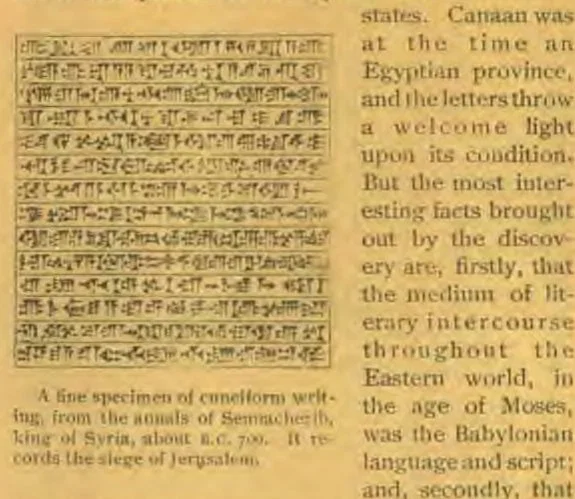
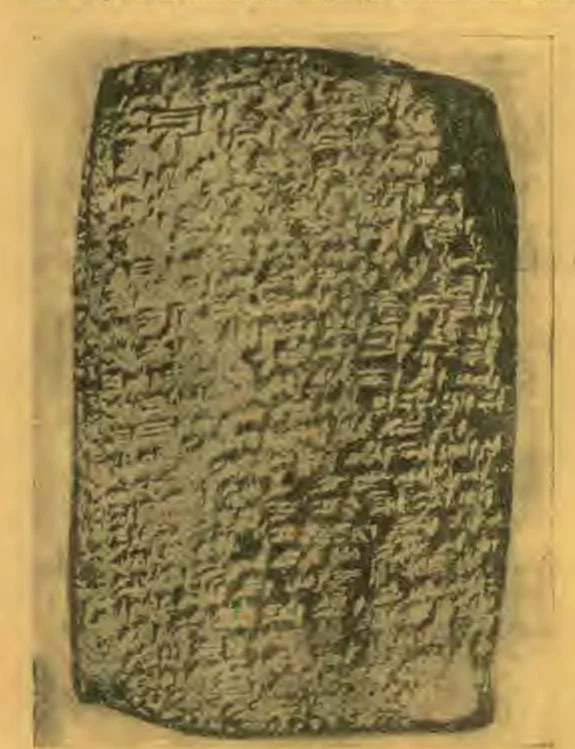
In Khu-n-Aten's record office a large collection of clay tablets was discovered, like those which have come from Babylonia and Assyria. They are all inscribed with Babylonian and not Egyptian characters, and with a few exceptions are written in the Babylonian language. They prove to have been the foreign correspondence carried on with the Egyptian court, and to consist of letters from the kings of Babylonia and Assyria, of Aram-Naharaim, of Cyprus, and of the Hittites, as well as from the governors and vassal princes of the Syrian and Canaanitish states. Canaan was at the time an Egyptian province, and the letters throw a welcome light upon its condition. But the most interesting facts brought out by the discovery are, firstly, that the medium of literary intercourse throughout the Eastern world, in the age of Moses, was the Babylonian language and script; and, secondly, that the whole of this Eastern world was highly educated and thoroughly acquainted with the art of reading and writing.
Let us take the second point first. The letters, we find, were written by all classes of persons. Among the Pharaoh's correspondents were ladies and Bedawîn shêkhs; and the varieties of local spelling show that a knowledge of writing could not have been confined to a special class of scribes. The letters, too, are often on the most trivial matters, and we gather from them that they were constantly passing to and fro along the highways which traversed Western Asia. But, as has been already said, they are written in a language which is not that of the majority of the writers, and must consequently have been learned by them, and in a system of writing which is one of the most complicated and difficult to learn that can possibly be conceived.
The acquisition of the Babylonian characters implies of itself years of patient labor at school. Schools, in fact, must have existed all over the civilized world, where the language and script of Babylonia were taught and studied. And this further means that the ancient literature of Babylonia was also studied. Indeed, among the Tel-el-Amarna tablets fragments of some Babylonianpoems have been found which have been used as school exercises. But by the side of the school there was also the library, as in Babylonia, where the official letters which were received could be stored along with those clay books of which so many have been disinterred from the ruined libraries of Babylonia and Assyria. Here the records and history of the past were preserved on imperishable clay, and the historian had at his disposal an abundance of materials for the earlier history of Canaan. Here, too, such Babylonian stories as that of the Deluge were to be found, which must have been well known in the West long before the days of Moses.
This brings us to the first fact which the Tel-el-Amarna tablets have made clear. The language and writing of the Babylonians were so firmly rooted throughout Western Asia that when the Egyptians founded their Asiatic empire, they were obliged to communicate in them to their Asiatic subjects and neighbors. This means that the influence of Babylonian culture, of which the language and literature were an integral part, must have long since made its way to the shores of the Mediterranean and have obtained a profound hold on the people of Syria and Canaan. And discoveries recently made in Babylonia itself show that such was the case. As far back as B.C. 3800, Sargon, of Akkad, established a Babylonian empire which extended to the Mediterranean, and appointed a "governor" over "the land of the Amorites," as Palestine was then called. Already at that remote period, Babylonian civilization was highly advanced. Art had already reached its perfection, and an organized postal system existed, which carried public and private letters along the principal roads.
From the time of Sargon of Akkad onward, the Babylonians claimed supremacy in Canaan. We hear of campaigns made in the Lebanon by kings of the dynasty of Ur, which immediately preceded that under which Abraham lived; and Abraham's contemporary, Khammurabi, or Ammurapi, the Amraphel of Gen. 14:1, calls himself, in one of his inscriptions, king of the land of the Amorites. The migration of Abraham is thus shown to be no isolated and extraordinary event. On the contrary, in moving to Canaan he was merely doing what hundreds of other Babylonians——soldiers, civil functionaries, and traders——were constantly doing; and in Babylonia itself there were colonies of "Amorite" merchants. In Canaan he would find the same law, the same literature, and the same official language as in the country of his birth; the deities of Babylonia had been adopted by the Canaanites, and the Canaanitish princes paid tribute to Babylonia.
What light all this throws on the campaign of Chedorlaomer and his allies! "Criticism" had declared that the campaign was imaginary, a mere reflection of the campaigns of the Assyrian kings into a distant and unknown part, and that even the names of the Canaanitish princes were etymological inventions. But the discoveries of archæology have now shown that the political situation described in the narrative is scrupulously exact, and that even the names of the invaders have come down to us with but little change. It is no longer the Bible only, but the inscriptions of Babylonia as well, which tell us that Kudur-Laghamar, or Chedor-laomer, the king of Elam, had made Babylonia subject to him, and that while the native prince, Amraphel, was allowed to remain at Babylon, an Elamite, Eri-Aku, or Arioch, ruled at Larsa, the Ellasar of Genesis, over Southern Babylonia. Tidal, king of "nations," proves to be the Tudkhula of the monuments, who seems to have been sovereign of the half-barbarous "hordes" of Kurdistan, and, like the princes of Babylonia, was subject to Chedorlaomer. As lord of Babylon, Chedor-laomer was lord also of Canaan, over which the father of Arioch was appointed "judge." When Amraphel succeeded at last in overthrowing the Elamites and restoring independence to Babylonia, the empire in the West passed to him along with the kingdom of Babylonia, and the title of "king of the land of the Amorites" was accordingly assumed by him and his successors. The Egyptian empire in Asia was built up on the ruins of that of Babylonia.
Such are a few samples of the way in which archæological discovery is verifying the Old Testament story. Each year, almost each month, brings new and unexpected confirmations of the Hebrew Scriptures, or throws light on points that were misunderstood or obscure. The Biblical narrative no longer stands alone, to be dissected and disparaged without fear of contradiction by the subjective critic; it is becoming part of that ancient history of the East which archæology is unfolding to our view, supplementing and being supplemented by the discoveries of oriental research. Hardly had the critic proved to his own satisfaction in a learned volume that the Israelites were "never in Egypt," when Prof. Flinders Petrie, two years ago, discovered a stela among the ruins of Thebes, on which the name of "the Israelites" is spelled out in hieroglyphic characters. The stela contains a hymn in praise of Merneptah, the son and successor of Rameses II., the builder of Pithom, and the Pharaoh of the oppression; and the author of the hymn refers to the Israelites as having been left "without seed." But it would seem that they were no longer in Egypt; while the other people referred to by the poet have the determinative of locality attached to their names, the Israelites alone have no such indication of local habitation. They must have already been lost to sight in the wilderness, and the land of Goshen, which they had inhabited, been left empty for others to occupy. When the stela, which is now in the museum of Cairo, was engraved, the Exodus must have just taken place.
A. H. Sayce.
Queen's College, Oxford.
A Clay Tablet (diverse side), from Tel-el-Amarna. The inscription is a letter in emotional characters from Abi-sulkh, risks of Tyre, to the king of Egypt, about s.c. 1290.