"They have healed also the hurt of the daughter of My people slightly, saying, Peace, peace; when there is no peace."
This method of treatment, merely to heal slightly, is quite popular in the world to-day. The effort to make people feel well when they are not well, is manifest in the treatment of physical as well as spiritual diseases. It produces an immediate effect, and that is what many want. The man who can preach something that will ease the consciences of men, and allow them to do things that are wrong, often becomes immensely popular. The doctor who can prescribe something that will instantly cure a headache, at the same time allowing the individual to continue indulging the appetite in things which produce it, is not the man that is likely to look in vain for business. In each case it is simply saying, "Peace, peace, when there is no peace." The hurt is healed but slightly.
The promptings of conscience are merely an indicator, showing that the man is sinning. Pain is the physical conscience, which tells a man that he is violating the physical law. Symptoms are merely indicators of the condition. To smother them arbitrarily, without removing their cause, is like removing the red signal-light that has been put out to stop a passenger train from plunging into a terrible chasm. Without doubt the sight of such a danger-signal would cause considerable anxiety to both engineer and conductor and to such of the passengers as might see it; they would feel much more comfortable if it were removed, but how woful would be the consequences! It would certainly be much easier to take down the lantern than it would be to rebuild the bridge; but rebuilding the bridge is the only safe thing to do. So when a man has wrecked his health, and nature begins to hang out warnings and danger-signals in the form of aches and pains and sleepless nights, simply to smother these is as absurd as to remove the lantern. The man must set to work to rebuild the wreck. This can not be done by swallowing sundry pills and drops. The remedy must be more potent.
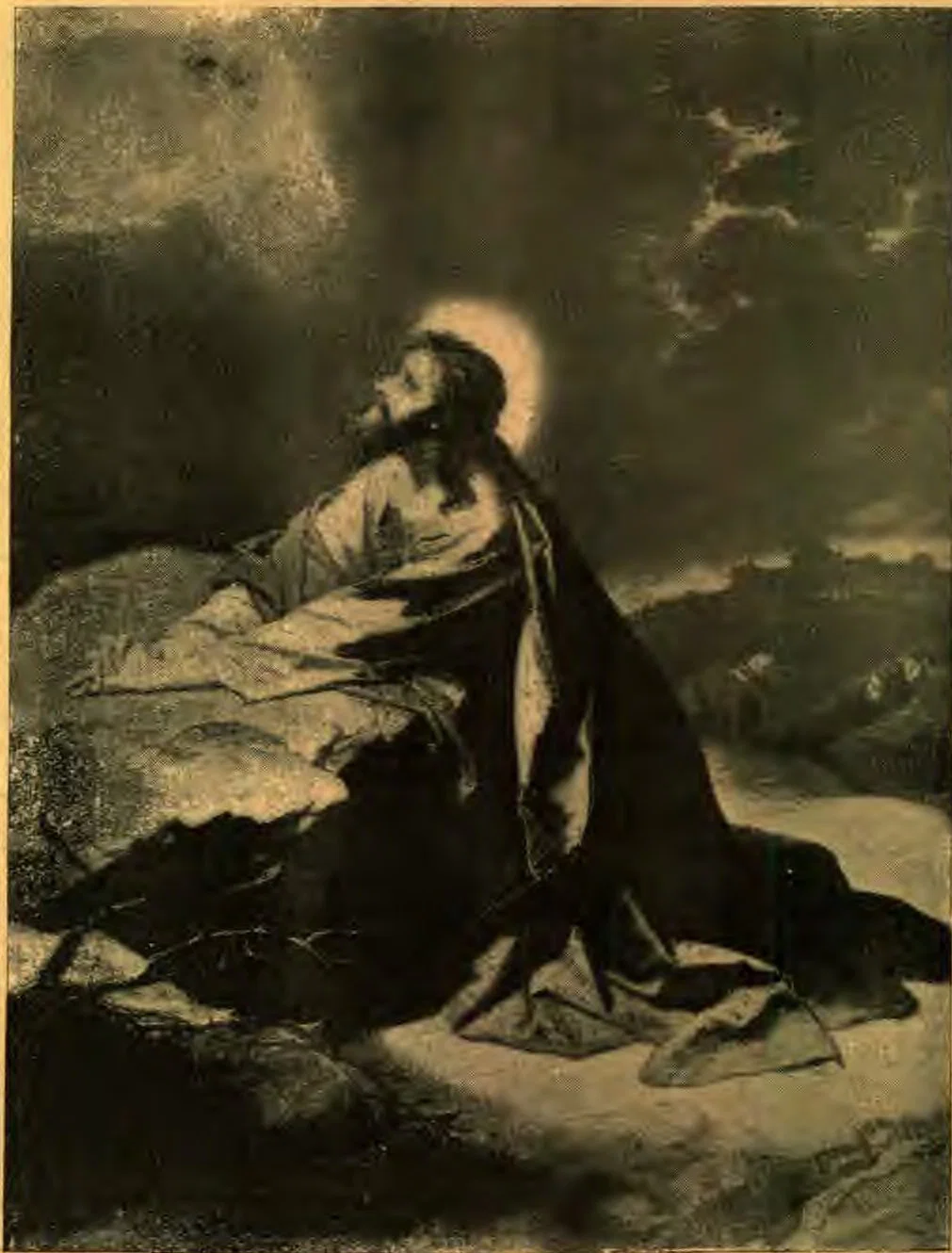
CHRIST IN THE GARDEN—From Hoffman.
It is true that there is a multiplicity of diseases and innumerable symptoms. If we were to deal with each one separately, it would indeed be a well-nigh hopeless task; but when we realize that there are only a few ways of becoming sick, and that, if we will live strictly in accordance with a few simple principles, health is an assured thing, the problem is much simplified. All that is necessary to cure any case that is curable at all is to bring ourselves into harmony with the law that is violated, the application of a few simple principles. In order to understand this fully, we must recognize that physical and spiritual laws are parallel; and a glance at the spiritual side of the question will help us to understand the physical.
Before Martin Luther's time every spiritual disease had a separate remedy. If a man had stolen, he would go to the priest to find out the remedy, and he was told to do this or that as a penance. If he had borne false witness against his neighbor, this required an altogether different treatment. Thus there grew up a colossal system of spiritual therapeutics, and none but the spiritual doctors, who were called priests, were supposed to know what to do for the various cases of sin. The subject was so complicated that the common people did not feel that they could ever understand it. But in the fulness of time Martin Luther and other reformers arose, and stated that while there were hundreds of ways of being spiritually sick, there were only a few principles that were violated, and the principles underlying the cure were simple. Luther prescribed justification by faith in Christ, and suggested the reading of God's Word, prayer, doing good to others, and meeting together to recount their experiences. The priests ridiculed the simplicity of this treatment, and tried to hold a vail of mystery before God's plan for the forgiveness of sin; but God's simplicity in treating spiritual diseases finally triumphed.
Exactly the same principle is applicable in physical disease. There are over sixteen hundred ways of being sick, but only a few ways of becoming sick; it is the violation of a few simple principles that brings on this host of diseases, as lack of fresh air and exercise, improper dress and diet, impure water, worry, and distrust of God. To effect a cure, we must bring the patient back into harmony with the laws he has violated, by coöperating with nature and by the use of her simple remedies. This brings the patient into harmony with God, who works mightily in him, and restores him physically, even as He does spiritually under similar conditions.
There has been a tendency to treat physical symptoms as the priests in the Dark Ages treated spiritual symptoms, and the same effort to keep from the people the simplicity of getting well as there was then to keep from them the simplicity of spiritual restoration. But we are now in a time when there is abroad in the land a physical reform, even as there was then a spiritual reform. Recognizing that God works in disease as well as health, all we have to do is to remove the obstacle that we have placed in the way, and unless the man has committed the physical unpardonable sin, so to speak, he will recover, as verily as he does spiritually when he comes into moral harmony with God.