ADVANCEMENT IN ASTRONOMY

5%

ADVANCEMENT IN ASTRONOMY

By Prof. Charles Burckhalter, F.R.A.S., Director of Chabot Observatory, Oakland, Cal.
THE progress of astronomy during the last twenty-five years is largely owing to two causes,—great advancement in the perfection and power of the instruments, to which many important discoveries are entirely due, and the new methods by which problems have been successfully and easily solved, but which were entirely impossible of solution by any of the methods employed a quarter of a century ago. Hard work along the beaten paths, with superior instruments, and ingenious methods by which old problems have been attacked from new standpoints, divide the honors in perfect harmony.
It may be said with much truth that we now have two astronomies, the Old Astronomy, or the Astronomy of Position, as it has been called, and the New Astronomy. In the first the great question was, "Where is it?" that is, In just what part of the sky was the given object at a given instant? And by the aid of these positions—more or less imperfect—astronomers have been able to make their wonderful predictions and achieve results almost beyond belief; while the leading question in the New Astronomy seems to be, "What is it?" or, Of what is it made? What is its physical condition? And a world of questions and problems are awaiting their turn to be investigated by the most ingenious methods and instruments.

Superior Instruments.

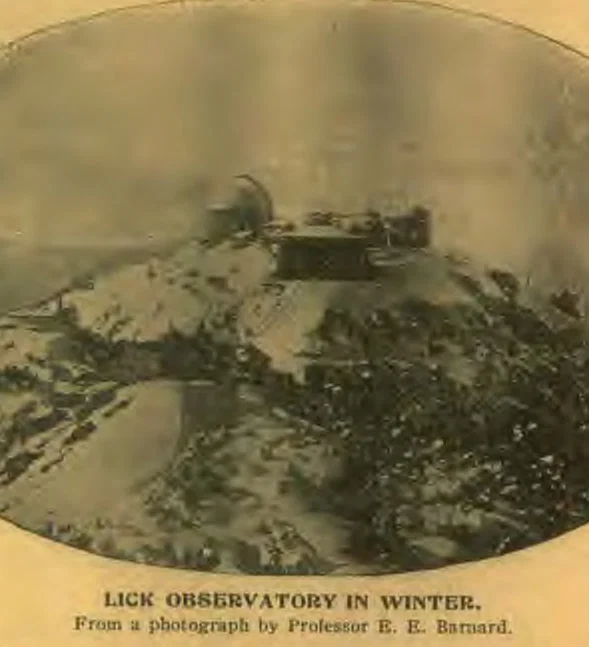
The progress in telescopes has been extremely gratifying. In 1862 the 18-inch lens for the Dearborn refractor was considered a triumph of optic art; but, in 1870, a 25-inch telescope was erected in England, and this has been exceeded since by no less than seven great telescopes in Europe from 26 to 32 inches, and five in America from 26½ to 40 inches, the 36-inch refractor of the Lick Observatory and the 40-inch of the Yerkes Observatory being the largest in the world. The great Lick telescope was put to work in 1888, and the Yerkes during the past year. The latter, in the opinion of competent astronomers, has nearly reached the limit of usefulness and fair returns for the vast cost; but the present state of our knowledge of optics and mechanics will readily respond to the persuasive influence of a heavy purse. In reflectors the 5-foot mirror of Mr. Common is, at present, at the head; but even larger ones have frequently reached the paper stage, and it would not seem unreasonable to hear of some of them becoming realities.
I present the following list of the thirteen largest refractors, including the photographic corrector of the Lick Observatory:—
Aperture. Focal length. Observatories. Maker. Date of erection.
40.0 in. 62.9 ft. Yerkes, Wisconsin. Alvan Clark (1) 1897
36.0 " 57.8 " Lick, California. Alvan Clark (1) 1888
33.0 " 49.2 " Lick, California. Alvan Clark (1)
32.5 " 53.0 " National, Meudon. Henry Bros. (2) 1891
31.1 " 39.4 " Astrophysical, Potsdam
30.3 " 52.6 " Bischoffsheim, Nice. Henry Bros. (2) 1889
30.0 " 42.0 " Imperial, Poulkova. Alvan Clark (3) 1882
28.0 " National, Paris. Martin
28.9 " 28.0 " Royal, Greenwich. Sir H. Grubb (4) 1894
27.0 " 34.0 " Imperial, Vienna. Sir H. Grubb 1878
26.0 " 26.0 " Royal, Greenwich. Sir H. Grubb 1897
26.0 " 32.5 " Naval, Washington, D.C. Alvan Clark (1) 1871
26.0 " 32.5 " Leander M'Cormick, Va Alvan Clark 1874

Methods.

It is hardly possible to touch upon the subject of methods in this brief article; but the velocity of light and the constant of aberration methods have given, perhaps, the most satisfactorily the distance from the earth to the sun. This great fundamental value (for the sun's distance is the "yardstick of the astronomer") has been in an extremely unsatisfactory state, on account of the great error that was known to exist; for, as the accepted distance was too small or too great, so was the distance of all bodies in space (where the distance has been measured) too small or too great, the sun's distance from the earth being the measuring-rod. The accepted, or, better, the assumed value, has been anywhere from ninety to ninety-five millions of miles, within the past twenty-five years, while the present value of 92,975,500 miles is probably correct within 50,000 miles, or thirty times nearer the truth than the value of 1874. The velocity of light is 186,330 miles per second, with a probable error of less than twenty-five miles.

Photography and Spectroscopy.

In certain lines of research, however, the greatest advance has been made by the aid of photography; and this new, powerful, and wonderfully versatile agent has completely revolutionized many older methods; as, for illustration, a photographic plate made in two hours, showed 2,200 stars in the Pleiades group, against the work of an astronomer occupying about six years to correctly measure and chart six hundred (all he could see) in the same cluster. Photography in from two to four hours, with a 6-inch lens, revealed stars that are beyond the reach visually of the giant refractor on Mount Hamilton.
This marvelous result has a double explanation. First, the eye will see at once all it is capable of seeing, and persistent effort only tires it and lessens its sensitiveness to light, while the photographic plate is tireless, and receives the light and allows it to pile up, or accumulate, so that an amount of light that is not effective at once may be in minutes or hours, as the case may be, and the image of the star is seen upon the plate. Increased exposure never fails to add fainter and still fainter stars, until the whole heavens are ablaze with these distant suns. The other reason is that some stars are rich in actinic (photographic) rays, but weak in visual rays, or the rays that affect the eye, and vice versa. Thus Aldebaran while a brilliant red star rating as a first magnitude, is, photographically, only a sixth-magnitude star, showing no brighter on a photographic plate than a white or blue star that is barely visible to the sharpest unaided eye. Altho photographic methods have been known and practised for fifty years, ninety-nine per cent. of the results have been obtained within the last eighteen years, or since the dry plate has come into use.
Photography has also been applied to spectroscopic methods with extremely satisfactory results. A few minutes is sufficient to photograph the spectrum of a star, the time required depending upon the brightness of the star selected; and the resulting lines can then be studied at leisure; and not only can the spectrum be compared directly with known terrestrial substances, by which many of the substances composing the star become known beyond a doubt, but the abnormal positions of the lines give unquestioned evidence whether the star is approaching or receding from our system. In the case of stars whose motion in the "line of sight" (that is, toward or from us) amounts, say, to fifty miles per second, the rate of speed is determined with an exactness admitting an error of not more than one or two per cent.

Discoveries.

About ten years ago a very close double star was observed, showing that the two bodies were revolving around each other in the remarkably short period of about eleven years, the shortest period then known, but by the combined efforts of spectroscopy and photography, double stars have been found so close together that no telescope ever made could show their duplicity, and whose periods are to be counted in days and hours instead of years, one having a period of less than a hundred hours. To properly appreciate this astounding result, it is only necessary to say that no astronomer would admit that our present telescopic power can ever be doubled (on account of the disturbances ceaselessly going on in our atmosphere), yet this result could not be obtained visually with a telescope hundreds, and, perhaps, thousands of times more powerful than any now existing.
The family of asteroids, those wee little worlds that have their place in the solar system between Mars and Jupiter, have been discovered by dozens and scores. While the first was not discovered until the first day of this century, and 135 had been added to the known bodies of the system by 1874, at present over 400 are known, and the 500 mark may be reached by the end of the century; and it should be remembered that their detection is constantly increasing in difficulty, for the reason that the larger and consequently brighter ones were discovered first.
More important, however, than many asteroids, was the discovery by Hall, of Washington, in 1877, of the two satellites of Mars; and "moonless Mars" is an obsolete expression. The estimated diameters are only five and seven miles—the smallest bodies, probably, known in the solar system; and in September, 1892, a still more brilliant discovery made by Barnard, of the Lick Observatory, added a fifth moon to Jupiter. When it is considered that the four well-known satellites of Jupiter were the first bodies discovered by Galileo with the first telescope, and that all telescopes have since that time, now nearly three hundred years ago, been turned upon the giant planet, this splendid discovery is all the more creditable.
Charles Burckhalter
*Since this article was handed in to the SIGNS, an asteroid has been discovered whose orbit is between that of the Earth and Mars, which is entirely unique. Very little is known concerning it as yet, but it is of unusual interest to astronomers.