By Prof. Percy T. Magan, Dean of Battle Creek College, Mich.
A FEW years ago, while making a special study of the philosophical history of the great nations of the world during the early part of the present century, I was somewhat amused by the frequent references made by many standard historians to the enormous wealth of this noble or that country gentleman, who reveled in luxury on fabulous incomes of from five to ten thousand pounds a year.
But the seemingly ridiculous side of the statement soon gave place in my mind to more serious reflections. Our ideas of the amount of money necessary to constitute a man wealthy have undergone a remarkable change. What our fathers rated as great riches we consider "ordinary," or at most "comfortable circumstances." An income of $1,000,000 a year is to us much the same as was a competence of $10,000 to our ancestors of a generation ago.
No longer can it truthfully be said that America is a country without pauperism and without great wealth. Things have changed since the days when Tocqueville wrote that in the United States there was a jealousy of wealth which compelled rich men, like the Jews of the Middle Ages, to abstain from all the ostentation of luxury.
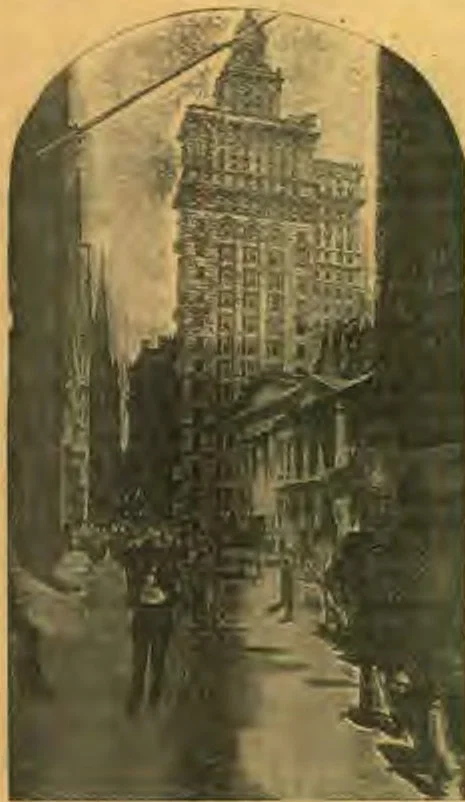
Wall Street, the center of money influence in America. Trinity Church spire in the distance, now insignificant, formerly a landmark. The huge building, a new one, just erected, the tallest on Wall Street. The little low building with columns in front, at the right of the picture, is United States Subversary building, and just this side the Government Assay Office.
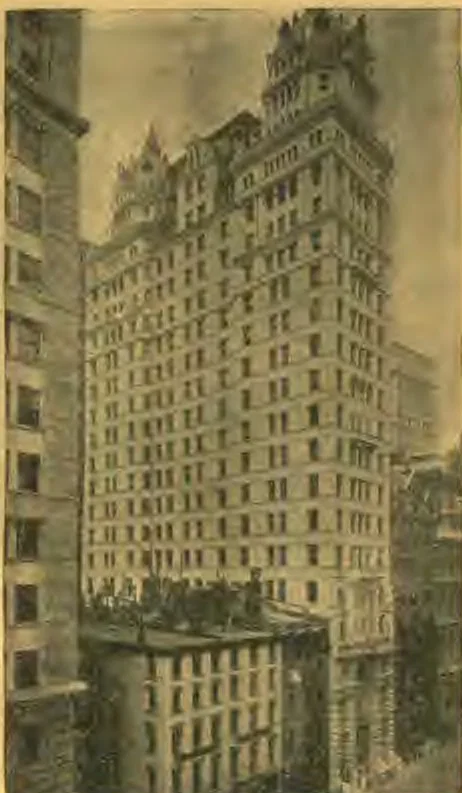
Commercial Gable Building, 60 Dead Street, between Wall Street and Custom House Place, 18 stories to the shoulder, 3 more above. Foundation leaders to bed-trick. These buildings are themselves marvels. The square white building in the right is the American Savory Building, 17 stories, high, the first of the old ones to be built.
Not very long ago a prominent New York daily, and one which is most friendly to the financial classes of the country, made a statement in an editorial paragraph concerning a noted money magnate: "His regular income is $20,000,000 a year. That makes him the richest man in the United States—perhaps the very richest in the world." And this sum, incredible as it may appear, is nearly three times the amount of the dividends paid in 1892 to all its stockholders by the Bank of England. The enormous rapidity with which American fortunes are amassed may be understood to some extent when we consider that the Bank of England has been for 200 years hard at work building up this earning power, whilst this American has won thrice its dividend capability in less than a generation. Two years after the appearance of the editorial referred to above, there was published in another entirely friendly paper, a statement concerning the income of this same gentleman, to the effect that his income was more than $30,000,000 a year; and no denial of these figures has ever been made.
The total population of the United States is estimated to be in the neighborhood of 70,000,000 people. In an able paper in the November Forum of 1889, Mr. T. G. Shearman gave good evidence that out of this total population, 25,000 persons owned one-half of the national wealth. He further estimated that 200,000 persons controlled 70 per cent. of the national wealth, and that 250,000 persons controlled from 75 to 80 per cent. of the whole. The figures given by Mr. Shearman were based upon official tax returns, and in a number of cases upon the inspection of the books of individual millionaires. The concentration of such a vast amount of wealth in the hands of a few led Mr. Shearman, in an article entitled "The Coming Billionaire," which appeared in the Forum of January, 1891, to inquire "how far this concentration of wealth may go," and "whether the existing hundred-millionaires foreshadow the coming billionaire." He then proceeded to estimate that at the current rate of increase of these monster fortunes, a fortune of $200,000,000 would become a billion dollars in less than forty years.
In 1838 the personal estates in England worth over £100,000 aggregated but one and a half times as much wealth as the estates of less than £1,000; in 1861 they aggregated three and a half times as much. From this it is clear that common observation has not exaggerated the relative gains of the richer classes. It is, further, a painful fact that more than three-fourths of the people of the United Kingdom of Great Britain and Ireland are without any registered property whatever. They have, to be sure, their household goods, but the total value of these can hardly exceed £100,000,000. Less than two per cent. of the families of the United Kingdom hold about three times as much private property as all the remainder, and ninety-three per cent. of the people hold less than eight per cent. of the accumulated wealth.
The Civil War of 1861 was a rebellion of the richer classes in the United States against the rule of the middle classes. The triumph of the latter, however, and the utter overthrow of the old aristocracy of the South, did not bring with it the extinction of plutocracy in America. On the contrary, the war itself created a new plutocracy. Toward the close of the war, Lincoln himself is reported to have said: "I see in the near future a crisis approaching that unnerves me, and causes me to tremble for the safety of my country. As a result of the war, corporations have been enthroned, and an era of corruption in high places will follow, and the money power of the country will endeavor to prolong its reign by working upon the prejudices of the people until all the wealth is concentrated in the hands of a few, and the republic is destroyed. I feel at this moment more anxiety for the safety of my country than ever before, even in the midst of the war."
This prophecy has been only too thoroughly fulfilled. The plutocracy of the South has been destroyed, but a much richer capitalist class at the North has been created.
Some idea of the concentration of wealth may be gathered from the Massachusetts tax returns of 1873. These show that the number of persons paying taxes upon property was nearly four-fifths of the whole number of families resident. Among those paying such taxes, however, four-fifths held less than one-fifth of the property, while one-fiftieth held nearly as much property as nearly all the remainder. Twenty years later the assessing department of the city of Boston made a return which showed that the whole number of property taxpayers was less than one-fifth the number of families residing in Boston. From the official figures for the year 1893 from the city of New York there appear to have been about 110,000 property-owning families. The whole number of families in the city was 339,000. In other words, in the year 1893, in the city of New York, two-thirds of the families were, in the strict sense of the word, propertyless. These not only possessed no savings-bank account, but no registered property of any description. Dr. Spahr, after the most elaborate and unimpassioned use of every available record bearing upon the subject in hand, estimates that in the United States seven-eighths of the families hold but one-eighth of the national wealth, while one per cent. of the families hold more than the remaining ninety-nine per cent.13
Not only is the wealth of the grandees of the United States and of the world more enormous than the fortunes of the rich of any past age, but it has been accumulated more rapidly, and it is spent with more reckless prodigality. And, still worse, it is sad to relate that many of these large fortunes have been obtained by what is little better than sheer robbery, and in defiance of every just and natural law. Democracy has turned into a corrupt plutocracy, and as an inevitable result, both national decadence and social revolution are being prepared. "When triumphant robbery is found among the rich, subversive doctrines will grow among the poor."
It may not be out of place to consider a few of the methods by means of which the enormous fortunes of some of the richest men in the United States have been acquired. Principles only will be dealt with, and therefore names will be withheld. Rich men are undoubtedly guilty of defrauding others, but that furnishes no excuse for a Christian to attack them personally. The sole object of this article is to show that the condition of affairs in the world at the present time proves that "the day when the Son of man is revealed" is at hand. And, moreover, the sole object of showing this is that men may be warned—both rich and poor—of the wrath to come, and give their hearts to God, that they may be saved through "Him that loved us, and washed us from our sins in His own blood."
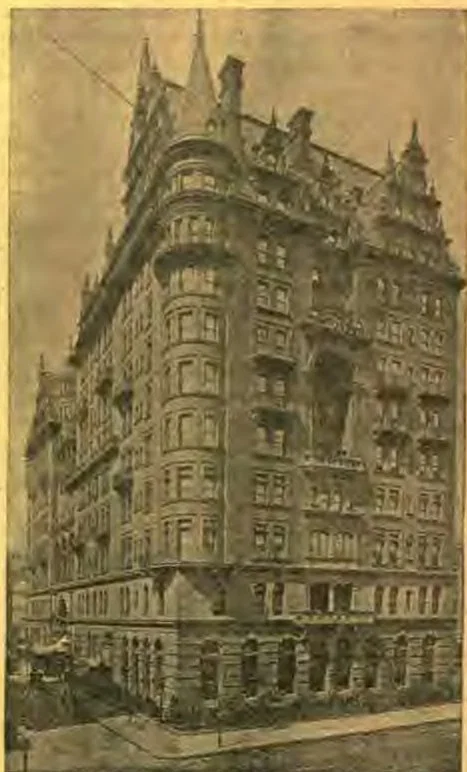
The Waldorf-Astoria, Thirty-third Street and Fifth Avenue, New York. Probably the richest, most expensive, and most luxurious hotel in the world, whose owner, it is said, talks of tearing it down and building one partly of glass, costing $20,000,000.
The title of this paper is not simply the development of wealth, but "The Development of the Money Power." There exist at the present time not only larger fortunes than ever before, but the power which the owners of these fortunes are enabled to exert through them over everything in the land, from the national government down, is almost beyond comprehension. Of late years a new word has come into our language, or rather an old word used in a new sense. I refer to the word "trust." Take, for example, the Match Trust, by whose consent all the fires in the United States and Canada are lighted. Thirty-one manufactories, practically the total number in the country, either went into the combine or were purchased, and all were closed except about thirteen. One of the company, a man whose name has been prominently before the public as a candidate for the presidency of the United States, witnessed on the stand that the price of matches was "kept up to pay the large sums of money expended to exclude others from the business, remove competition, buy up machinery and patents, and purchase other factories." In the decision of the court in the case where the above was given as testimony, the judge very forcibly argued:—
"Such a vast combination is a menace to the public. It is no argument to say that this company has reduced the price of friction matches. That policy may have been necessary to crush competition. The fact exists that it rests in the discretion of this company at any time to raise the price to an exorbitant degree. . . . Indeed, it is doubtful if free government can long exist in a country where such enormous amounts of money are allowed to be accumulated in the vaults of corporations, to be used at discretion in controlling the property and business of the country against the interest of the public and that of the people, for the personal gain and aggrandizement of a few individuals."
Not all the concerns becoming part of a trust are in favor of it. Many times they are forced to join through intimidation, and threats that if they do not their business will be ruined. Still others are given the choice of having war waged against them till their business is destroyed, or of taking a small sum annually in payment for keeping their factories closed, in order that it may be made to appear to men who wish to start a similar enterprise that it does not pay. In this way a trust can limit the output, discourage competition, and hold up prices.
The anthracite coal business is another line of commerce which illustrates the enormous power of wealth. During the past three decades, private individuals owning anthracite coal mines have been so far "run out" of the business that more than ninety-five per cent. of the anthracite coal of America, according to the report of Congress in 1893, has passed into the hands of railroad corporations controlling the highways to the coal fields.
One way in which this absorption is accomplished is this: A number of men, the directors and leading lights in a railroad company, will buy up a number of coal fields contiguous to their line. When the time for delivery arrives, the railroad company, through its officials, will allege its inability to furnish cars to private mine owners. These have contracts to furnish local dealers in the cities and towns all over the country. Because they can not get the cars, they can not keep their contracts. The dealers must supply their customers, and are obliged to cancel their contracts with the private mine owners who can not get cars, and deal with the railroad company's second self, which is furnished with an abundance of cars. In this way the private mine owners are really compelled to sell to their railroad competitors at ruinous figures.
Another plan is for the railroad company to make a contract with its second self,—the railroad coal combine,—to furnish it with cars at a much lower rate than to other shippers, or to give it a certain per cent. of the freight receipts of the other shippers of coal. By this means it is impossible for "outside shippers" to compete with the trust. "These high freight rates serve the double purpose of seeming to justify the high price of coal, and of killing off year by year the independent coal producers." "This excess over just and reasonable rates of transportation constitutes an available fund by which the railroads are enabled to crush out the independent coal producers." The extortion in the price of coal, as fixed by the coal railroads, was found by Congress in 1888 to be "considerably more than a dollar a ton." That is, from $39,000,000 to $41,000,000 is wrongfully taken from the consumers yearly.
Perhaps the most notable trust in all the world is the famous Standard Oil Company. Its power is not confined to the United States alone, but now encircles the earth. It is, as nearly as can be ascertained, controlled by four men, and it controls ninety-five per cent. of the oil industry of the globe. It operates not only in the United States, but in Canada, Great Britain, Germany, and Russia. There is a statement, which has been published and circulated widely, that one of the motives which prompted the Russian Government to promote the alliance between the Russian and American oil-men, was that Russia wanted "to secure the influence of the powerful members of the oil combination in favor of certain plans for which Russia needed co-operation in America." This coöperation was in the matter of the extradition treaty. The Russian Government had obtained this ratification, and obtained it in a way which indicated that some carefully-concealed but irresistible American influence was behind it. And the New York World, in its editorial columns of May 25, 1894, made the suggestion "that the power behind this treaty of shame was that of the oil trust, earning from the czar the last link in its chain of world monopoly." "Did the oil combination," it asks, "succeed in bartering away the character of this country as a political sanctuary for the monopoly of the world's markets?"
It was Abraham Lincoln who asked and answered the great question: "At what point shall we expect the approach of danger? By what means shall we fortify against it? Shall we expect some transatlantic military giant to step across the ocean and crush us at a blow?—Never! All the armies of Europe, Asia, and Africa combined, with all the treasure of the earth (our own excepted) in their military chest, with a Bonaparte for a commander, could not by force take a drink from the Ohio or make a track on the Blue Ridge in a trial of a thousand years. At what point, then, is the approach of danger to be expected?—I answer, If it ever reaches us, it must spring from amongst us; it can not come from abroad. If destruction be our lot, we must ourselves be its author and finisher. As a nation of freemen we must live through all time, or die by suicide."
Never have more truthful words been spoken. It is from the evils of great wealth concentrated in the hands of a few that the great civilizations of the past have one and all met their death. External military influences have in truth had little to do with the ruin of the powers of past ages. Rome herself fell not by the hand of the Germans, but because it was impossible for her longer to sustain the weight of her own wickedness.