MILITARY AND NAVAL DEVELOPMENT FOR TWENTY-FIVE YEARS.
By A. O. Tait
BY ELDER A. O. TAIT.
[Author of "Heralds of the Morning."]
THE inventions, the discoveries, and the general material progress of the nineteenth century have placed our day in as marked contrast with all past ages, as would be shown by the loftiest and largest mountain rising in the midst of a perfectly level plain. And in no field is this great development more remarkable than in the realm of military and naval activity.
In 1812 the great Napoleon had reached the zenith of his military strength and fame. In that year he organized an army of 475,000 men to march against Moscow. He said to one of his generals that he had never made such great preparations for a military struggle. This French army was not only the terror of Russia, against which it marched, but it spread dismay over all Europe combined.
Napoleon, however, planted some military ideas. He placed the whole of the male population of France subject to service in the army. This was a new plan, but it was some time in developing. Twenty-five years ago the French army, on a war footing, had only reached 757,727. Yet this was nearly double what it was in Napoleon's time. His idea of organizing into immense armies all males who could carry arms was working, and in sixty years it had produced noted results.
But as the French army was increased under Napoleon's new idea, the rest of Europe had to increase its armies accordingly. Hence the combined armies and navies of the principal nations of Europe on a war footing in 1874 numbered, according to the Statesman's Year Book, 5,947,695. During the next eighteen years these armies were increased to 20,945,000, and in the following seven years they reached the amazing figure of 26,524,768. This shows for the last twenty-five years an increase of the men under arms in Europe of 20,577,073, of which vast increase 2,434,094 were added in the year 1897 alone.
If any of the achievements of all time deserve to be styled as marvelous, this gigantic increase of the armies of Europe during the last quarter century should stand in the front rank. And it has been our custom to speak only of military Europe; but the year 1898 was destined to cast the great America into the whirlpool, and territorial expansion, and the increase of army and navy, is the topic of the hour in the United States. Why all this mighty and world-wide arousing of the passions for bloody strife? Are not the demons of war madly driving the nations of earth to Armageddon?
But if the increase of armies during the last twenty-five years is a marvel, even in this age of marvels, the development of arms and equipments in their ingenuity of deadliness is still more appalling.
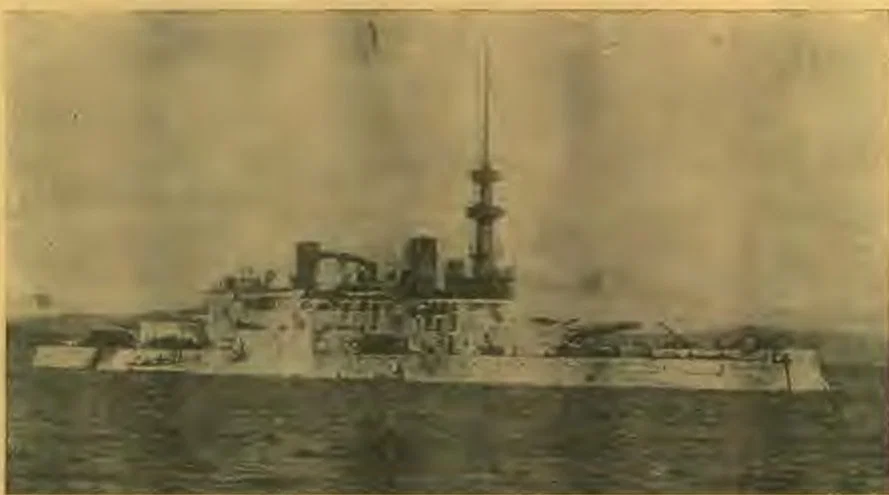
Twenty-five years ago the iron-clad man-of-war was in its infancy; to-day great battle-ships, armored with eighteen inches of steel—and a steel, too, that offers more resistance by far than anything that was known then—are patrolling all the seas.
Twenty-five years ago the muzzle-loading gun was just giving place to the breech-loading and magazine rifle.
Twenty-five years ago the automatic machine-gun had hardly materialized into a dream; to-day the automatic gun can throw from 600 to 2,000 rifle bullets per minute, 300 one-pound shells per minute, 150 six-pound shells a minute, and 60 nine-pound shells a minute.
Twenty-five years ago the old cast-iron, smooth-bore, muzzle-loading cannon, with its spherical shell, was just being side-tracked for the high-power, breech-loading, steel ordnance, with its long cylindrical projectile. These old cannon of twenty-five years ago could not drive a shell through four inches of common iron; to-day one of the big guns hurls its shell through forty-four feet of iron and oak and granite and concrete and brick, twenty-eight inches of which is compound plate and wrought iron. It took from five to fifteen minutes to load those old-fashioned cannon; but the modern 8-inch gun can be fired four times in one minute; the 6-inch gun, seven times a minute, and the 4-inch gun, fifteen times a minute.
And, while the old smooth-bore gun of twenty-five years ago could not pierce 4 inches of common iron, the big 16-inch gun of to-day uses a charge of 1,060 pounds of powder and throws a shell weighing 2,370 pounds with such terrific force that the power exerted would lift 64 of the largest locomotives 10 feet into the air; or it would hoist the great battleship Iowa from her dry dock 6 feet into the air. The 12-inch gun uses a power in hurling her shell that would lift such a ship as the Spanish cruiser Vizcaya 4 feet into the air; or, to make another comparison, the shell is shot out with a force equal to the driving power of a 60-ton locomotive with a train of eight cars running at fifty miles an hour.
Twenty-five years ago the smokeless high-power and slow-burning powder was not invented; to-day the powder is made in large blocks that burn from the inside so that the gases are given off gradually instead of with a bursting charge, and by this means, and through the agency of the long cannon, the pressure behind the shell begins gradually and increases all the time it is passing out of the barrel of the gun, reaching its maximum force at the muzzle. And twenty-five years ago the high explosives of to-day were hardly dreamed of. But to-day such powerful explosives are made that if a ton of them is discharged it will exert a pressure of 12,000 pounds to the square inch, at a distance of 250 feet. Mr.
BATTLE-SHIP ORIGON.
Hudson Maxim, who has done so much in the development of these high explosives, is hard at work on a gun that will throw a shell charged with a ton of this giant explosive a distance of 5 miles. The best scientific and military authorities think that he will succeed with this murderous weapon, and when it is done, he can stand off 5 miles and by striking anywhere within 250 feet of it destroy the greatest battle-ship afloat.
If the things that are actual facts in the military world to-day had been imagined and described twenty-five years ago, they would have been regarded as more fictitiously visionary than the wildest stories that an ignorant and superstitious nurse ever made use of either to terrify or entertain her nursery charge.
Would it be outside the realm of literal fact to say that if all the invincible armies, commanded by all their illustrious generals from the days of Nimrod down to Grant and Lee and Sherman, were marched upon a great battle-field, almost any one of the great nations of the now could send out a force that could mow them down and hardly lose a man? Supposing that all this great host of former times would have the courage to continue to advance, a hailstorm of monster shells would begin to meet them when they were ten or twelve miles away, and this storm would continue to increase as the distance was lessened, and these smaller guns that hurl out steel like a hard storm of hail were brought into action.
Such is the merest outline of the appalling facts in regard to the military and naval developments of the last twenty-five years. The long roll is sounding, and armies, not of thousands or of hundreds of thousands, but of millions, are falling into line. And the weapons with which these men are armed strike terror even to the brave.
What does it all mean? Why is this awful spirit of war rising and spreading like a hurricane in these closing decades of the nineteenth century? A single passage of Scripture tells the story plainly. It reads:—
“And I saw three unclean spirits like frogs come out of the mouth of the dragon, and out of the mouth of the beast, and out of the mouth of the false prophet. For they are the spirits of devils, working miracles, which go forth unto the kings of the earth and of the whole world, to gather them to the battle of that great day of God Almighty.” Rev. 16: 13, 14.
This scripture is too plain to need comment. It clearly tells of the world-wide work of the evil spirits as they go to the kings of earth to gather them to the battle of “that great day of God Almighty.” There are other scriptures that tell with the same vivid clearness the meaning of these unprecedented preparations for war. Read them, and let the Father, who loves you and who seeks to save you from the perils of this time, impress you by His Spirit as to your needs and duties in this hour of peril.