THE first constitution adopted by Mexico is known in history as the Constitution of the Three Guarantees. One of these guaranteed that Roman Catholicism should be the only religion tolerated by the government. It was not until 1867 that the laws of reform which had been enacted by Congress ten years before went into effect. The laws of reform abolished all monastic orders, confiscated all property held by the church, except that actually used for public worship, made marriage a civil contract, placed the cemeteries under municipal control, forbade religious processions and other public demonstrations, and conferred upon every citizen and stranger freedom and protection in his religious faith and practise. The noble and patriotic men who have given civil and religious liberty to their country have also opened up before it an era of prosperity such as has not been known before in its history. A splendid system of public schools has been established, all the useful arts and sciences are fostered, all benevolent and philanthropic enterprises calculated to benefit society encouraged, and enterprising and experienced foreigners welcomed.
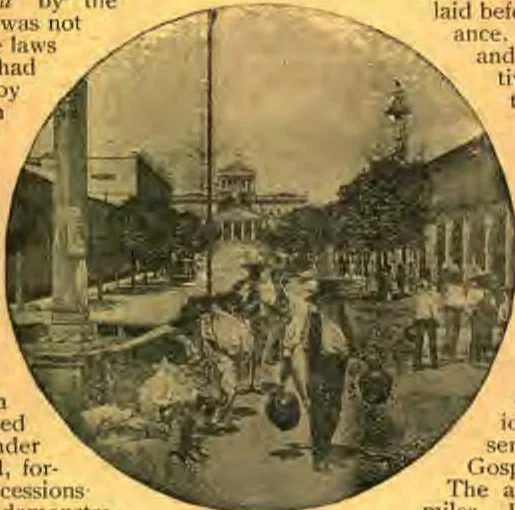
A Street Scene in Guadalajara. Mexico.
But Roman Catholicism is endeavoring to maintain, through clerical influence, what it has lost at the hands of the civil power. Every effort is being made to keep the people wholly under the influence of the Church of Rome. Protestantism is misrepresented and scandalized. But God has prepared the way for His truth to go to all these millions of Spanish-speaking people. They are still in almost total darkness in reference to the love of God and of the saving power of faith through the Gospel. The Bible has been, and still is, almost unknown among the masses. But the way is open for the Bible to be placed in the hands of the people, and for the Gospel to be preached to them. God has done wonders in opening up the way. It now remains for His people to do the work the Lord has enjoined upon them.
Spanish is more extensively spoken than any other modern language except the English. At a moderate estimate, 75,000,000 people speak Spanish, and very few of all these speak any other language. More people speak Spanish to-day than spoke English at the beginning of the century. Spanish-speaking nations encircle the globe. They may be summed up as follows: Spain, 17,000,000; Mexico, 13,000,000; Central America, 3,000,000; South America, 30,000,000; West Indies, 3,000,000; the Philippines and other Pacific islands, 8,000,000; North Africa, 1,000,000.