(Reported for the SIGNS OF THE TIMES by John S. Wightman.)
II. OPENING OF CONVENTION.
THE Fifth Annual Convention at Buffalo was opened at St. Joseph's Cathedral, Sunday morning, July 29, with solemn pontifical high mass for the delegates, celebrated by Archbishop Messmer. This was followed by a great mass meeting in Convention Hall, presided over by Bishop Colton.
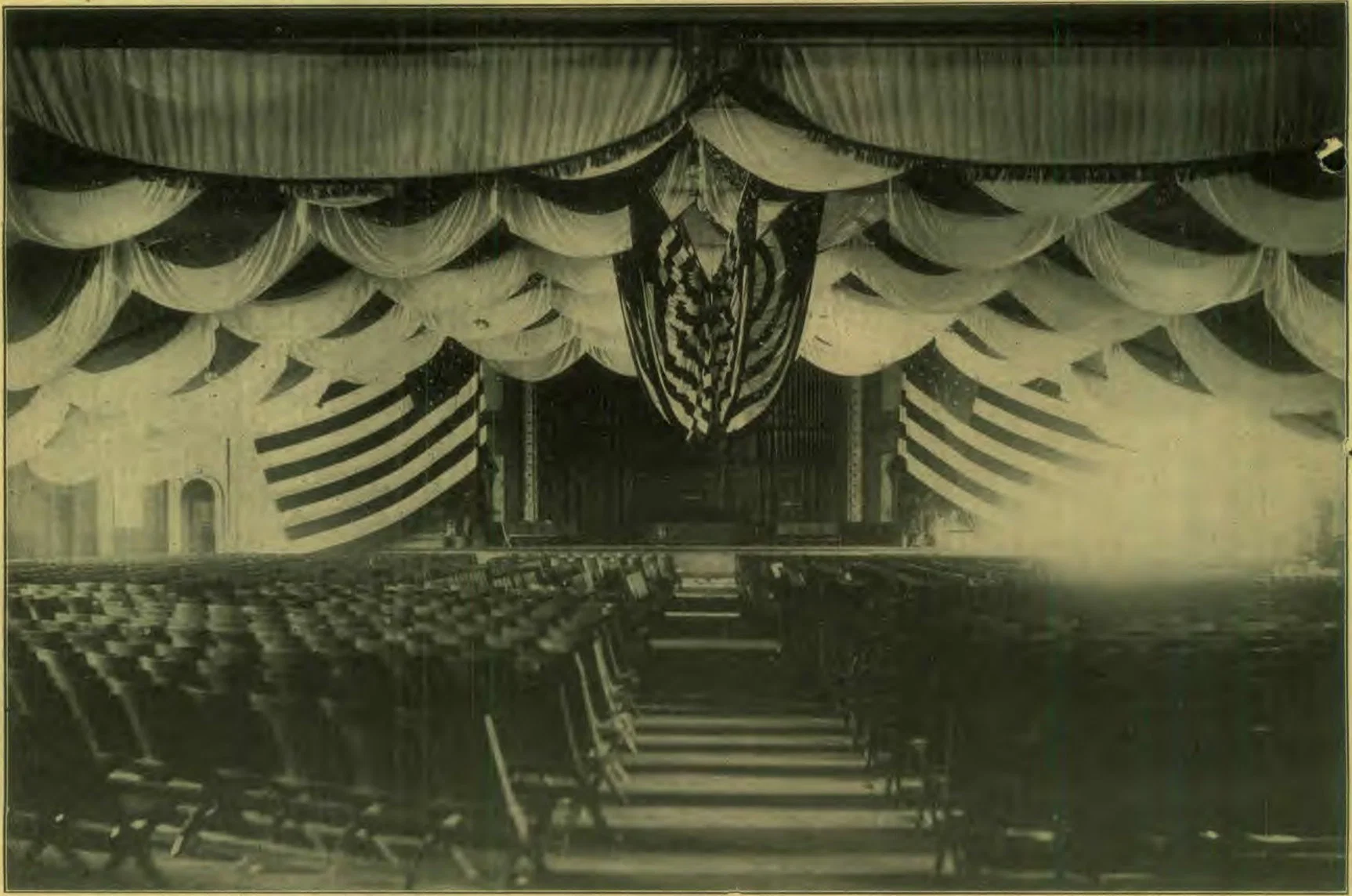
Mayor J. N. Adam welcomed the convention and the delegates to the city, and assured them of its most cordial esteem and a genuine hospitality. He, in return, received an enthusiastic ovation on the part of the convention. The Hall was profusely decorated with American flags and bunting, interspersed here and there with the colors of the Vatican.
Priests and dignitaries of prominence from every part of the country lent dignity and influence to the scene. Among these were Archbishop S. G. Messmer, of Milwaukee; Bishop James A. McFaul, of Trenton; Rt. Rev. J. F. Regis Canevin, D. D., of Pittsburg; the far-famed Bishop Charles H. Colton, of the diocese of Buffalo; the eminent speaker and orator, Rev. Thos. H. Kelley, of La Peer, Mich; Rev. L. L. Kavanagh, of New Orleans; Dr. F. X. Dolan, of Boston; Rev. Thomas Burke, of Seneca, Kan.; and Rev. Cyprian Pena, of Porto Rico.
The following national organizations were represented: Catholic Order of Foresters; German Roman Catholic Central Verein; Catholic Knights of America; Catholic Mutual Benefit Association; Knights of St. John; Irish Catholic Benevolent Union; Western Catholic Union; Catholic Knights and Ladies of America; Women's Catholic Order of Foresters; Catholic Women's Benevolent Legion; Young Men's Institute; Ancient Order of Hibernians; Bohemian Roman Catholic First Central Union; The Texas Bohemian Catholic Union; and the South Slavonic Catholic Union.
The ten thousand Indians of Sioux Reservation in South Dakota were represented by Chiefs Joe Horn Cloud and Eugene Little, and Porto Rico Societies were represented by a priest-delegate. Catholic federation is backed by eleven state, four hundred county, and fourteen national organizations; in short, by the Catholic laity of the United States and her possessions. Its cosmopolitan character commands attention. Altogether, 1,500,000 members of the affiliated societies were represented by the hundreds of delegates.
During the three days succeeding the auspicious commencement of the first day, business meetings were held morning and afternoon, and mass meetings on Monday and Tuesday evenings, July 30 and 31. The mass meetings were addressed by Hon. Nicholas Gonner, of Dubuque, Iowa, on "Socialism and its Evils;" Hon. Daniel J. Kenefick, of the Supreme Court of New York, on "Divorce;" Rev. Thomas H. Kelley, of La Peer, Mich., on "The Dream of Equality;" and Bishop C. H. Colton, on "Purposes of Federation."
Socialism, divorce, religious education, and federation itself were the chief subjects of discussion, while the Sabbath, immorality, extension of church work, missionary efforts, the separate school question, and Catholic rights in the civic government claimed a good share of the time and attention of the delegates.
The address of Nicholas Gonner was a vehement arraignment of Socialism and a tirade upon the Socialist Party. He spoke of the dangers likely to result from the growth of Socialism; of rebates, price-juggling, and other unfair and unchristian methods, and said there was no greater helpmate to the cause of Socialism than the excesses of a business world "in which the principles of Christianity have been lost." In concluding, he remarked:
Fortunately there are in America men who will not allow the abuses to continue that lead to the abyss of Socialism. With the help of God, and under the leadership of strong men like our strenuous President or such eminent Christian statesmen as Mr. William J. Bryan and thousands of their equals, and especially with the Christian spirit of the masses of the American people, the United States will easily avoid the Scylla of irreligion and infidelity and the resultant Charybdis of Socialism. That is the strong foundation of our hopes as Christian Americans. While we know that the tendencies we have pointed out in different fields of15American religious, political, and civil life threaten to lead to the hopeless Utopia of Socialism, we have an unalterable faith in the regenerating powers of Christianity. "Omnia restaurare in Christo!" "To restore all things in Christ!" the motto of our gloriously reigning pontiff, Pope Pius X., is the motto of all friends of Christian order in society.
The address of the Hon. Daniel J. Kenefick, of the Supreme Court of New York, upon "Divorce and its Present Evils," received marked attention, and, from a judicial standpoint, was a most admirable and comprehensive presentation of the subject, showing the existing evil of diversified divorce legislation and abuses under its regulation. His plea was chiefly for uniformity of legislation, and gave to the church canon the entire credit for all that was right and proper in the system, and endeavored to show that church and state stand together in their view of the marriage relation. In closing his able address, he said:
May we not look forward to the time when the state, looking back at the divorce laws of our day, shall say to society: "Those laws were written because of the hardness of your hearts. They are repealed. The state proclaims the unconditional perpetuity of marriage as essential to the peace and happiness of mankind, and to the progress of civilization."
Rev. Father Kelley's address, "The Dream of Equality," was worthy of note for many reasons, one of which must not be overlooked. For him there is no equality in reality other than that which must be the legitimate outcome of religious government, and that is maintained under the supervising force and power of church discipline. This brings equality of the right kind. His address was a complete Catholic argument for religious teaching as a part of all sound education. The most striking statement of this speaker, apropos the question of a tolerative policy in educational matters upon the part of the civic government, was:
If we were more intolerant this would be a better country. We want intolerance of the right kind. Intolerance instead of false instruction. Instruction is not education. True education implies a trinity—the church, the home, and the school. Education is discipline and nothing else.
Bishop Colton's mass meeting address was altogether to the point of federation and its practical results. In part he said:
All must admire the aim and purposes of Catholic federation. The church has ever been assiduous in establishing societies from the beginning, so that now we have tens of thousands of societies and church organizations, and millions in their membership. These societies have mainly for their object the advancement of religion and the salvation of souls. The progress of the Catholic Church in this country, which has been so marvelous, is due largely to the societies which she established in her parishes from their beginning. As the local organizations help religion and strengthen society in particular districts, so the federal body is to help the church and country at large. The federation has accomplished much already, and it will accomplish still more as time goes on. The federation has at heart the interests of 80,000,000 of American citizens.
Telegrams and cablegrams were read from prelates and federation societies in many parts of the world, wishing success for the deliberations of the convention and for the movement. Resolutions were reported and adopted recommending Catholics to seek membership in Catholic organizations in preference to non-Catholic bodies, favoring the wide distribution of Catholic literature, placing the convention on record as against the use of any one language in the Catholic Church; re-asserting Catholic principles and demands in the public school question; denouncing all forms of socialism; re-affirming the Catholic position on divorce; deprecating and strongly condemning the "unchristian action of those employers, both public and private, who, actuated merely by greed and in absolute scandalous disregard of the sanctity of the Lord's Day, force their employees to perform unnecessary labor on the Lord's Day;" condemning the public display of indecent posters; expressing sympathy with English Catholics; and providing for the Volksverein plan of membership by which parish societies and individuals may be admitted to the Federation. This last is a genuine stroke of policy upon the part of ardent federationists by which it is hoped within a single twelve-month to increase the membership of the Federation from its present number of 1,500,000 to 15,000,000. Speaking in reference to the adoption of the Volksverein plan, a plan which originated with the Catholic societies in Germany, and of the probable immediate effect, Bishop McFaul said: "It has been an epoch-making congress. We feel now that we have got this federation on a basis that will eventually reach out to every Catholic in the United States." Great satisfaction was expressed upon every hand over the adoption of the Volksverein plan. "Now that this plan is adopted," says the Buffalo Enquirer, "the federation will proceed to enrol the eligibles. When this is accomplished, the American Federation of Catholic Societies will become the greatest brotherhood organization in the world." Bishop Canevin said:
To carry out the purpose of this association, every force of religious activity, pastors, and people, bishops, priests and laymen, speakers and writers, must be solidly united to speak with one voice and act with one will for God and our country.
Interior of Convention Hall, Buffalo, N. Y., where the Federation meetings were held. Note its gorgeous drapings and festoonings.