Is It Peace or War?

1%

Is It Peace or War?

From Our Own Correspondent
(Continued from Last Week.)

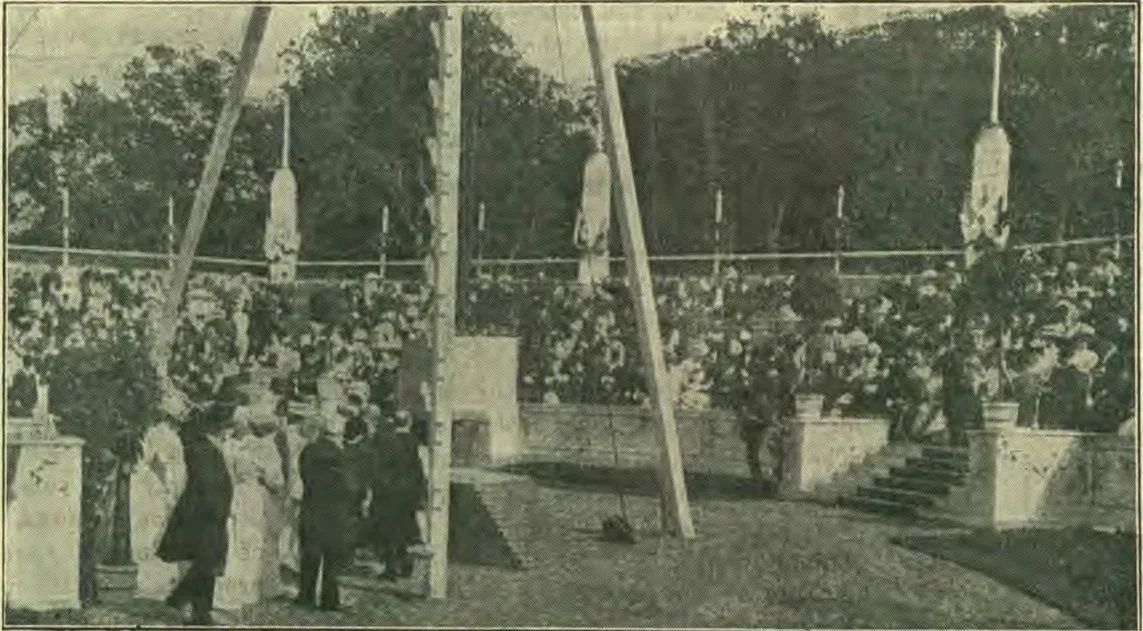
Laying the Corner-stone of the Peace Palace.

AND now that the conference had shown such self-denial in favor of establishing the peace of the world; now that the tree of arbitration had been firmly planted on the soil of amity, the conference proceeded to devote one day in rejoicing over the work done, by laying the corner-stone of the Palace of Peace.
All know that Mr. Carnegie had given a million and a half dollars for the building of this palace. The ceremony took place July 30, in one of the suburbs of The Hague. An amphitheater had been erected on the spot. On both sides of the platform the peace banner, bordered with white, and the Dutch and North American banners were floating in the breeze. At half-past two the orchestra played the
Hallelujah
from Handel's
Messiah,
followed by Beethoven's
Benedictus Qui Venit in Nomine Dei
—a solemn mockery!
A speech was then made by Mr. van Karnebeek, chairman of the board of trustees of the Carnegie Fund. Speaking of the conference of 1899, Mr. van Karnebeek called the permanent arbitration court
an organization so elastic that it does not seem to press to any degree upon the self-government of the States and to adapt itself to any kind of cases which might be presented for arbitration.
It is possible, it is, perhaps, desirable, to take one step forward from the system of arbitration to the system of judicature proper.
This discourse was followed by the laying of the corner-stone by M. Nelidoff, president of the conference. A lady presented to him a silver trowel with which he laid some cement on the masonry, and the stone was slowly allowed to take its appointed place. On one side, the following inscription was written in gold:
PACI JUSTITIA FIRMANDAE HANC AEDEM ANDREAE CARNEGII MUNIFICENTIA DEDICAVIT
M. de Nelidoff then read a paper from which I quote the following:
A new idea, a new principle—peace thru justice and law—is about to see a worthy edifice erected for its abode. From the remotest times, nations have worshiped war. But there has never been in the world an altar erected to peace. It was preached eighteen hundred years ago by the divine Redeemer at the same time as brotherly love, charity, and fraternity. But of all these sublime precepts which sum up the highest aspirations of the human soul, the idea of peace has been until now the most neglected. It has been necessary in order to insure its triumph—and this honor is due to the emperor of Russia—that governments should agree to study in common the means of making the words of peace a reality by seeking the possibility of realizing this boon in order to insure its benefits to the nations.
If the reader will study the above he will agree with us that it is a model of a meaningless phrase.
After M. de Nelidoff had resumed his seat on the platform, a lady arose and presented Mr. Karnebeek, for Mr. Carnegie absent, a silver medal in the name of the Universal Women's Alliance. The orchestra and the choir closed the ceremony with Wagner's
Wach Auf Es Naht den Tag!

A Magnificent Pageant Planned.

The grounds on which the Peace Palace is to be erected were a portion of a park belonging to the royal family, and have been donated by the Dutch Government. Two hundred sixteen plans were furnished the board of trustees by so many architects. Those made by M. Louis Cardonnier of Lille (France) were accepted, and their author has been selected as builder. They are now on exhibition in The Hague and have already been inspected by thousands of people.
A plan has been formed to arrange a grand allegoric pageant on the occasion of the inauguration of the Palace of Peace, presumably in about three years, and
to symbolize the noble effort to suppress all wars and to remove all differences among the nations.
A long, picturesque crowd will represent in their native costumes all the nations of the earth, past and present, moving in lines toward the temple which is to be the residence of peace. In the front yard of the temple and on the steps and the terraces before the temple, the pageant will take place. First will come Asia, with her ancient Chaldeans, Assyrians, Persians, and Hindus. Next Africa, with her Phenicians, Numidians, Carthaginians, and Arabians. Then Europe, with the old Celts, followed by the Greeks, Romans, Gauls, Franks, and Byzantians. Then again, America, with the Aztecs, Toltecs, Mexicans, and Incas. Next, Australia, represented by the Papuan race and the Maoris.
In the second part of the procession will appear the works of peace: arts, letters, agriculture, cattle-raising, trade, industry, and education, represented by allegorical groups. They will all move toward the Temple of Peace and there, in a grand musical performance, give utterance to their desire to renounce all wars and enmity, praying to Peace (not to the God of heaven) to assume the sovereignty of the earth. The amphitheater to be built will be able to accommodate 25,000 spectators.

The Capital of the World.

But the grand dreams of international
pacifism
do not stop with a palace and a magnificent performance. As Mr. Olsen wrote to the SIGNS in his letters from The Hague, there is an intense pacific movement going on in that city outside of the conference. In fact, the
pacifist
movement all over the world has made The Hague its headquarters. During the time of the conference, it has operated an
International Club
in which lectures have been delivered twice or three times a week by the leading men in the movement from various lands. The influence of this club over the delegates can not be doubted; and if the latter had had only themselves to consult, the peace conference would certainly have had different results. Under the auspices of the
pacifist
movement are issued the
Conference Daily Messenger
and the
Review of Internationalism,
a bimonthly published in four different languages. The
pacifist
movement is responsible for the foundation of the Palace of Peace and for the grand pageant to be held at its inauguration. Yet all this is but a parcel of a
gigantic conception which may yet fascinate the imagination of the world.
There has been organized at The Hague by this same
pacifist
movement a foundation for internationalism which seeks to
unite all the international societies into a unique world association.
It is to be the
gray matter of the brain of humanity so far as organized.
With this in view, and in order to carry out the plan, it is proposed to buy extensive unoccupied lands in the vicinity of The Hague for the erection of a new city, the
international capital of the future United States of the World.
This city is to be the seat and headquarters of the innumerable departments of international life. One of these departments, the highest one, will be, of course, the peace court and the peace conference, which are to become permanent.
A Dutch architect, K. P. C. de Bazel, has designed the plan of the future capital of the world.
The grounds, whichare three times larger than greater Amsterdam, are to be bought from the city of The Hague and from the government. It is supposed that they afford space enough for two or three centuries. They begin one kilometer from The Hague city limits and three kilometers from the center of the old city, and extend to the northwest on a parallel with the North Sea coast. The city is to lie two kilometers from the beach. As seen from Mr. Bazel's plans, it has the shape of five concentric octagons, the fourth one ending in triangles which give the city the appearance of a star. These octagons are cut into triangles and quadrangles by eight avenues radiating from the center, a large square. Four of these avenues form a cross. The body of the cross, longer than the head and arms, ends in a square which is the place selected by the architect for the site of the Peace Palace (Musschenberg Hill). Enlargements outside of the octagons are provided for by symmetric and graceful lines. The head and end of both arms of the cross are to be occupied by various academies, such as academy for pedagogy, hygiene, and political economy, academy of arts, and academy of anthropology. A library, a sanitarium, and practical institutes are planned for. The center of the city has not yet been assigned to any special destination.
All buildings, private and public dwellings, will be separated by gardens which will save the city from the objectionable features of modern city life. All streets, avenues, and squares will be so wide as to answer the future requirements of the largest capitals, and will be provided with the most modern of electric means of transit. Appended to the city will be a
garden city
made up of a thousand dwellings with gardens for working people. Finally, the future capital of the world will be connected in the most direct manner—by the Rotterdam-Scheveningen Electric R. R.—with London, Berlin, Paris, New York, and all the other
large cities of the universe.

Is this the Millennium?

Such are the bewitching plans made by
pacifism
for the establishment of peace on earth. Do they not remind one of the golden city of the Revelation? Might this not, to some minds, seem to be the fulfilment of John's visions? Is this, perchance, the way in which the Prince of Peace intends to establish on this earth His kingdom of righteousness?
No!
Pacifism
is not the kingdom of Christ—tho it has some features resembling it. Jesus Christ said that His kingdom was not of this world,—this sin-cursed world,—while
pacifism
is content with it as it is. Divine grace and conversion are Christ's means of bringing about peace, while
pacifism
seeks to bring it about thru man's own goodness and righteousness. Christ asks of men only faith, while
pacifism
turns to politicians and parliaments.
Pacifism,
then, is condemned in the light of Scripture as well as in the light of all the history of the world. Yea, it is condemned in the very light shed by the present peace conference—the lurid light of battles such as the world has never yet witnessed. Thus, by unconsciously seeking to cover up the appalling realities of a near future and to prevent people from seeking the true and only remedy, the soon and personal coming of Christ as King of Kings,
pacifism
becomes one of the most dangerous movements of the present time.
As says the last number of the
Revue Politique et Littéraire:
The
pacifist
song is another lullaby. By turning the masses from the present problems, it helps governments in their most crafty maneuvers. Governments are obliged to obtain from the people the money necessary for the incessant increase of war expenses. This task would not be easy, if, near them, did not appear the preacher of peace, the consoler, the man who knows how to turn the attention of the nations from the sadness of the present hour, from the black smoke of the 18,000-ton battleship to the blessed morn of universal fraternity. Conclusion: Whether he wants to or not, the
pacifist
is a most valuable helper to warlike imperialism.

The Question of Disarmament Decently Buried.

Since writing the above, a new act has been played at The Hague peace theater. The conference has deemed it proper to hold up another peace signal for the relief of the world. At last, the question of armaments was touched upon! A full meeting of the Conference was called together on Saturday, August 17. After an hour had been spent in despatching war matters, Sir Edward Fry, standing on the platform at the right of the president, read a proposition of the highest importance made
by the government of his British majesty.
Mr. Fry mentioned the wish voted in favor of reducing armaments by the first peace conference. He quoted Count Mouravieff's memoir addressed to Europe in the name of the czar in August, 1898, in which is drawn a frightful picture of the present military condition of the world, which,
should it last, would inevitably lead to the very cataclysm which it is sought to avert, and the horrors of which make every human soul shudder in advance.
He afterward disclosed the fact that between the first and second peace conferences, the annual military expenses in Europe had increased by 1,725 million francs, and exclaimed:
Such is the Christian peace of the civilized world in the twentieth century!
Then, referring to the general desire for peace, he made the proposition in the name of Great Britain to submit annually to any nation who would do the same, her project for the building of new war-ships and the amount to be spent in their construction. Finally, Sir Edward Fry proposed the following resolution to the conference:
The conference confirms the resolution adopted by the conference of 1899 respecting the limitation of military burdens; and, whereas military burdens have increased considerably in almost every land since the said year, the conference declares that it is highly desirable to see the governments resume the serious study of this question.

Mr. Fry's Resolution Discussed.

The president then read a letter from Mr. Choate, supporting the resolution in the name of the United States. M. Bourgeois also supported in the name of France. A letter from the Spanish delegation did the same. The delegations from Chile and Argentine submitted the treaty on disarmament signed by these two countries. Then M. Nelidoff took the floor. He recalled how, at the first conference, when the question of reduction of armaments was submitted,
opinions were so discordant and the discussion soon became such
that the very existence of the conference was threatened. He also recalled how two of the great powers soon after the conference engaged in disastrous wars. He added:
If this question was not ripe in 1899, it is no more so in 1907. It has not been possible to do anything in this direction, and the conference finds itself as little prepared to take up this question as it was then. Any discussion, fruitless in itself, could only harm the object we have in view by making more conspicuous our differences of opinion.
He then proposed that the resolution submitted by England should be voted without any discussion and by unanimous acclamations. And this was done.
Now we have the work of both conferences beforeus as follows:
In 1899, the peace conference resolved that
the limitation of military burdens . . . was greatly desirable.
In 1907, the conference confirms that resolution and adds that, considering the fact that these burdens have increased considerably since 1899,
it is highly desirable to see the governments resume the serious study of this question.
This is what the
Conference Messenger
calls a
hypocritical wish,
a stone instead of bread given to hungry nations,
a first-class burial of the reduction of armaments.
This paper even printed on the first page of its number for August 18, the pictures of delegates Fry and Nelidoff framed in black, accompanied by the above epitaph also draped in mourning.
And now that The Hague institute on twentieth century war operations has closed its classes, now that the grandest and most enrapturing dreams of peace have been palmed off upon the world, the arming of nations will go on with greater madness than before. For a few years more, the peoples will keep marching with unconcern toward the
indescribable cataclysm
involved in the coming European war. More than ever can we say now with M. de Blowitz, Paris correspondent of the London
Times,
who wrote thus in 1891:
The weapons are furbished; the arsenals are full; it is nation rushing against nation.

The Coming

Cataclysm
Before we close, may we not cast a timid glance at the awful realities of the coming war so quietly organized by The Hague peace-makers? The writer just quoted had done so in 1891. He said:
I have frequently for two years endeavored to ascertain whether European diplomacy thinks of this event, whether it is weighing the imperative consequences, whether it is preparing for it. I have been stupefied at seeing that among those who ought to scan the future, not one has fixed a steady eye on the mysterious horizon that conceals the thunderclap which must one day awake and startle Europe; and when, seeing them absorbed in their present task, I have pointed out to some of them the eventualities which will then arise, I have seen them shudder and draw back as if terrified by the problem which forced itself on their meditation and which seems to me to have no other issue than war—war from one end of Europe to the other.
What could be said now, sixteen years later? The horrid picture has been faintly drawn in a recent publication issued by the International Peace Bureau at Berne, Switzerland; it is entitled:
The Consequences of a European War.
We boil it down for the benefit of our readers in the following paragraphs:
The next war in Europe will undoubtedly involve five nations. But let us take into account only four: France, Germany, Austria, and England. Ten million men will be called to enter the field at the first signal. It will take 630 million francs for the mobilization alone. Every single day of war will cost 125 million, which make 40 billion a year. Moltke estimated that the European war would last two years, and General Von der Golts declared that it would terminate in the
utter destruction of the economic resources of one of the adversaries, or, which is the most probable conclusion, by the complete exhaustion of both.
The number of the victims would be one million, two hundred thousand. The corpses of the soldiers, putrefying on the battlefield around the cities and villages, for lack of burial, will infect the whole country. Epidemics will be carried from the camps and ambulances into the homes of the people; the hospitals will be crowded and every family in mourning.
But the threatening aspect of a future war,
says Vice-Admiral La Reveillere,
is not so much the loss in men, which will be immense, as the suspension of all the functions of national life. The farming class and the aristocracy as well will be compelled to be under arms; all will be torn away from their occupations; no one will be able to work. The fields will remain unplowed; factories and shops will be closed, and with great difficulty will it be possible to furnish the millions of soldiers with their daily food.
Speaking of the same aspect of the
future war,
M. Jules Roche, a French deputy, says in a recent review that it will be equivalent to
a formidable earthquake, to an immense geological cataclysm. . . . We would see,
he says,
everywhere, a crisis, an economic cyclone such as the world never saw at any time!
And what will all that be when it does come, but an exact fulfilment of what the Bible predicts for the last days? What will it be but the battle of Armageddon, where all the kings of the earth are to
gather
for the
battle of that great day of God Almighty
? And thus The Hague Peace Conference—perhaps the most important political event of our times—is but another witness to fulfilling prophecy, but another startling sign of the times. JEAN VUILLEUMIER.
Laying the Corner-stone of the Palace of Peace.