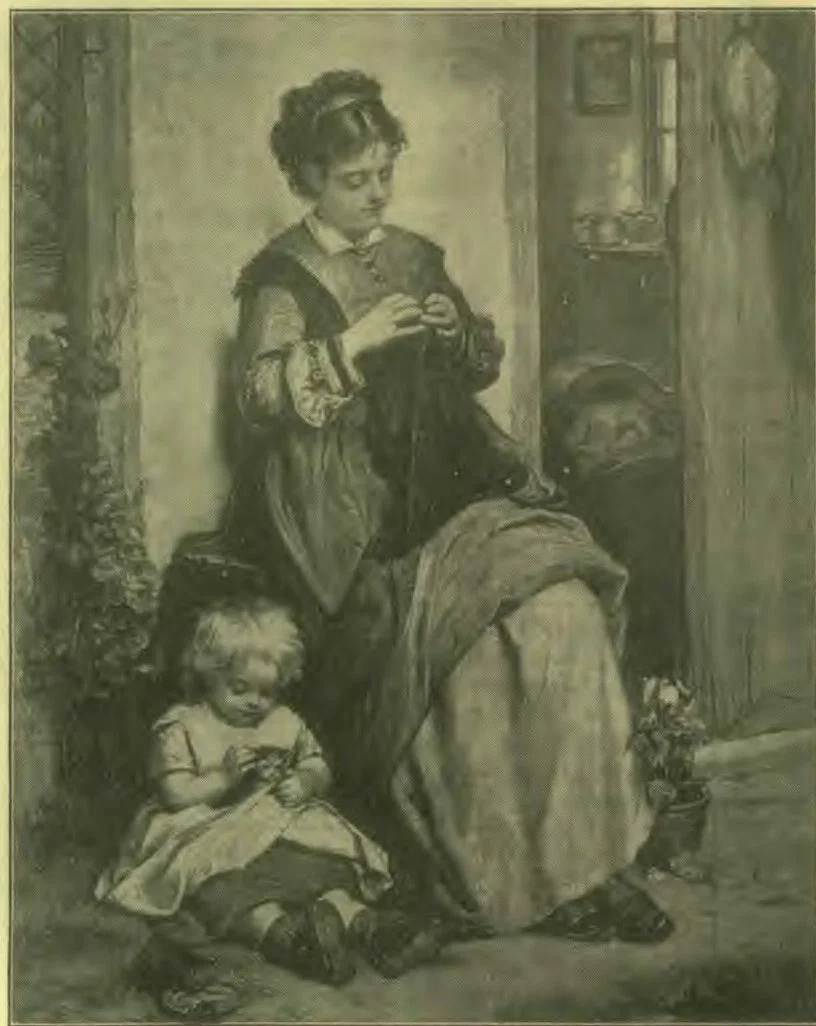
The Building of a Home

6%

The Building of a Home

By Mrs. L. D. Avery-Stuttle

The Part of the Wife.

THERE!” exclaims Mrs. Nagging. “Good enough! I’m glad some one has the courage to arise and tell these men what’s what!”
But, my good woman, not so fast. There are always two sides to every question; and the part which the wife should act in the home life is as difficult, perhaps, as that of the husband, and perfection is as rarely attained by her as by him. We must be careful. Possibly our clear eyesight may be blinded by something almost as large and as opaque as the proverbial “beam.”
“But,” continues Mrs. Nagging,—now Mrs. Nagging is very prone to continue a conversation when once begun, especially if it will reflect blame on some one else,—“but I never spend money on horse-races or games or anything at all questionable—not even theaters. I’m almost always at home evenings. I try to attend to the needs of my family, I am kind and thoughtful of the comfort of my loved ones, I never scold—that is, I don’t call it scolding when I am obliged to remind my husband of his shortcomings—I never even——”
Negative virtues, all of them. Do you remember the admonition of the good Book, to “let another man praise thee and not thine own mouth, a stranger and not thine own lips”?
You remind me very much of a lady I met a number of years ago, a professed Christian, by the way, who actually assured me with the utmost earnestness and gravity, that she didn’t believe that she had a single selfish hair in her head! You may not be greatly surprised when I tell you that this paragon of unselfishness very shortly afterward gave up even a profession of Christianity. O there is nothing so utterly blinding to the spiritual eyesight as selfishness; and the saddest feature of the case is the poor victims themselves think they can see perfectly well.
“But, pray tell us, what are some of the most important duties of a wife?” exclaim a multitude of earnest young matrons, anxious, I am sure, to live up to their high privilege.
My friends, let me whisper a secret in your ear—the true key to the whole situation: Sincere and perfect love is the best teacher in the world. Circumstances differ so widely in the lives of all that it is quite impossible to lay down any cast-iron rules which must be followed upon all occasions and by all women. But true love makes few mistakes. Let this be your guide, your director, your teacher, your mentor.
But there are some general principles which it is always safe to follow. One of these is this: Confide in your husband,—give him your perfect confidence. Allow no secrecy to come between you; hearts are easily sundered, sometimes, and if we would be of the class of whom it is written, “The heart of her husband doth safely trust in her,” we must avoid anything like underhand deceit. Be frank, loyal, truthful. If a lapse is sometimes made,—for we all of us are but dust,—be quick to admit your fault. “Let not the sun go down upon your wrath;” sometimes a few words of candid explanation will clear a cloudy sky in a moment.
Happy as the Day Is Long.
Then, avoid the disagreeable traits of Mrs. Nagging. Don’t nag. The nagging habit will do more to ruin the happiness of an otherwise pleasant home than almost anything else. When you have quietly and pleasantly spoken your mind, LET THAT END IT. Don’t keep referring to the same unpleasantness. The first thing you know, you will talk about it until somebody loses his temper.
As a rule, men like their wives to study their little likes and dislikes,—especially in the matter of their food. We all remember the old saying: “The easiest way to a man’s heart is thru his stomach.” If John doesn’t like salt, do be careful not to put so much into the beans that he pushes back his plate, with a wry face,—but if you do happen to make such a blunder, don’t cry because he tells you, without mincing the matter, that “these beans are too salt!” It will be more sensible to agree with him, and tell him you will do better next time.
And O! I wish I could be heard and heeded by all the women in all the world, young and old. I would say to them, Cultivate a pleasing, soft voice. Don’t whine—DON’T! and never, never raise your voice, no matter how much in earnest you are. It sounds as if you were angry, whether you are or not.
“Well, but”—you hasten to explain that you are sick so much that it seems impossible to avoid whining. But it is possible. Your voice may be weak and faint, but you need not whine. To most men, I’ll venture to say, there is nothing more irritating than to hear the whining voice of the wife from morning till night. So, if you feel that as soon as you open your lips you must whine, keep them fast shut until you are brave enough to speak in quiet, pleasant tones.
It was said of the Empress Josephine, of France, that altho her face and features were not beautiful, she was possessed of such a sweet disposition and such wonderfully pleasing tones (they generally go together), that she was accounted one of the most lovely women in Europe. Her biographer says: “Like the harp of David to the troubled breast of Israel’s king, this charm is known to have wrought profoundly upon Napoleon. His own admission was: ‘The first applause of the French people sounded to my ear sweet as the voice of Josephine.’”
[This article on the part of the wife concluded next week.]