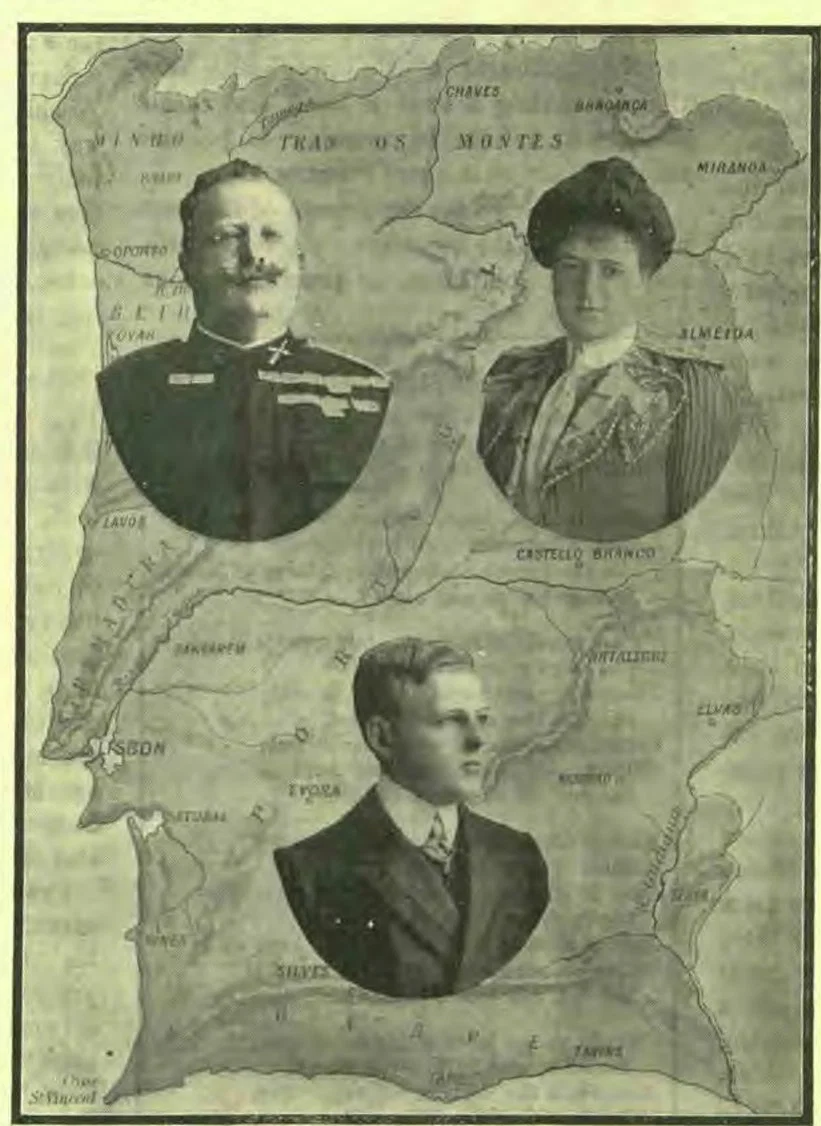
Portraits of the late King Carlos of Portugal, his son, the Crown Prince Luiz Philippe, Duke of Braganza, who were assassinated in Lisbon on February 1, and Queen Amelie. The king, queen, and their two sons, Philippe and Manuel, were on their way to the palace in open carriages, going from the railroad station on their return from Villa Vicosa, where they had been sojourning for a time, when they were fired upon by a band of men who were waiting for them on a street corner. The outline of the realm over which the late king ruled is given also in connection with the portraits.
Portugal has been in a condition for some time bordering on revolution. When Carlos ascended the throne in 1889 on the death of his father, the omens were fair for a peaceful and useful reign. He had made a favorable impression on his people during a short regency preceding his father's death, but very soon trouble began among the discontents, and almost every one of the seasons in each year witnessed outbreaks, revolutions, and violence in the kingdom. This led up to the appointment of Franco as prime minister and finally dictator of the realm; the parliament was dissolved, and Franco refused to recall it according to the terms of the constitution. His reply to the demands for the calling of the parliament was, "My dictatorship is administrative, not political. To govern by decree is an affair of transition, a passing thing. Whenever the parties are conscious of their duty and ready to do it, parliament will be open to them. In the meantime, I must do the work of reform. I must do my duty. I shall govern over the parties, and, if necessary, against the parties."
His policy was adhered to so closely that the country was filled with revolutionary and anarchistic ideas, with the result that he and his oldest son were assassinated, as above stated. The second son, Prince Manuel, was immediately proclaimed king, Franco was deposed and fled from the kingdom, and at present it looks as tho the country would again enjoy a term of quiet, especially so since the despotic hand of the dictator was so promptly removed by the newly crowned king.