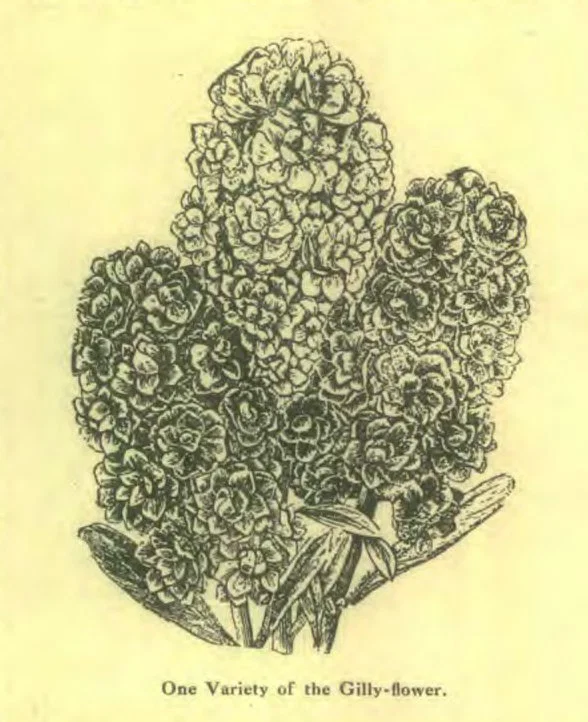
ON a recent evening the writer sat alone in her room reading beneath the electric lights. Suddenly there swept thru the room a whiff of perfume, subtle, penetrating, arresting instant attention.
Looking around to ascertain whence came the fine odor, I was reminded that during the day I had placed upon a small stand at one side of the room several stems of gilly-flowers.
I had been attracted—in a friend's garden—simply by the beautiful coloring of the blossoms, a delicate pink shaded up to a rich, vivid crimson, and not by their odor, which, in the California variety of this hue, I had never found inviting.
I continued my reading, thinking that possibly my imagination had generated the fine scent. Presently a second wave of the appealing fragrance broke around me. My curiosity awakened now. I rose, went to the stand, lifted the vase in my hand, and looked for the source of this elevating pleasure.
There, hidden behind the taller stems, gleamed under the artificial light a short stem of the white variety of the pretty blossoms, exhaling sweetness inexpressible, sending out gentle comfort, awakening uplifting emotions, accomplishing its exquisite mission daintily, uttering no cruel word, incensed by no rivalry toward its more conspicuous, more showy kindred.
Instantly there flashed into mind the thought: What an object-lesson for human beings! Why may not men and women, young people, even children, truly trained, indeed, why may not I evoke pleasure so welcome, awaken rapture so rare, attract other hearts with power so keen, give comfort so unmixed, by simple sweetness of deeds, pure fragrance of character.
Why may not men and women, why may not I express as clearly, as impressively, by deeds, looks, and charming bearing, God's purpose in creating us—that of glorifying Him and of making every one around us as happy as possible?
The gilly-flower lives to gladden by its tints and hues, to breathe out entrancing sweetness; to win astonishment at the strange alchemy by which it extracts those tints and hues from the glowing sunlight, and that sweetness from the inert, homely, gray soil.
It never worries lest the ground shall withhold the singular elements from which it gathers odor, scent, perfume, lest the sun shall refuse the requisite light and fervor.
How blissful would be man's life on the earth did he but fulfil his mission as placidly, with as little display of envy, jealousy, greediness, and selfishness; were he as willing to be overlooked that others might shine and be admired.
That would be an almost ideal condition of being, akin to the future kingdom of Christ on the earth, wherein LOVE shall be the exclusive rule of action.
Each member of the race would concede to all others full right to life, to liberty, to exercise every fine inborn mental power in pursuits for which they were adapted. To every one room would be given to take root and develop.
Ownership to vast estates in land would no longer be claimed by a few men in any country, while thousands of the race possessed none at all. Great forces of men would not be toiling for a starvation wage while millions in fortunes were being accumulated by a few hundred financiers.
To live, to live to send a thrill of pleasure into a sad heart, a sense of companionship into a desolate soul, an emotion of joy into a mind stricken with grief, a spark of hope into a spirit faltering, irresolute, is to set before one's self a high aim and purpose. It is to render one's life sweet with perennial fragrance.