READ again Daniel 7. We repeat the specifications of the prophecy of the little horn given in our last. They are as follows:
1. It arose among the ten horns. V. 8.
2. It was a little horn at first. V. 8.
3. In order that it might be established, three of the first horns are plucked up before it. V. 8.
4. It had eyes like the eyes of a man. V. 8.
5. It had a mouth which uttered not the meaningless noise of a beast, but great boastings, such as could be uttered only by a being above a beast. Vs. 8, 11, 25.
6. It was a different horn in character from those around it. V. 24.
7. It became strong, so that its look was more stout than its fellows. V. 20.
8. It made war upon the saints, or people of God. V. 21.
9. It was to prevail against them till the Lord should come and take judgment to Himself. Vs. 21, 22.
10. It should presume, or think, to change "the times and the law" of God. V. 25, R.V.
11. It should continue for "a time and times and half a time," or three and one-half years. V. 25, R.V.
12. It would lose its temporal dominion as a horn. V. 26.
13. Its greatest words come in the very closing part of its career.
Fulfilment of the Papacy.
Four of these were considered last week. Let us study the last eight in this lesson.
5. Great words have been spoken. In the tremendous claim which the Papacy has made as the one sole authority in all religious matters above conscience and the Bible; in its right to dethrone and set up kings and rulers, and to absolve their subjects from obedience; in the titles assumed for the bishop of Rome—as for instance, "Lord God the Pope," "Vicar of Jesus Christ," "Arbiter of the World," "The Light of the World," etc., etc., it has surely spoken great words, and "great words against the Most High," in assuming prerogatives and authority which belong only to God, and which even Jesus Himself did not assume.
6. It is diverse in character from the kingdoms among which it arose. The ten kingdoms were civil governments. The state was at the head, even if religion was connected with it. The only true idea of government, the Christian idea, is that of absolute separation of church and state; that civil government has no right to meddle in the things of religion. Its duty is to protect all its subjects equally without respect to religion. It is to prevent as far as possible incivility to all, irrespective of creed. Many nations of the past had departed from this, but the state had been kept paramount. Religion was subject to it.
When the Papacy came in, a different theory was taught; the church should be dominant, the state subject. The church should define heresy and its punishment; the state should execute it at the behest of the church.
A Threefold Phase.
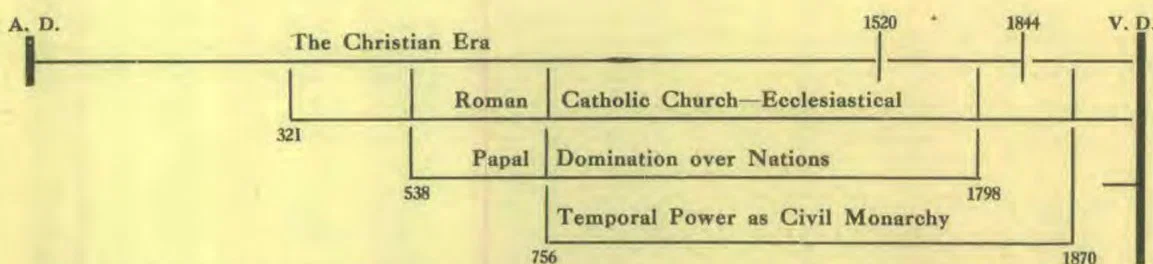
The great Christian apostasy is set before us in the prophetic word in three phases: (1) As the Roman Catholic Church, ecclesiastical, in which are many honest, earnest, self-sacrificing souls, longing for light, and living according to their best knowledge. This apostate church, beginning in organized form, markedly in the days of Constantine, exists to the end as an ecclesiastical organization. (2) As the Papacy, the power or claim of which to define heresy and its punishment is acknowledged by the civil power, the state placing itself at the disposal of the Papacy, to execute the sentence of the church. This phase of the Papacy, acknowledged by the civil powers, began in A.D. 538 and ended in 1798. We will call it spiritual domination over the nations. (3) The Papacy as a civil kingdom, limited to the States of the Church, beginning in the middle of the eighth century, and terminating in 1870. This is the true "temporal power" of the Papacy. All these are contrary to, and subversive of, the Gospel of Christ. The last two phases are presented in this chapter.
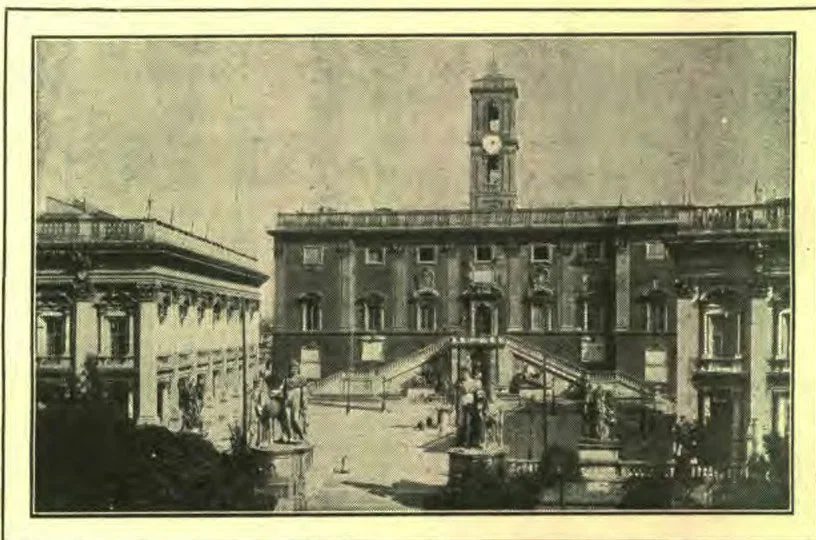
The Capitol at Rome—Formerly Held by the Papacy, but Now Opposed to It.
7. The little horn became strong, so that its look was more stout than its fellows. At first it sued for power, for prestige, for favor; it soon came to command. The Chaldean word, rab, translated "stout," is rendered chief, captain, great, lord, master. The look of the Papacy, or its representative, became more masterful than that of his fellows. The Papacy became chief. Jesus said, "I am among you as one that serveth;" the Papacy, the self-assumed "vicar of Christ," became as one that ruled.
War with the Saints.
8. It made war. Logically, it could not do otherwise and be true to its system. Jesus Christ said, "If any man hear My words, and believe not, I judge him not; for I came not to judge the world, but to save the world." John 12:47. The Papacy assumed to be judge, or arbiter. It defined the faith without regard to conscience. It stepped between the individual soul and its God, to whom each one must give an account. It separated the child from its Father. It placed between the human subject and the divine-human Redeemer, who invites all to "Come unto Me," a cordon of ecclesiastical police. Assuming all this, it must, to maintain its dignity and power, punish infractions of its law. It logically argues, from its false premises, always, that the very honor of God's throne demands that heretics (those who dare disobey the Papacy's interpretation of God's will) should be punished with death if need be. And therefore the Papacy could do naught but make war, and, too, with the saints. For the saints of God are free souls, who receive their law, not in the cold, dead creeds of men, but in living words of truth from Heaven. Of course, they could not yield their life to an organization that had departed from the Fount of Life, and therefore they were, by that organization—the Papacy—adjudged heretics; and the powers of earth dominated by the Papacy executed the sentence.
9. It prevailed against God's people. It put to death, in mistaken zeal, countless thousands of the—
"Whitest of the saints of God,"
and it will continue to make war, so far as its power lies, till the Master comes again, and judgment shall be given to the saints of the Most High. See 1 Cor. 4: 5; 6: 2, 3.
The Times and the Laws.
10. The little horn shall think to change times and laws. Not that it should be able to do this, but it would think itself able, it would assume to do this. The Septuagint reads, "the law;" the Revised Version, "the times and the law;" Spurrell's translation, "the appointed times and the law." All these point to the times of God's appointment, the law of His giving. And the Papacy has thought to do this. It has substituted for the Sabbath of the Decalogue, the seventh day, the first day of the week—a day which has absolutely no claim to Scriptural authority.¹
11. It was to continue for a time, times, and a half. A "time" is a year. See Dan. 11:13, margin. "Times," dual, the least number that can be expressed by the plural, is two years. The total is three and one-half years, or forty-two months—twelve hundred and sixty days. Rev. 11:2; 12:6, 14; 13:5. As God uses short-lived beasts to represent long-existing dynasties, so He uses brief periods of time to represent longer periods. A day in prophecy symbolizes a year. Eze. 4:4-6. The 1,260 days of the prophecy represent 1,260 literal years. These years began in A.D. 538, when the last Arian power was plucked up and the Papacy became the head of Christendom generally recognized by the states of Europe. In 1798 these days expired. In a larger sense10
Studies in the Book of Daniel
(Continued from Page 9.)
these days began in a period from 533 to 538 and ended in a period from 1793 to 1798. The corruptions of the Papacy and the light of the Gospel thru the Reformation took from Europe the fear of the pope; and its final blow as corrector of heretics, as the acknowledged head of the church, came when the army of the French directory, under Berthier, entered Rome, and took the pope prisoner, in February 1798. The dominancy of the Papacy over the other horns there and then received its finishing deadly blow. The ecclesiastical organization of the Roman Church was not affected, nor did its own dominion over its own territory here come to an end. The deadly wound and its healing is more fully set forth in the Revelation.
The chart above covers the time of the Christian era, from Christ's fire, afreat to His second coming; 1530 marks the era of the Reformation; 1884 the time of the Investigative Judgment. Dan. 7:9, 10.
Daniel sees the whole career of the little horn as a persecutor until the coming of the Ancient of Days. He notes the preeminent power for 1,260 years. But he does not mention the restoration which makes it a persecutor to the end, as indicated in verse 21. This is reserved for John.
Loss of Temporal Power.
12. The little horn was to lose its own dominion as a little horn. "The judgment shall sit," the prophet declared, "and they shall take away his dominion, to consume and to destroy it unto the end," not the end of the world or age, but to the end of his dominion, the last of it. Her dread judgment, prior to Christ's coming, is presented before us in verses 9 to 14. That judgment is, in connection with the closing of Christ's priestly work, a subject to be treated later. It began in 1844. Immediately after this is the removal of the dominion of the little horn. "They" evidently refers to other horn-powers. In 1844 the States of the Church covered an area of 16,000 square miles, with a population of 3,000,000. Four years afterward revolution broke out in France and northern Italy. In 1849 they revolted, but were brought back by France. In 1859 Romagna revolted, and was annexed to Sardinia in 1860. The same year Umbria and Marches revolted, and placed themselves under the standard of Victor Emmanuel. These were annexed to Sardinia. From 1848 to 1860 the consuming process had reduced the papal states from 16,000 square miles to 4,500, and from 3,000,000 population to 700,000. In 1870 the last vestige of temporal power was swept away. The end of his temporal dominion, as a horn, had come.
13. Verse 11 indicates that the greatest words, the greatest assumptions of the little horn, occur near the end of all earthly dominion, close down to the burning day of God. We have seen a partial fulfilment in the utterance of the dogma of the immaculate conception in 1854 and of infallibility in 1870. Doubtless the world will listen to still greater words; they will be the logical result of the system, the perverted Gospel of the Papacy.
Which Will We Choose?
Every one of these thirteen specifications is met in the Papacy; they are met in no other power. God has warned us in His word of its evil. He has portrayed its career and end. Great tho it has been, mighty above all kingdoms of earth, daring, even, to substitute its law for that of Jehovah, before that mighty truth of God, "the Most High ruleth in the kingdom of men," it falls, and falls forever. Not knowing God, it has blasphemed His name, usurped His throne, persecuted His people. It has seemed to triumph, and those who walk by sight, and are guided by sense, have yielded to its kingdom of outward pomp and show. If they continue with it, they will reap its fruitage.
But those, who, as free men, have dared to worship God according to the dictates of conscience, who have dared to be non-conformists, who have dared excommunication, proscription, anathema, exceration, banishment, torture, death, are in God's hands, held in remembrance by Him; and when it has been demonstrated to the world, and to worlds, what the fruit of exalting man to the place of God is, then the Lord will come and save those who have acknowledged His rule in their own hearts. There it must begin, and then, when earth's struggle is over, "the kingdom and the dominion, and the greatness of the kingdoms under the whole heaven, shall be given to the people of the saints of the Most High; His kingdom is an everlasting kingdom, and all dominions shall serve and obey Him."