PHILIPPINE NOTES

8%

PHILIPPINE NOTES.

[Gathered largely from an article in the June Cosmopolitan by Robert Lawrence Packard.]
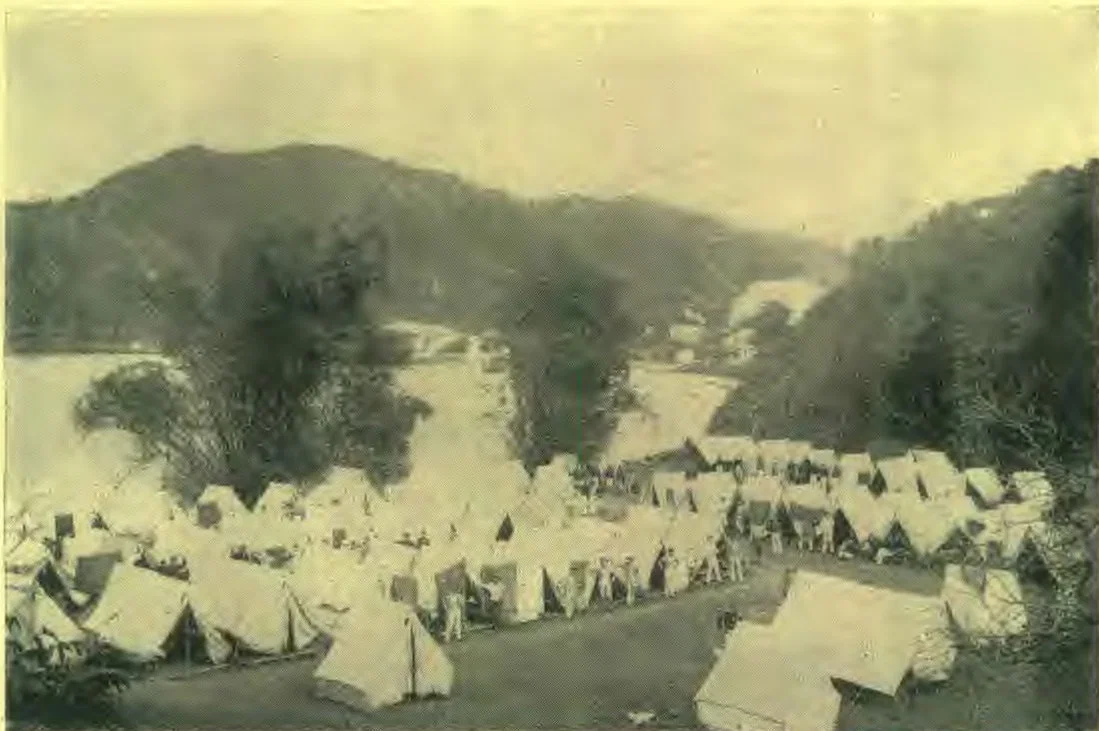
The above is a good illustration of the beautiful scenery in the Philippines. The particular island is Corregidor. The tents are those of the Tenth Pennsylvania Volunteers. Had indeed it is that sin has marred God's fair creation; since the blood of Abel was shed by Cain man has marred against his fellow. Sadder than all else are wars of ambition and conquest, undertaken in the name of humanity. The view is from a photo furnished by Mrs. Wood, of this city, whose husband is a physician connected with the hospital corps of the army.
THE two most civilized tribes in the Philippines are the Tagals and Visayas, numbering between three million and four million, about one-half of the entire population. The nominally Christian natives number about six million, and are largely under the Augustine, Franciscan, Dominican, and Recollect orders in the Roman Church. The Jesuits and secular clergy have charge of only about one million.
The Filipinos first appeared in history in 1509, when the Portuguese, who were then "expanding"—i. e., capturing or burning cities and killing natives by thousands—in the East, found vessels from the islands on their arrival at Malacca in that year. That busy port was the great mart for eastern merchandise. The Filipinos were, therefore, traders in those early days, as, indeed, they had been for a long time previously. The islands themselves were discovered by Magellan in 1521, and he lost his life there. Their present name was given them by the conquistador Legaspi, in 1564, in honor of Philip II., then Prince of the Asturias. At this time the Filipinos were living in villages as they do now. They had no kings, properly speaking, but in each village community there were certain individuals who were distinguished by birth or personal qualities, who could declare war and decide other matters, and had the title of raja, which was often hereditary.
There are three classes in the community, nobles, plebeians, and slaves. These have continued from a remote past to the present. This organization has been maintained by annual elections.
The Filipinos possessed an alphabet and knew the art of reading and writing before Columbus was born. Schools were maintained in every village.
The best educated among the Filipinos are those who have studied at the university of Santo Tomas, in Manila, and have become lawyers, some of whom are worthy to be compared to the most celebrated advocates of Spain.
There may be in the neighborhood of 10,000 Spanish civilians in the islands, and ten times as many Chinese. Some of the natives have written creditable poems, and several have acquired celebrity in Europe as artists, linguists, and in literature, as, for instance, Dr. Rizal, who was shot in Manila, 1897.
Naturally the Tagals are a cheerful and peace-loving people, disposed to enjoyment. They are natural musicians, every village having one or more bands. The music they select is usually of a superior kind.
The religious orders have gradually usurped the position once held in each village by the native chiefs, and they have become possessed of vast estates. Their rapacity, more than anything else, brought about the uprising which began in 1896.
In early times the monks protected the natives from the government officials by admitting them to the religious orders, but when the orders were abolished in Spain, the Spanish priests flocked to the islands in such numbers that natives were excluded from the ranks of the clergy. These European monks have used their positions to amass wealth, having millions in deposit in foreign banks. The Spanish Government feared that this wealth might be used to aid the Carlists. Greed and extortion and oppression lost the Philippines to Spain.
But there is a large missionary field for the true ambassador of Christ. The natives are religious, but not Christians. Who will carry them the Gospel of Christ?