THE following, from a report from the Rev. John R. Sykes to the American Bible Society regarding some of the conditions in the Philippines, may be of interest to our readers. He was sent there from Shanghai last September by the society, to investigate the island as a field for Bible work. After describing the various peoples, he says:—
Not more than one-third of the arable land of the valleys of Luzon has been cultivated. The mountains are rich in valuable timber. While some of the valleys have been denuded of the forests, Spanish official obstruction has spared the valuable trees of the interior. It is not a bad thing that it required about two years' effort and a large fee in order to get a license to fell a single tree, and a heavy duty before it could be exported.
The climate is a continual summer, and it is not unhealthful for Europeans. The cold or dry season is from November to February inclusive; the hot season from March to June, and the wet season from July to October. The average temperature for the year is about 81 degrees Fahr. The most common diseases are malarial fever, diarrhoea, and dysentery.
Of the morality and religion of the natives he thus speaks:—
I am sure that the Roman Catholics of the United States would be as much shocked as anybody at the immorality of the friars. I am aware that there is no such Roman Catholicism as is to be found in England and the United States to-day, and it is necessary that this should be emphasized in order to comprehend the religious condition of the people, and to adequately realize their spiritual needs.
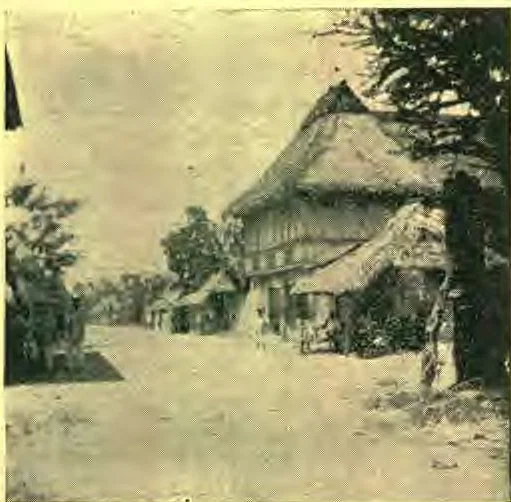
Native Houses in Manila, Mode of Bamboo, Tlatchod Roof. (Photo by Dr. Wood.)
It is astonishing that a lower standard of morals does not exist among the people when we consider the character of their spiritual teachings. It is generally conceded that the Filipino priests are vastly more moral than the Spanish friars, and it is, perhaps, this fact and their inherent superstitions that has prevented the people from abandoning all religion.
With the native, religion is a mere form, and not a spiritual life. The symbols and the observance of religious rites are about all he knows of religion. The friars have been losing their hold on the people. They can not be held much longer in spiritual thralldom.
Of the need of Bible distribution, Mr. Sykes says:—
General Otis, the military and civil governor, said there can not be any doubt of the great need of our work. The Spanish priests are thoroughly hated by the Filipinos, and their hold upon the people is gone. He would welcome the American Bible Society and any other missionary organization, and he would have much pleasure in giving us any help in his power. He thought that our work would probably be discouraging at the start, but there could be no difference of opinion as to this being the church's greatest opportunity in the Philippines.
Admiral Dewey received me most cordially, and spoke enthusiastically about opening mission work. He said he was anxious for the churches and the Bible societies to come in and begin work at once. We could not come too soon.