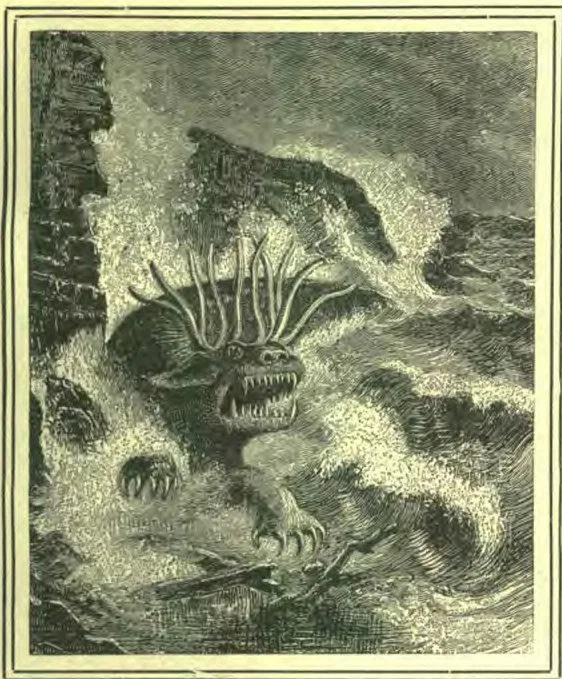
READ again the chapter under consideration. The four beasts are symbols of Babylon, Medo-Persia, Grecia, and Rome. Upon this there is general agreement. Even the notes in the Douay Bible, or common Catholic standard translation, say on verse 3: “Four great beasts; namely, the Chaldean, Persian, Grecian, and Roman empires.”
Each succeeding kingdom of the four possessed territory peculiarly its own. Before Medo-Persia conquered Babylon, these nations had existed in territory peculiarly their own, to the north and east of Babylonia; and Babylonia, as a part of the Medo-Persian empire, continued to exist after her subjection by Medo-Persia. Grecia arose out of territory peculiarly her own to the west of Medo-Persia. When Grecia conquered Persia, that nation continued to occupy territory, then subject to Greece. Rome, the fourth kingdom, arose out of territory peculiarly her own, west of that of Greece; and while all the territory of these preceding empires was subject to her sway, yet as nations and peoples they still continued to exist. So the prophecy declares: “And as for the rest of the beasts, their dominion was taken away; yet a prolonging in life was given them.” Verse 12, R.V., margin.
Of the fourth beast, “dreadful and terrible,” we read that “it had ten horns.” These horns, we are told in verse 24, “are ten kings [or kingdoms] that shall arise” “out of this kingdom” represented by the beast. In other words, they represent divisions of the Roman empire, the part distinctively Roman, the western part. This division is represented in Daniel 2, not by any parts of the image, but by the intermingling of clay with iron. “Whereas thou sawest the feet and toes, part of potters’ clay, and part of iron, the kingdom shall be divided,” and “they shall not cleave one to another, even as iron is not mixed with clay.” Dan. 2:41, 43. We do not wait for the division till we come to the toes; it begins in the feet, and continues till the end. It is not that the toes will not cleave together, but that the divisions of imperialism and democracy will not cleave one to another, even as iron does not mix with clay. In chapter 2, it is declared that the kingdom will be divided, but we are not told the number of parts. In chapter 7, we are distinctly told that the parts finally become9just ten. These ten divisions, if symbolized by the toes, naturally ten, would exist as ten to the very end; but, according to chapter 7, where the horns are specifically said to represent kingdoms, three of these kingdoms are plucked up at least a millennium and a half before the end. And this also clearly shows that the division of the fourth kingdom, as indicated in chapter 2, is symbolized by the intermingling of the iron and the clay, and not by the parts of the image.
The Ten Kingdoms.
These ten divisions we gave last week. We give them again from the “Great Empires of Prophecy,” the author of which admirably summarizes Gibbon’s irrefutable testimony as follows:
“Alemanni, about A.D. 300, in Agri Decumates, from the River Main to Basel, and the Lake of Constance; A.D. 351, take Alsace Lorraine in addition; A.D. 455, extend to the Seine.
“Franks, A.D. 351, northeast Gaul; early in the fifth century spread to the Somme; middle of the fifth century, A.D. 455, to the Seine, and gradually progress till in the sixth century they take all Gaul, north and west of the Moselle and the mountains of the Vosges and the Cevennes.
“Burgundians, Dec. 31, A.D. 406; in Burgundy, A.D. 420; spread over West Switzerland and the whole valley of the Rhone, A.D. 443 to 476.
“Suevi, October 13, A.D. 409 in Spain; A.D. 428 in Galicia in Spain; A.D. 466, held the kingdom of Galicia, and shortly afterward spread to what is now Portugal.
“Vandals, Dec. 31, A.D. 406; in Spain, A.D. 409; in Africa, May, A.D. 429.
“Visigoths, A.D., 408, Italy; in southwest Gaul (Aquitaine), A.D. 419; spread into Spain, A.D., 466.
“Saxons, A.D. 449, Britain.
“Ostrogoths, A.D. 451, under Attila; A.D. 453, in Pannonia; A.D. 489, in Italy.
“Lombards, A.D. 451, under Attila; A.D. 453, in Noricum.
“Heruli, A.D. 451, under Attila; A.D. 475, in Italy.”
The ten divisions of Rome were complete in A.D. 476. They remained ten till A.D. 493. At this very time the prophet, in considering the ten horns, sees coming up “among them another horn, a little one, before which three of the first horns were plucked up by the roots.” Verse 8.
Thirteen Particular Specifications.
What does this little horn symbolize? Read again from chapter 7 the following verses concerning this little horn: Verses 8, 11, 19, 20, 21, 22, 24, 25, 26. Note these particular specifications:
It arose among the ten horns, v. 8.
It was a LITTLE horn at first, v. 8.
In order that it might be established, three of the first horns are plucked up before it, v. 8.
It had eyes like the eyes of a man, v. 8.
It had a mouth which uttered not the meaningless noise of a beast, but great boastings, such as could be uttered only by a being above a beast, vs. 8, 11, 25.
It was a different horn in character from those around it, v. 24.
It became strong, so that its look was more stout than its fellows, v. 20.
It made war upon the saints, or people of God, v. 21.
It was to prevail against them till the Lord should come and take judgment to Himself, vs. 21, 22.
It should presume, or think, to change “the times and the law” of God, v. 25, R.V.
It should continue for “a time and times and half a time,” or three and one-half years, v. 25, R.V.
It would lose its temporal dominion as a horn, v. 26.
Its greatest words come in the very closing part of its career.
Here are thirteen definite, specific characteristics given of the power symbolized by this little horn. In the very nature of the case it would be a certain impossibility to find even two powers to which these specifications apply. But the prophecy tells us that this little-horn kingdom is diverse from those among which it arose. These specifications reveal wherein it is diverse. Two or three might apply to several powers of earth; but it is an utter impossibility to find more than one to which they all apply. Thus specific is God in His “sure word of prophecy.”
Let us ask the reader in this study to divest himself of all prejudice and receive just what the word says. In its application to us, the only application which can be made, it does not deal with persons, but with systems. It is the evil system and its consequences against which God warns us. It is submission to an evil system based on evil principles which makes the most conscientious man do evil. It is to warn all, within the system and without, that God gives us this Gospel of Daniel 7. Let us examine the specifications, or earmarks, of this power.
"A fourth beast, dreadful and terrible. . . . and it had ten horns. . . . And the ten horns . . . are ten kings that shall arise."
1. The little horn arose among ten horns. What power differing in character from the civil divisions of Rome rose to a position of prominence in Western Rome in the fourth century? There was but one—the Papacy, centering in the bishop’s See at Rome. Primarily there was no preeminence of one bishop over another in the early church. “One is your Master, even Christ, and all ye are brethren,” were the words of our Lord. But at an early date the bishops of Rome began to put forth great claims for the See at Rome. Rome being the political capital of the empire, and the church becoming more or less political, it was demanded that the bishops of Rome should have the preeminence. This was the horn that the prophet saw coming up among the ten. No one will dispute the fact.
2. It was a little power at first, in the eyes of man. It did not look as if it would amount to any great thing. Other bishops were as great and learned. Its claim to authority was not thought to be serious. Other bishops considered their own sees as important and as influential as Rome. In its organized form the Papacy was at first a little power.
3. Three horns were plucked up before this little horn. In the midst of the great controversy between Arianism and Trinitarianism the Papacy arose. In brief, the bishop of Rome stood on the Trinitarian side of the controversy, waging relentless war against Arius and his followers. In the finality of the conflict, three of the ten kingdoms—the Heruli, the Vandals, the Ostrogoths—opposed the rising power of the Papacy and its coalition with the state. The last of the ten kingdoms was established in A.D. 476; the first of the three, the Vandals, was “plucked up” in March, A.D. 493; the last of them, the Ostrogoths, was overthrown in March, A.D. 538. In 533, by acknowledgment and decree of Justinian, the bishop of Rome became “head over all the holy churches,” and “true and only corrector of heretics.” This decree reached its culmination when the last opposing power in Rome was overthrown.
4. The little horn of the beast had “eyes like the eyes of a man.” It would be a strange thing to see a horn with eyes at all. But if eyes were given it, they would naturally10be the eyes of the beast whose horn it was. But this horn of a beast had eyes, not of a beast, seeing only what is near, but the eyes of a man,—far-sighted eyes, that see the future—indicative of the mind behind that thinks, and plans, and schemes.
How true is this of the Papacy as compared with the kingdoms of earth! Like blind beasts, they have seen only what is present and near. They have planned for the present. They have lived for the present. Present power, present glory, present prestige, have been the rule, and the future is often sacrificed for the present. Not so the Papacy. She has planned for generations ahead. Pain, toil, sacrifice, have been taught her children that she might enlarge, expand, and be established. Thus has her diplomacy been more than a match for all Europe.
[The rest of these specifications will be considered next week. Study these and them. They are important.]