GREETINGS of the season to all our readers! With them we rejoice in the great event around which many of the pleasant greetings and glad gatherings cluster in God's great gift of the Christ-child.
BUT this gladness and rejoicing is, in the light of that long-ago star, a matter for every day. For "the Word was made flesh" not for one day in the year, but for every day. We would not, dear friends, say one word to take from the joy of any truly happy season; and the truth never does this if received as truth; for in the knowledge of living truth is always joy. With this thought let us study earnestly the important question.
WHAT does the birth of the Christ-child mean? Of what value is His birth to us? Why should we celebrate His birth more than that of many other children? Listen to the words of retribution spoken to the adversary in Eden, to the people of God a promise and a prophecy of the ages: "I will put enmity between thee and the woman, and between thy seed and her Seed; He shall bruise thy head, and thou shalt bruise His heel." Gen. 3:15. When Adam and Eve yielded to that adversary in Eden, sin became incarnated—infleshed. Sin was dominant in the flesh, subject to the will of the devil. The promise was that there should come into the flesh of an offspring of the woman a seed from above the human, which would lift man from the domination of the devil, and bruise the head of the enslaver and oppressor. And from the day that Mother Eve in the joy of her fearfully disappointing first-born said, "I have gotten the God-man" (so rendered by some), till the day of the angels' song over the hills of Bethlehem, the world was waiting for the promised Seed, the Desire of all nations.
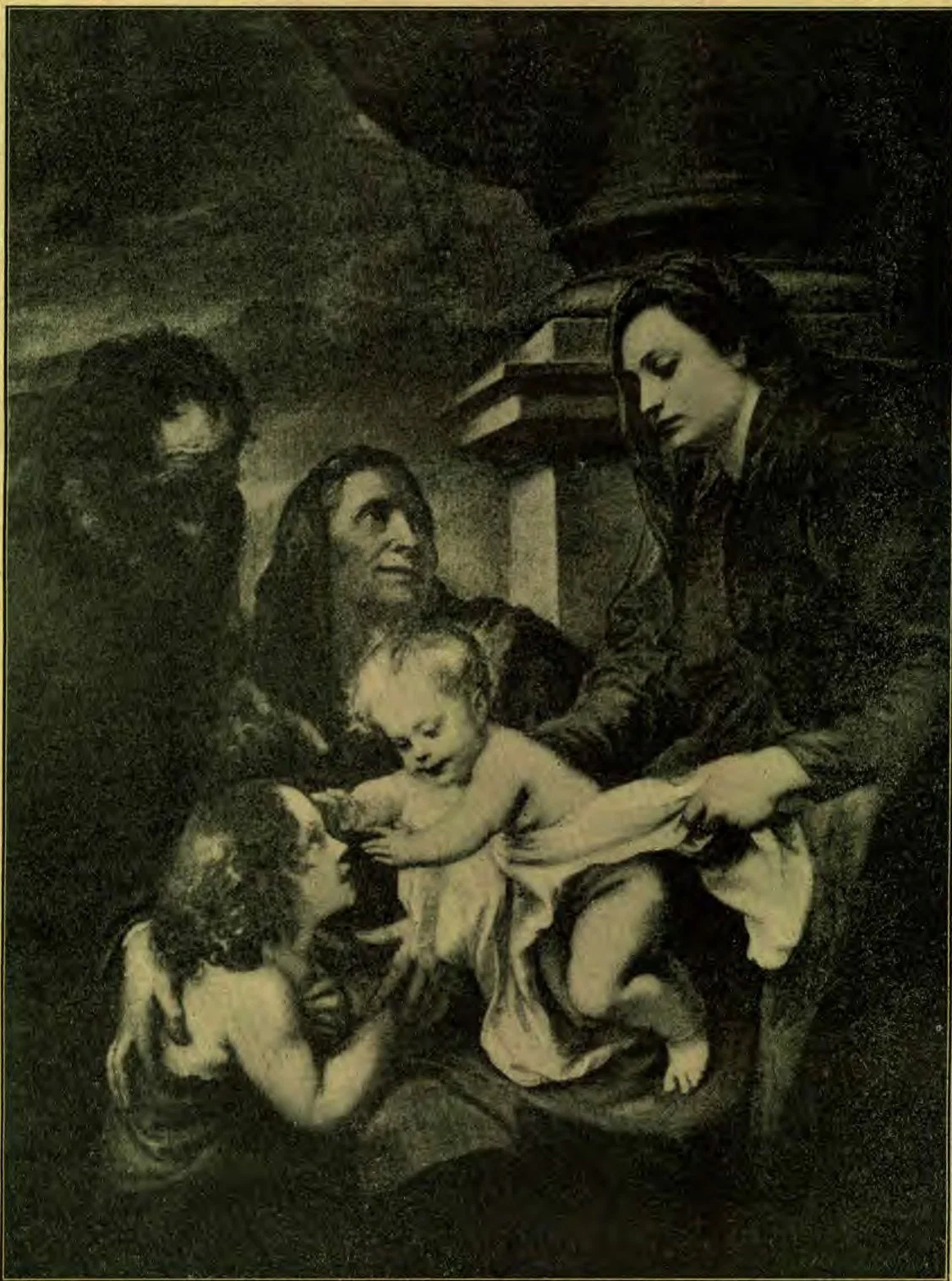
The Infants Jesus and John the Baptist, and Joseph, Mary, and Elizabeth.
IN all the intervening ages men had known God, had known His power to save, but the world had not seen "the Perfect Man." God in His fulness of character had not yet been manifest in the flesh. "But when the fulness of the time came, God sent forth His Son, born of a woman, born under the law, that He might redeem them that were under the law, that we might receive the adoption of sons." Gal. 4:4, 5. "And the Word became flesh, and dwelt among us (and we beheld His glory, glory as of the Only-begotten from the Father), full of grace and truth." John 1:14. "For it was the good pleasure of the Father that in Him should all the fulness dwell." Col. 1:19. "For of His fulness we all received, and grace for grace."
THE Son of God came into the flesh of Jesus of Nazareth—was made flesh—that through our faith He might come into our flesh; that by faith we might live His life. He did not come, that once a week, or once a month, or once a year, we might partake of a wafer, blessed by a man, and call it the "Real Presence" or the flesh of the Son of God, but that Jesus Christ by His Spirit might come into the flesh of every believer, and live His own life again in each believing soul. For thus it is written: "Every spirit that confesseth that Jesus Christ is come in the flesh is of God." Whose flesh?—"Greater is He that is in you than he that is in the world." 1 John 4:2, 4. To this also the apostle Paul bears witness: "I have been crucified with Christ; and it is no longer I that live, but Christ liveth in me; and that life which I now live in the flesh I live in faith, the faith which is in the Son of God, who loved me, and gave Himself up for me." Gal. 2:20.
THIS, dear reader, is what the birth of Jesus the Christ ought to mean to us—a present Saviour, Christ in us, with us, our4life, our power, our hope, every day, every hour, every moment, the Real Presence of Christ. How it degrades such a gift, such an abiding life, to connect it with the old heathen Saturnalia of December 25, with its feasting and drunkenness and reveling and gifts; or to link it with the old licentious Norse idolatries of the Yule log and holly wreath and human sacrifice. They are all human and heathen, and O, how they utterly mar the object, meaning, and power of the gift of the Christ-child.
WHENEVER Jesus was born, it was not in the cold of midwinter; for not at that season were the shepherds keeping their flocks in the open field at night. The time was probably in the autumn days. Whenever it was, God has not revealed it, because He did not wish an event which is of equal value and significance every day, to be confined to one day in the year, a day already dedicated to one of the maddest, most licentious feasts of all heathenism.
If we feel that we must observe the day, do not as the heathen do. Let it not be a day of mere sense enjoyment. Would you bestow gifts? Let them be gifts of usefulness and service; let them be gifts to the little child, the needy, the widow, the orphan, the ill, the infirm, the helpless, the heathen, the great, always needy, cause of Christ. Give and give liberally to these needs, and know that the Christ-child and God-man dwells with you.