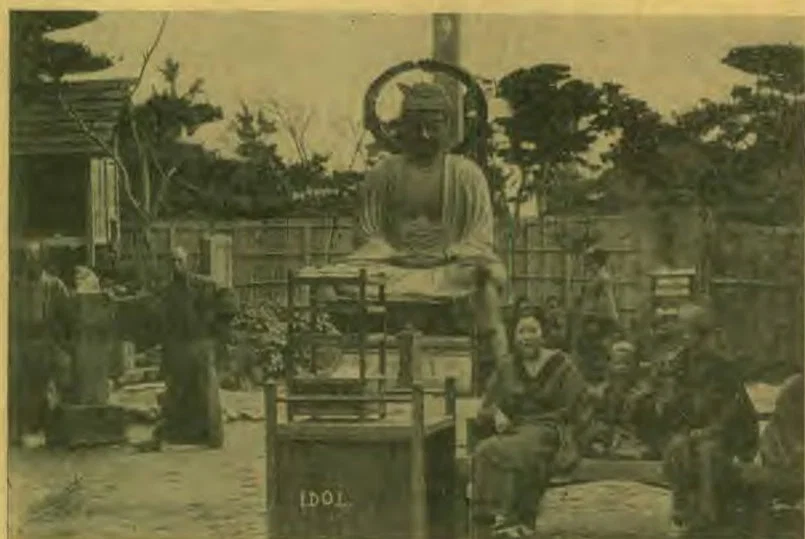
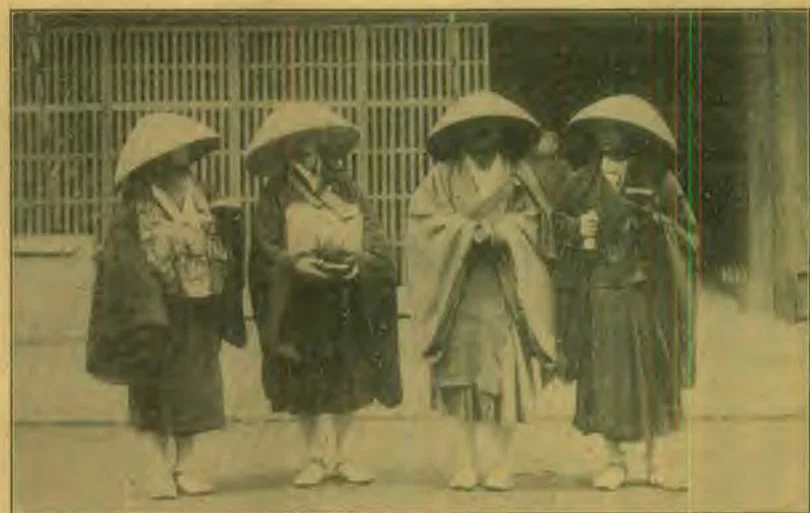
IN attempting to explain the religious situation in the Orient in a way that will be intelligible to Western minds, it is first necessary to make a number of preliminary observations. In the Occident, a person professes some definite faith to the exclusion of all others, or else makes no profession of religion. But in the Orient it is different. It is not at all inconsistent to the oriental mind that a person should be an adherent of several religions at the same time. For example, a Japanese might adhere to the moral teachings of Confucius, believe the Shinto myths concerning the origin of the Japanese nation and of the world, worship at the Shinto temples where the heroes of the past are enshrined, and at the same time be a devout Buddhist.
This condition of things is confusing to the Western observer, and makes it difficult to form definite ideas and conclusions concerning the religious conceptions of the people. But it explains the widely varying statistics claiming to give the number of adherents of these oriental religions. For example, while the great majority of Japanese might truthfully be counted as adherents of Shintoism, they might with equal truth be set down in the Buddhist and Confucian columns. But among the adherents of these religions, no attempt at statistics is made. Not only this, but no list of membership is kept. In fact, there is no ceremony or election by which members are initiated. People do not "join" these religions as Christians join a church. They are educated and trained in the way of their fathers and in the customs of the community. Superstition and custom are strong ties that hold the adherents of a heathen religion.
Different Modes of Worship.
And this brings us to consider the marked difference between Eastern and Western ways of worship. Christians have churches where they assemble at regular times for religious services. In the East there are temples; but these are very different from churches. Instead of being opened only occasionally, they are open every day; and the priests in charge are in constant attendance. Nor does the contrast end here; for the people, instead of assembling in congregations, worship privately. So the visitor to such a temple on any day and at any time of day, would see the people coming to pay their devotions. They seldom enter the temple, but stand at the entrance, throw a coin into the big money box, clap their hands or ring a bell to call the attention of the deity, bow the head a few moments in prayer, and then go about their other business. It might be added that some Buddhist priests gather the people together for instruction at their temples, but this is a modern practise, borrowed, some say, from Christians.
Of course there are festival days, when the people visit the temples in throngs. But even then they come and go, instead of assembling as a congregation. Besides this worship at the temples, nearly every house has one or more household shrines, where the family ancestors and favorite deities are worshiped.
Confucianism.
Turning our attention now to the principal religious systems of Japan, let us first consider the status of Confucianism. A well-known Japanese writer has this to say: "Confucianism is never looked upon in the far East, at all events not in Japan, as a religion. Confucius and his famous followers are no more regarded as the founders or promulgators of a religion than are Socrates, Plato, or Aristotle so esteemed in the West. Confucian precepts of morality pervade every branch of our culture, it is true. But Confucianism is with us cultivated as tending toward elevation of intelligence and of ethical notions, never as a religion. This being the case, both Shintoism and Buddhism are very good friends with Confucianism. As a matter of fact, both Buddhism and Shintoism rely upon Confucianism, to a great extent, so far as practical ethical teachings are concerned."
Shintoism—Ancestral Worship.
As to Shintoism, it also can hardly be regarded as a religion, and was not so regarded till within a few decades. It has been described as having no particular dogma, but vague notions of the future world, yet a firm belief in the immortality of the soul. To quote again from the author mentioned above: "Shintoism is essentially a creed founded upon reverence for ancestors, conjointly with a love of the fatherland, and likewise of the exalted personage, who mirrors the best traditions of our common ancestors and exercises the wisest control over our land; hence loyalty and patriotism are the most important features of the creed, as regards its outward manifestations." Shintoism is the primitive cult of the Japanese, and supplied the place of a religion till the introduction of Buddhism.
Buddhism.
It will be seen from what has already been said that Buddhism in Japan has been considerably modified by contact with Shintoism and Confucianism. There are numerous sects, each with its peculiar philosophical teachings. But with these theories the common people are little concerned. "In Buddhism, as reflected to them, there is an eternal soul in every individual. There are paradise and hell. All this is much in accord with the religions of the Occident." To be sure, the idea of a future life, with its rewards and punishments, lies at the foundation of all religion. But what a hollow mockery these man-made religions are to the sin-sick soul. Yet into this confusing mixture of philosophy, ancestor worship, polytheism, and demonology, the light of divine truth has shone.
Christian Missionaries and Persecution.
The first Christian missionaries to Japan were Portuguese Jesuit priests, who landed at Kagoshima, in the southern part of the country, in 1545. This was the beginning of a very successful propaganda, and the believers in the Roman Catholic faith were13soon numbered by thousands, and included some of the leading men of the times. Christianity seems to have been favored by Nobunaga. In 1585, certain Spanish Franciscan monks arrived in the country. Three years after this Hideyoshi issued his first decree against the missionaries, but it was not enforced. In 1595, by order of the same ruler, six Franciscans and three Jesuits were burned at Nagasaki. Tokugawa Ieyasu was as much opposed to Christianity as his predecessor. He issued a decree of expulsion against the missionaries in 1600, but this was not carried out till 1614. By this time the number of adherents is said to have been two millions, while the missionaries numbered two hundred. The persecution that attended the execution of the Shogun's decree continued for years, and reached its culmination in 1637, when thirty thousand Christians were massacred at Shimabara.
From this time the name of Christian was held in execration by the Japanese, and severe laws against Christianity existed till a few decades ago, even during the early years of the present emperor's reign. But through the influence of America and other foreign countries, these old laws were either repealed or not enforced, and the country became once more open to missionary effort.
The History of Christian Missions in Japan
since this time forms a story of thrilling interest, but can only be touched upon here. Roman Catholics, the Greek or Russian Church, and the various denominations of Protestants, are well represented. At present the foreign missionaries in the country number nearly eight hundred, and the number of native pastors is about twelve hundred. The total number of communicants of all creeds is probably upwards of one hundred thousand. This is but a small percentage of the population, but they exert an influence in the country far out of proportion to their numbers.
The efforts of Christian missionaries have extended throughout the length and breadth of the country, but have been made especially in the cities and larger towns. It is said that only thirty per cent. of the Japanese live in cities and towns, while the remaining seventy per cent. are reckoned as forming the rural population. Among these there is still a great work to be done in carrying the Gospel message.
Preparation for a Closing Work.
The Lord has prepared the nations of the earth to receive the last closing message of the Gospel. As an example of this, the history of Japan for the past fifty years is full of meaning. Half a century ago the country was fast closed to all missionary effort, as well as to all commercial intercourse. But what a change these few years have wrought! The country enjoys the freest intercourse with the rest of the world. Facilities for travel have been wonderfully increased. All restrictions to the preaching of the Gospel have been removed, and a great work has already been done toward the evangelization of the people. The Bible is being widely circulated throughout the country.
Contact with western ideas is shaking the faith of many in the old creeds. Educators are beginning to realize that intellectual training alone will not suffice, and are casting about for a system of moral training that will meet the needs of the rising generation. All these conditions furnish the grand opportunity for proclaiming the everlasting Gospel with a power that will send it ringing from chilly Hokkaido to the sun-lit islands of the Inland Sea, while its echoes are heard in lonely Karafuto, the scattered Loo Choos, and far Formosa. It is a great work; but the Lord has given His word to finish it in this generation. So, grasping His promise, and relying upon His power and guidance, we go forward.