OUR EUROPEAN LETTER

3%

OUR EUROPEAN LETTER.

FRANCE AND SPAIN.

French Government and the Catholics.

ON the eleventh of December, the 36,000 parishes of the Catholic Church in France will lose 40,000 church buildings, cathedrals, and chapels. Such is the positive and final decision of Pius X.
My last letter ended with the alarm and amazement of hundreds of intelligent Catholics, as expressed in a letter to the pope himself, in which they ask for some good reasons for his strange attitude.
This radical policy on the part of the pope does not seem to be fully appreciated even among the cardinals. Says a Catholic writer in a correspondence from Rome:
"There is a profound dissatisfaction among the old cardinals regarding the direction given to pontifical politics; especially in those questions which concern France, the pope seems to them to betray a complete ignorance of the situation. They now recognize the mistake they have made in raising to the pontificate a cardinal with whose ideas they were not fully acquainted, and upon whose diplomatic ability they were more or less mistaken." The same writer adds that another cause of discontent is the fact that the older cardinals have very little to say in the Vatican, where the leading influence belongs to two cardinals, one of whom is the young Spanish secretary of state, Merry del Val.

Civil War or Surrender.

What is the pope's plan? For a plan he must have in taking the dangerous step that he has, despite the misgivings of many bishops and cardinals. The scheme is unveiled by one of the leaders of the clerical party in France, Count Albert de Mun. Here are his words in the Catholic paper La Croix:
"Since there are no church associations, the 40,000 churches of France will have to be closed. Yes, that is the law. "But who will dare, who will be able to close them, if the Catholics are not willing? Who will dare, who will be able to drive them out if they have resolved to remain? "This is the question before France. The story of the inventories may suggest the answer. The 'flock' is on the lookout; the wolves can not take it by surprise. I do not believe that it will allow the churches to be closed."
In short, the plan of the pope and of the French clericals is to compel the government to enter violently into 40,000 churches to drive out the worshippers. The French Government is thus brought to face the following dilemma: Civil war or surrender. If it surrenders, well. The church will have gained the day in its determined struggle with its enemies. But if the government plunges headlong into those 40,000 conflicts with fanaticism, it is hoped that the confusion, blows, and bloodshed which will result, will so disgust the country against the liberal parties that it will vomit them out and give the power to the clericals and, possibly, to the monarchy.
After the second council of the French Episcopate, one of the bishops confessed to a Catholic writer, M. de Narfon, his regret at the decision taken, and his deep concern at the prospects before the country and the church. He said:
"We have voted the civil war with raised hands. We have voted like so many officers of Nicholas II. I signed like the rest, or, rather, I shall sign to-morrow with the rest, but with tears in my eyes and death in my soul. . . . It will be war, since we enter into open rebellion with the law. It will be war, unless the government gives up the idea of enforcing the law. . . . The decisions of the council mean not only war, but to us ruin, the loss of faith on the part of a great many souls, and France wiped out from the map of the world as a Catholic nation."

How the Monarchists and Anti-Clericals Feel.

While the bishops, in a circular letter to their flocks, say: "We will still hope that civil war will be spared to our country," the fanatical, monarchial papers are exulting at the prospect. Says The Libre Parole:
"Now has come the time for French Catholics to do their duty. They see what a degree of humiliation they have reached by yielding all the time and not resisting on time. The awakening will take place. On the day when the sacred asylum of conscience of all will be invaded, the sectarians will find themselves facing unexpected resistance. The inventories are there to show that there are still beings capable of denying themselves and of dying for a faith which was the faith of France for fourteen hundred years."
The anti-clerical papers are more violent and rabid still. So La Lanterne:
"In principle it's war! "Republicans and free-thinkers, let us hope that it will soon exist as a fact. "Rome defies us; Rome threatens us; not in vain will she have thrown the gauntlet. "Since the abject band of impostors and pick-pockets, which still levies the tribute of lie upon the fools of the two worlds, dares, through its foreign chief, to defy the French Republic, let the punishment follow the insult quickly, and let it be severe and final."

A New Party.

But now, while extreme parties are preparing for the worst, a new party is entering into line. Its name is the 'French Catholic League.' Its object is to secure the church buildings by organizing the very associations provided for by the law and forbidden by the pope. Of course, the bishops are denouncing the league and excommunicating those organizing or entering into church associations. Some twenty of them have already been organized. At the head of the league stands a brilliant journalist, Henri des Haux, who was formerly editor-in-chief of the leading French organ of the Vatican at Rome. He is boldly denouncing the pride and grandeur of the Papacy as being contrary to the Gospel of Jesus. Other voices are being heard now, even from profane lips, calling for a purer religion. May God help His children in France to answer these calls!

Spain and the Vatican.

Has somebody been praying for Spain? At any rate, the handful of news which comes from the country of Torquemada and Loyola is very interesting. Only two years ago, as I had occasion to relate in one of my letters, an agreement, a convenis, was passed between the Spanish Senate and the pope. This agreement was for the purpose of tightening the grasp of the Papacy over this gentil nation. And now we see the government of young Alfonso XIII. marching toward liberty with astounding strides.
First comes a royal edict wrestling the marriage institution from the despotic control of Rome. Next comes the intention of the government denouncing the convenio of 1904. Thirdly, a bill restricting the power of the monks. Fourthly, the expressed intention to repeal the Spanish Concordat with the pope, signed in 1851.
The bishop of Tuy and the archbishop of Valence could not refrain from giving vent to their indignation at the establishment of civil marriage, which they termed undecorous. But the government took up the matter so promptly and so seriously, that the good bishops had to make proper amends.

Dealing with the Orders.

There are now in Spain over 50,000 monks. The proposed law is said to declare unlawful all monastical orders which by perpetual vows abandon such rights and liberties as are granted to every citizen by the Constitution. All civil and judicial authorities will have the right of entering into convents without asking the permission of the directors of these establishments. Many orders will be dissolved; none will be allowed to teach; all orders devoted to commerce or industry will have to pay taxes; and the salaries of some high church dignitaries, like the archbishop of Toledo, who gets 45,000 francs a year, will probably be reduced.
To any one who knows something of the history of Spain and its present condition under the crushing rule of Romanism, this is indeed a sign of the times. God's mills grind slowly, but surely. Now at last has Spain's turn come also when she may have another opportunity to think and act according to the dictates of her own conscience! For this hope and prospect let us pray, and thank the Giver of every good and perfect gift!
JEAN VUILLEUMIER.
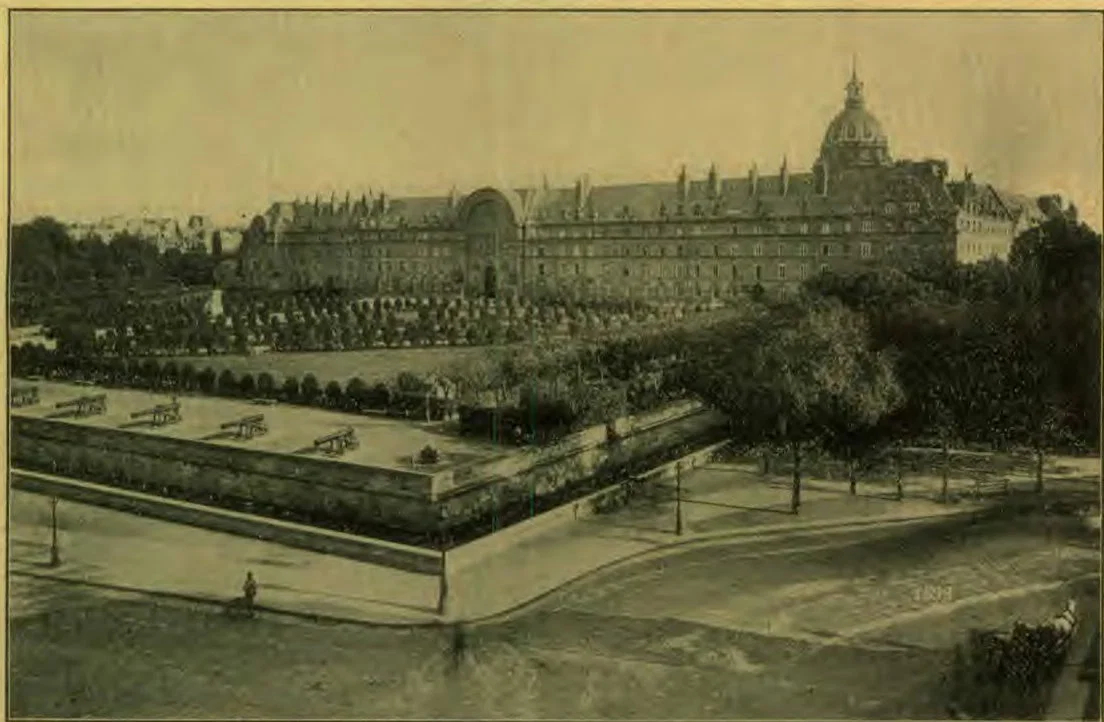
The Hotel of the Invalides, Paris, really an old veteran's home, in which are exhibited many of the trophies which French military prowess have won, and in the rear of which is the tomb of Napoleon.