THERE is one strike that laboring men could make that would be of great gain to themselves and also to their employers. It is safe to say that if a general strike against the use of alcohol and tobacco had been made fifty years ago, very few, if any, of the great strikes since that time would have occurred. It has been demonstrated many times that employers do appreciate steadiness and sobriety in employees—and are willing to pay for it.
But the fraudulent union principle insists that the unreliable, unsteady, or incompetent man—if he belong to a union—must have the same wage for the same hours that is paid to the reliable, competent employee. The amount of work that the slowest man can do is made the standard, and however great the better man's desire to do more work in a given time, he must not do it. He is compelled to rate himself with the incompetent.
Competency never was a condition of unionism, practically, and now that the unions have avowedly gone into politics, the party will not reject any voters no matter how incompetent or unreliable they may be as workmen. The union is the resort of incompetency and unreliability, because, no matter how unsteady the man, he knows he has the union behind him; and if the unions have a political campaign on hand, he knows that they want his vote.
All the strikes that ever have occurred have occasioned loss generally to both employers and employed, but nearly always to the employed. Every advantage that they have gained costs no small amount to maintain. But if all would unionize and strike against these twin evils, alcohol and tobacco, instead of endeavoring to keep their fellow men out of employment, they would be so much more competent that employers would have more inducement to keep them employed and to pay them good wages. If there is one thing above another that the average employer appreciates, it is punctuality and clear heads on Monday morning.
Then how much farther a week's wages will go if spent for food, clothing, and other home comforts—and charity; not compulsory dues, but charity. G.
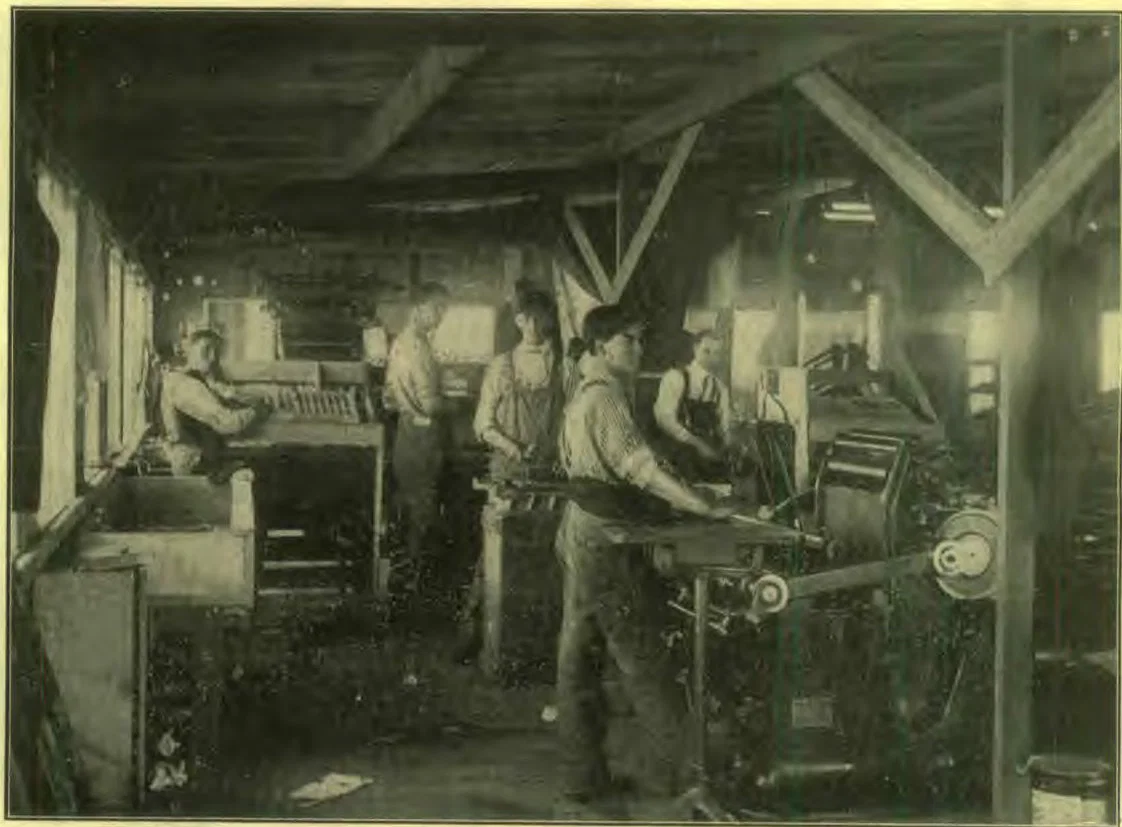
A Corner of Our Present Temporary Office.
HUMAN NATURE.
IMMEDIATELY after the great fire in San Francisco, the disposition on the part of landlords, merchants, and others to raise prices was summarily curbed by the mayors of the city and of Oakland. Those who raised prices on commodities had their places seized and placed in the hands of receivers. Of course such a recourse could not last long, because the process had only the authority of might behind it. There was nothing that would legitimately raise prices; the only reason was that men could take advantage of other's needs, and because they could get more they took occasion to do so.
So almost every line of staples has raised in price. Because of the demand, everything in the line of building material has been raised excessively; note it was not because of increased cost of production in outside markets, or because of increased freight rates, but because of the innate human desire to take advantage of public necessity. There seems to be a combination of the spirit of trustism, associationism, and unionism; the raiser in one line giving the excuses for advances in others, without other necessity for advance in either.
The greed inherent in human nature is at the bottom of it all—a greed that seems to fatten and grow even in the face of misfortune and suffering. It knows no sympathy, no charity. Even the donations of sympathetic people from abroad have been exploited to feed the appetite of the greed that is rampant in these last days. Some people have been making a text of the large donations from the country at large to preach the doctrine that "the world is growing better," but the conditions that prevail in and around the stricken city but emphasize the ever-increasing selfishness of human nature.
3And to add to the evidence of this condition, we have the disposition of insurance companies (mostly Eastern or European corporations) to evade the payment of losses. Then because merchants are retarded in re-opening their stores, it is reported that wealthy merchants in Eastern cities are taking advantage of the situation to occupy the field. Such is the spirit of this sin-cursed world. Is there not every inducement to seek an eternal habitation "wherein dwelleth righteousness." This is man's greatest opportunity. G.