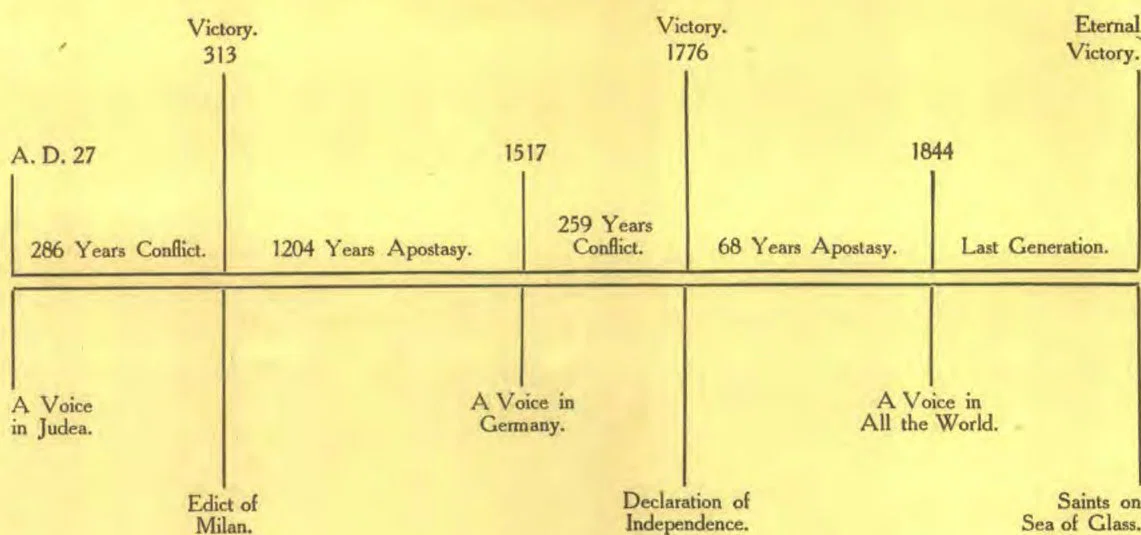
THE above diagram represents some of the striking parallels of history, in the battle that has been waged between truth and error, between light and darkness, between liberty and bondage, since "liberty to the captives" was proclaimed by the greatest of all the reformers that the world has ever known.
When Christ began His ministry in this world, the shackles of an earthly despotism were bound so firmly upon mankind that no man dared to assert his God-given liberty of conscience. The world at that time was "one vast Roman prison," from which death was the only means of escape. The condition of the world at that time is forcibly expressed by Mr. Bancroft, who says:
"No one thought of vindicating religion for the conscience of the individual, till a voice in Judea, breaking day for the greatest epoch in the life of humanity, by establishing a pure, spiritual, and universal religion of mankind, enjoined to render to Cæsar only that which is Cæsar's."
There was begun at that time a mighty contest between the forces of light and darkness. On the one side there was all the wealth, education, influence, and power of the mightiest empire ever built by human hands, and backed up by the unseen hosts of the Prince of darkness. Against all this confederacy of the powers of darkness there was uplifted one human voice.
It has been said of truth, that "you may put handcuffs upon it, shackle it, bind it down to the cold prison floor, behind iron bars, and surrounded by massive stone walls; it is truth all the same, and is on the road to victory. But put error upon a throne, with a crown upon its head, a scepter in its hand, and worshipping millions at its feet, and it is error still, and on the road to defeat."
From the time when that voice was first heard in Judea, proclaiming liberty to the captives, there followed a contest between liberty and bondage, which lasted for two hundred and eighty-six years, when victory was proclaimed to all men, in the Edict of Milan. That was a declaration of human rights, giving to every man in the world the right to think and act for himself in the realm of conscience.
But that noble victory won by truth, was, by scheming religio-political priests and bishops, turned into a worse despotism than ever existed under Pagan Rome, and there followed a thousand years of the "midnight of the world's history."
Twelve hundred and four years after the Edict of Milan, the midnight of the Dark Ages was broken by a voice in Germany, heralding day for another grand epoch in the life of humanity. The sound of Luther's hammer, as he nailed up his ninety-five propositions against Rome, on the church doors at Wittenberg, was a signal for another battle which raged for two hundred and fifty-nine years, when liberty was again proclaimed to all the world, in the grandest charter of human rights the world had ever heard—the Declaration of the Independence of the United States. That declaration of principles was the crowning event in that grand reformation begun by Martin Luther and his associates. John W. Draper, in his "History of European Morals," recognizes this fact in the following statement:
The history of the Reformation does not close, as many European authors have supposed, in a balanced and final distribution between the Protestants and Catholics. . . . Macaulay and others who have treated of the Reformation, have taken too limited a view of it, supposing this to have been its point of arrest. It made another and enormous stride, when, at the American Revolution, the state and church were solemnly and openly dissevered from one another.
How gladly would we speak of the glorious fruits of such a victory; but alas, it was no sooner won than scheming religio-political priests began to use, for their own aggrandizement, the liberty for which millions had bled and died, thus turning back the sun-dial of religious freedom.
The hasty retreat toward the Dark Ages that is now taking place, calls for another voice to be lifted against the principles of religious intolerance and spiritual bondage. The message due the world at this time has been foretold in the prophetic Word, as a proclamation to go to "every nation, and kindred, and tongue, and people." Such a message, bearing on its front, the "commandments of God, and the faith of Jesus," is now being sounded in the ears of humanity. This message has now encircled the globe, and in every country in the world there are living witnesses of its saving, sanctifying power—a people who are designated as those who "keep the commandments of God and the faith of Jesus." This message is found in the fourteenth chapter of the Revelation, and is there designated the "Third Angel's Message."
D'Aubigne, in the preface to his "History of the Reformation," says: "Christianity and the Reformation are the two greatest revolutions on record." He then restates the matter thus: "Christianity and the Reformation are the same revolution, effected at different times, and under different circumstances. The one is a repetition of the other; the middle ages lie between."
5The whole history of the contest between truth and error, since the time of Christ, might thus be summed up as one great three-fold reformation. Christianity, the Reformation of the 16th century, and the Third Angel's Message, are the three mightiest revolutions on record. We may restate the case thus: Christianity, the Reformation, and the Third Angel's Message are the same great revolution effected at different times, and under different circumstances.
The last great decisive battle between bondage and liberty is now being waged. This conflict is destined to end in eternal and everlasting victory, with the victors—the saints of God—standing upon a sea of glass, having harps of victory, and singing the song of Moses and the song of the Lamb. Rev. 15:2, 3.
"Nay, now, these things that you yearn to teach,
Bear wisdom in your judgment, rich and strong.*
Give voice to them, tho no man hear your speech,*
Since right is right, tho all the world go wrong.*
The proof that you believe what you declare,*
Is that you still stand firm, tho throngs pass by;*