I WAS greatly surprised, in coming up into this country, to learn of the number of missions there are here, and how closely they are packed together in some sections. There are four mission stations about Blantyre and the farthest from the town is not more than five miles. At Cholo there are two missions and these are about four miles apart. Then going northward from Blantyre there are missions scattered all along the way to Lake Nyassa and these are only twenty or twenty-five miles apart. Then to the north and to the west the whole country is now under the supervision of various missions. Mission societies that are looking for a place to plant new missions are finding it very difficult to get a location. The missions already established have educated natives who are teaching village schools all through the country.
Many of the missions in this country are industrial missions, and this, to some degree, accounts for their being so close together in some sections. They were not started with the idea of doing any great amount of work with natives living near, but with the hope of getting natives from a distance to come and work at the missions and thus bring them under the influence of Christianity. In this way they are able to draw hundreds of natives from the Portuguese territory where, at present, the country is closed to Protestant missions. Strange to say, the Roman Catholics are doing but little in the Portuguese sections, where they have the whole country to themselves; and, at the same time, they are very active in British territory where they have large sections allotted to them for their field of operation.
The chief industries in which these missions are engaged is that of growing maize, coffee, cotton, chillies, and some are starting to grow the rubber tree. At Blantyre there is one mission which has over two hundred boys in its boarding school, and these are being taught various trades such as carpentry, cabinet making, printing, tailoring, gardening, etc.
The Zambesi industrial missions are doing a great amount of work growing coffee, cotton, and maize. At Mitsidi they have a flouring mill, saw mill, cotton gin, and press in connection with other industries. In this way hundreds of men were employed to do the work at the stations and are brought under the influence of the Gospel. The Nyassa industrial missions are doing a similar work.
Many of the readers of the SIGNS would consider it a very hard undertaking to cultivate hundreds of acres and get the produce to the river, which is from a few to many miles from these missions, without teams with which to do the work. But this is done up here. The native is the one who does the work of digging the land and tilling it; and, with few exceptions, he is the one that carries the tons and tons of maize, coffee, and cotton to the river where it is shipped to the coast in barges. There are some roads that can be traveled with teams and a few people have availed themselves of oxen and are doing some of this work with them. I saw a load of three and one-half tons on a wagon which had been hauled from the river, but not with oxen, one hundred and fifty natives drew this load up the long hill from the river.
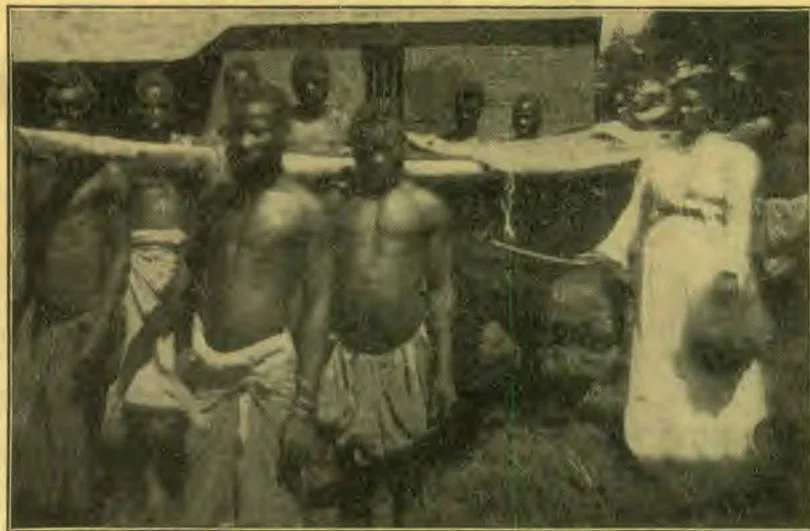
Truly the native is the burden bearer of the country. He not only digs and cultivates the soil and bears the loads of produce, but he is the one who does the work in building the railroad that is coming up into the country. With his basket he makes the road-bed and prepares the way for the iron horse that will relieve him of some of his burdens. The traveler who desires to make a trip into the country or to go from one place to another, secures a few carriers, called tenga tenga men, who carry his belongings, and a machila team of twelve or sixteen boys who will carry him from twenty-five to fifty miles per day. On these trips the native has a little maize which he roasts over the fire and this he eats and is quite happy and contented if he is treated at all right.
The native on the machila reminds me of some mustang ponies I have seen. The latter will stand about and act as if they did not have life enough to do anything, but, the moment the saddle is put on their back, their heads are up and it takes a good man to mount and ride them. Just so with the native. He does not show signs of much activity till you get into the machila and then he is off on a trot and the whole team are shouting, one or more shouting something and the others answering him. If you get out of the machila to walk, feeling to have compassion on the boys, then everything is quiet and you have to urge them to keep up with you, but the moment you are again in the machila they are full of life and off on a fast swinging walk or a trot, singing, and happy as larks.
Miss Mabel Branch with a Machila Team.
Along the Shire River which flows into the Zambesi, the country is less than one hundred feet above the sea, while at Cholo and Blantyre the country is over three thousand feet above the sea. Altho this is a good altitude there is considerable fever in the country and missionaries expect to have a furlough every three years that they may retain their health. It is not uncommon for persons to contract the fever in coming up the river and occasionally deaths are reported within a few days. Not long ago a missionary was taking his wife up into the country to a station. She was taken with the fever and died before she arrived.
It was up in this country where Dr. Livingstone did his last work, and died some distance to the northwest. Mrs. Livingstone was on her way down the river trying to get out of the country when she was taken ill and stopped at the Shupanga Mission and there died. It was indeed a privilege to stand by the side of the grave of such a noble woman and devoted Christian. It seems to breathe an inspiration into the heart to be willing to spend and be spent in the cause of the Master in trying to save poor, degraded humanity. Thus it is that when one falls there are many others ready to lift the banner and bear it forward to victory.
Through the work of devoted missionaries there are thousands and thousands of the natives who have heard the ringing sound of the Gospel, and today there is a good sized army of native Christians who are engaged in working for their fellow-men.
The missions who have young men in training send them out weekly to hold services in the native villages about them, and in this way the young men are trained for the work, and the native hears the Word of God. Surely the Lord has paved the way for the last message, "Prepare to meet thy God" to go with great power. Railroads are penetrating the country almost everywhere, and the Word of God is being carried into the darkest parts of Africa. It is marvelous in our eyes, but it is the Lord's doings.