CHRIST neglected no opportunity of proclaiming the Gospel of salvation. Listen to His wonderful words to that one woman of Samaria. He was sitting by Jacob's well, as the woman came to draw water. To her surprise He asked a favor of her. "Give Me to drink," He said. He wanted a cool draught, and He wished also to open the way whereby He might give to her the water of life. "How is it," said the woman, "that Thou, being a Jew, askest drink of me, which am a woman of Samaria? For the Jews have no dealings with the Samaritans." Jesus answered, "If thou knewest the gift of God, and who it is that saith to thee, Give Me to drink; thou wouldest have asked of Him, and He would have given thee living water. . . . Whosoever drinketh of this water shall thirst again; but whosoever drinketh of the water that I shall give him shall never thirst; but the water that I shall give him shall be in him a well of water springing up into everlasting life."
How much interest Christ manifested in this one woman! How earnest and eloquent were His words! When the woman heard them, she left her water-pot, and went into the city, saying to her friends, "Come, see a Man, which told me all things that ever I did: is not this the Christ?" We read that "many of the Samaritans of that city believed on Him." And who can estimate the influence which these words have exerted for the saving of souls in the years that have passed since then?
Wherever hearts are open to receive the truth, Christ is ready to instruct them. He reveals to them the Father, and the service acceptable to Him who reads the heart. For such He uses no parables. To them, as to the woman at the well, He says, "I that speak unto thee am He."
The Healing Touch.
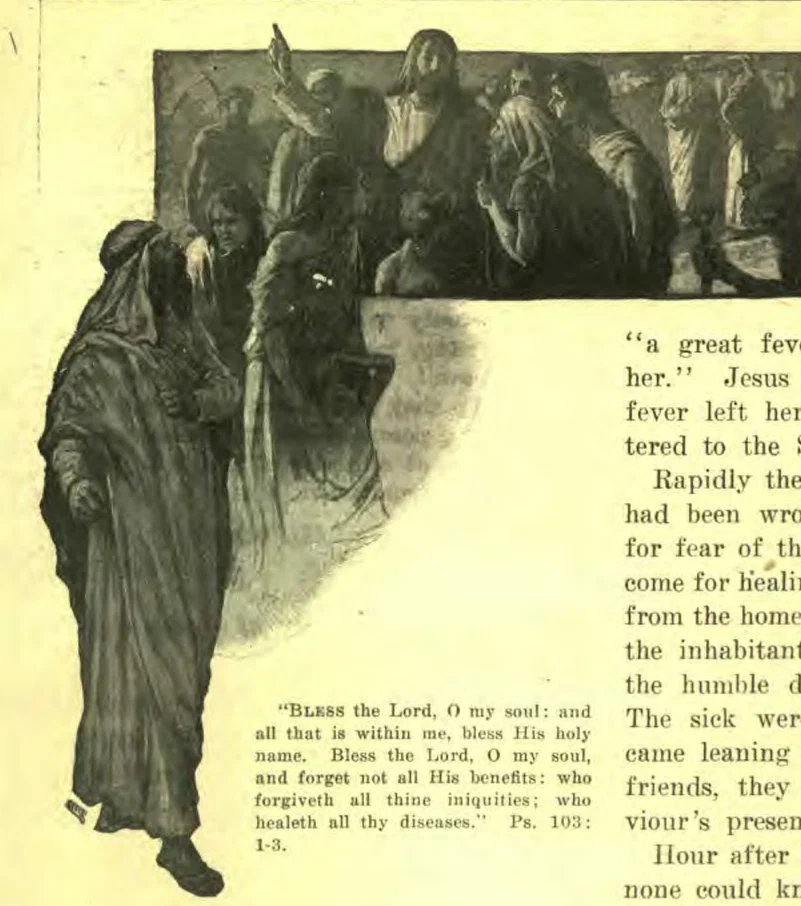
In the fisherman's home at Capernaum, the mother of Peter's wife is lying sick of "a great fever," and "they tell Him of her." Jesus "touched her hand, and the fever left her," and she arose and ministered to the Saviour and His disciples.
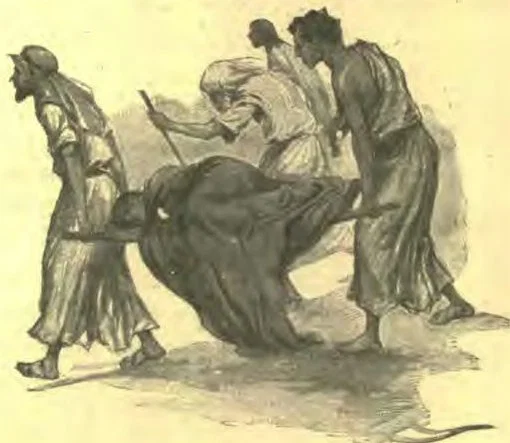
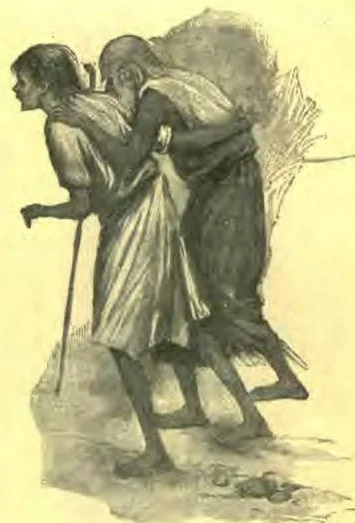
Rapidly the tidings spread. The miracle had been wrought upon the Sabbath, and for fear of the rabbis the people dared not come for healing until the sun was set. Then from the homes, the shops, the market-places, the inhabitants of the city pressed toward the humble dwelling that sheltered Jesus. The sick were brought upon litters, they came leaning upon staffs, or, supported by friends, they tottered feebly into the Saviour's presence.
Hour after hour they came and went; for none could know whether to-morrow would find the Healer still among them. Never before had Capernaum witnessed a day like this. The air was filled with the voice of triumph and shouts of deliverance.
Not until the last sufferer had been relieved, did Jesus cease His work. It was far into the night when the multitude departed, and silence settled down upon the home of Simon. The long, exciting day was past, and Jesus sought rest. But while the city was wrapped in slumber, the Saviour, "rising up a great while before day, . . . went out, and departed into a solitary place, and there prayed."
Early in the morning Peter and his companions came to Jesus, saying that already the people of Capernaum were seeking Him. With surprise they heard Christ's words, "I must preach the kingdom of God to other cities also; for therefore am I sent."
Not to Himself.
In the excitement which then pervaded Capernaum there was danger that the object of His mission would be lost sight of. Jesus was not satisfied to attract attention to Himself merely as a wonder-worker or as a healer of physical disease. He was seeking to draw men unto Him as their Saviour. While the people were eager to believe that He had come as a king to establish an earthly reign, He desired to turn their minds from the earthly to the spiritual. Mere worldly success would interfere with His work. And the wonder of the careless crowd jarred upon His spirits.
"Brought upon Litters."
No self-assertion mingled with His life. The homage which the world gives to position, wealth, or talent, was foreign to the Son of Man. None of the means that men employ to win allegiance or command homage did Jesus use. Centuries before His birth it had been prophesied of Him, "He shall not cry, nor lift up, nor cause His voice to be heard in the street. A bruised reed shall He not break, and the dimly-burning flax shall He not quench: He shall bring forth judgment unto truth."
"Supported by Their Friends."
The Pharisees sought distinction by their scrupulous ceremonialism, and the ostentation of their worship and their charities. They proved their zeal for religion by making it the theme of discussion. Disputes between opposing sects were loud and long, and it was not unusual to hear on the streets the voice of angry controversy from learned doctors of the law.
In marked contrast to all this was the life of Jesus. In that life no noisy disputation, no ostentatious worship, no act to gain applause, was ever witnessed. Christ was hid in God, and God was revealed in the character of His Son. To this revelation Jesus desired the minds of the people to be directed.
The Sun of Righteousness did not burst upon the world in splendor, to dazzle the senses with His glory. It is written of Christ, "His going forth is prepared as the morning." Quietly and gently the daylight breaks upon the earth, dispelling the darkness and waking the world to life. So did "the Sun of Righteousness arise with healing in His wings."