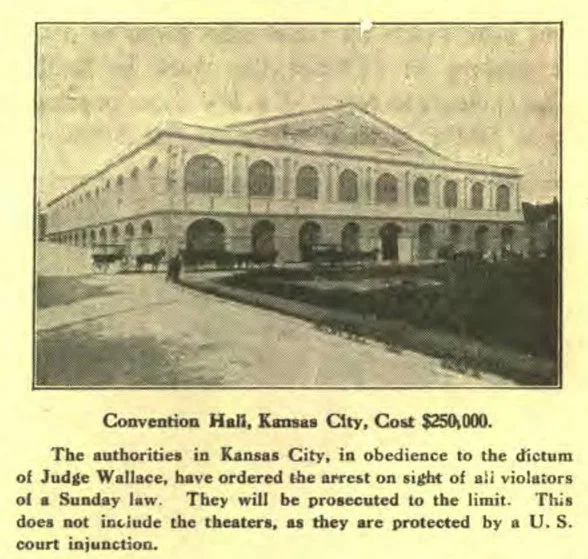
THE Sunday-law campaign is by no means settled in Kansas City. The Kansas City Star gives a report of an address by Judge William H. Wallace, of the criminal court, before the Kansas City Bar Association. The judge is reported to have said:
"Now I am going to warn you; I am going to tell you; you had better climb into the band wagon. The day of reckoning has come. Over this country there is sweeping a tidal-wave of reform . . . that will pick upon its crest the enforcement of Sunday laws and carry it to success."
Then after a diatribe against the Jews, the judge continues:
"This open defiance of the law and this wanton desecration of our Sabbath is in direct opposition to the laws of Moses and the Old Testament which the Jews themselves brought down for us to accept."
The judge fails to observe what is as plain as words can make it that, in the first place, the Sabbath which comes down to us thru Moses and the Bible is the seventh day and not the first day; and secondly, that Israel started out from Sinai a theocracy, while this government is a republic. The people of that government were all worshipers of Jehovah, professedly, while this is a government composed of all classes of people, from all nations and religious beliefs. But this does not seem to affect the judge. He tells us that the citizens will "abide by the law as I construe it until a higher court reverses me, and I think the chances for that are about one in a thousand." He is said to have cited various decisions to uphold his Sunday law and support his hypothesis that this is a "Christian nation" and that its laws are based on Christianity, and yet he tells us, "This is not a question of the church or religion;" and again, "The Jews can not see the wrong of desecration of the Sabbath or of the defiance of the law," which very clearly shows that it is a matter of religion with the judge.
If this were a "Christian nation" it certainly would not need laws to enable it to do what is right. Christianity is made all that it is, obtained all its power, not from the enforcement of human law, but from the Gospel which is the power of God.
The Kansas City Post presents a reply of a rabbi to the judge, and also an editorial which strongly attacks him because of his strong utterances against the Jews. The Ministerial Alliance, however, passed resolutions commending Judge Wallace for the stand that he has taken. The matter has been appealed, however, to the presiding judge of the circuit court, Hermon Brumback. He has taken the matter under advisement. How he will decide no one knows, but according to the Times of November 16 it is stated that he may count the Sunday law in part unconstitutional, especially that part that condemns a person who observes any other day as the Sabbath, such as orthodox Jews and Seventh-day Adventists.
The trouble is that the whole law itself is unconstitutional, as is every law which seeks to uphold dogmas or religious institutions.
Men forever go astray when they get to looking upon any insensate thing whatsoever as having rights, rights that should be guarded and rights that should be conserved. There is but one object in government in this respect, and that is to conserve the rights of humanity, entirely irrespective of religious opinion; but the rights of this or that dogma, the rights of the Sunday law, or the rights of property, should have no bearing in the question whatever. All these things are incidental to the rights of humanity, which ought to be so considered by every government.