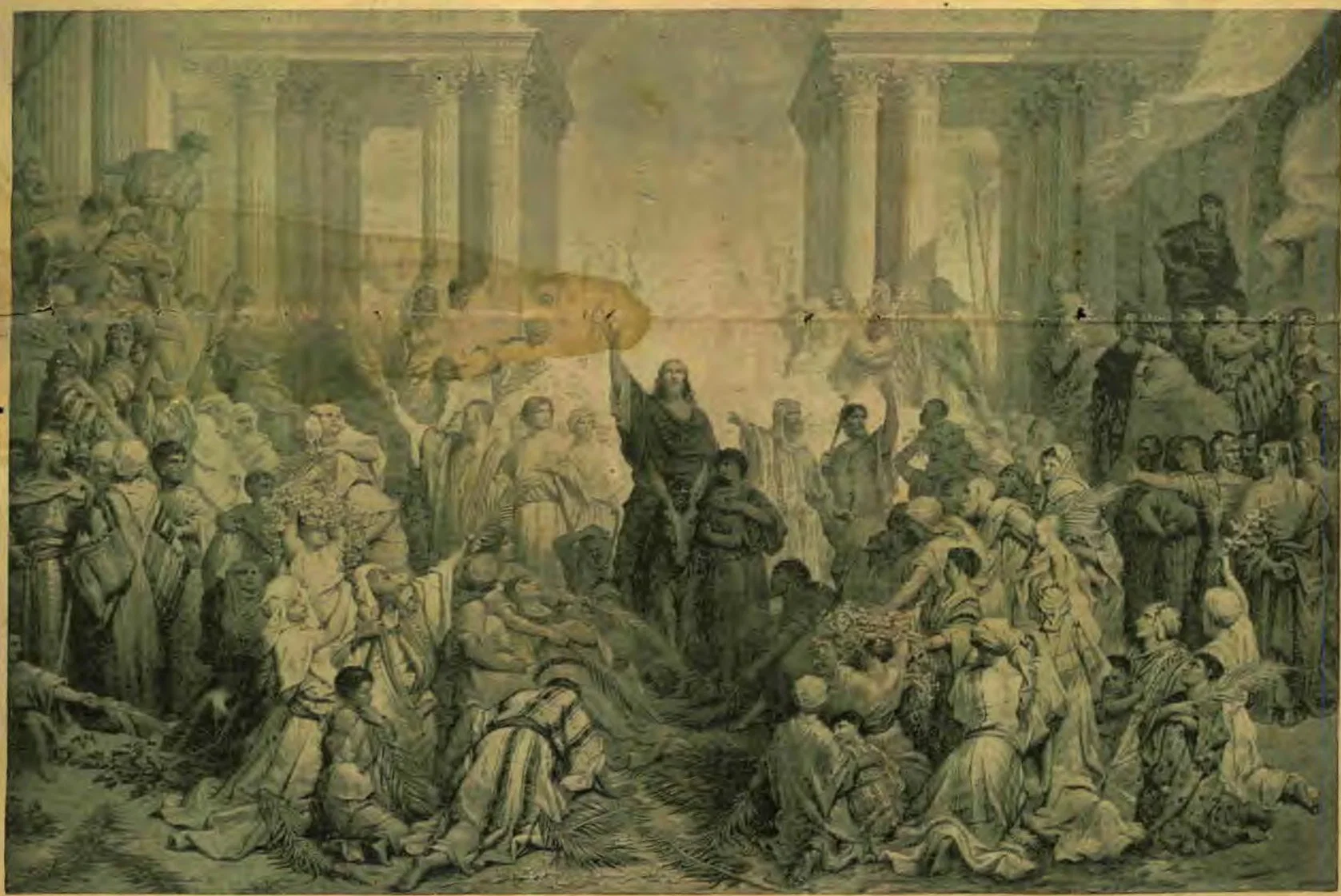
THIS remarkable scene illustrated in our cut is described in Luke 19:24–44; John 12:12–16; Matt. 21:1–16. It occurred shortly before Christ's sufferings and death. The people rejoiced, and manifested their joy by spreading their garments in the way, cutting off branches of the trees and strewing them in like manner, and by praising God for the mighty works which they had seen.
THE TRIUMPHAL ENTRY INTO JERUSALEM.
They had witnessed the wonderful miracles that Jesus had wrought. They had seen the sick healed, the lepers cleansed, the eyes of the blind opened, and the dead raised. Even the children joined in the anthems of praise to God for the gracious manifestations of divine power in behalf of suffering humanity.
MANY had become convinced that Jesus was indeed the promised Messiah, and Israel's King, the Son of David, and so they exclaimed, "Blessed be the King that cometh in the name of the Lord;" "Hosanna: blessed is the King of Israel that cometh in the name of the Lord;" "Hosanna to the son of David."
They thought the appointed time had come for Jesus to be made king of Israel, and deliver them from Roman rule, and hence the royal demonstrations which greeted Him on this stirring occasion. The multitudes caught up the joyful strain and were inspired to swell the cry, "Blessed is the King of Israel."
BUT, as is always the case when a memorable event takes place, and stirring scenes are enacted in connection with the Lord's work, there were Pharisees present who were not pleased with the rejoicing and enthusiasm of the people. Their "sense of propriety" was shocked. Their cold formalism and self-righteousness were not in accord with the shouts of victory and the songs of praise which came from grateful hearts and joyous lips, and so they said to Jesus, "Master, rebuke Thy disciples." Jesus answered, "I tell you that, if these should hold their peace, the stones would immediately cry out." Why was it so necessary for the disciples of Christ to praise God and welcome Jesus as they did on that eventful day?
"ALL this was done, that it might be fulfilled which was spoken by the prophet, saying, Tell ye the daughter of Sion, Behold, thy King cometh unto thee, meek, and sitting upon an ass, and a colt the foal of an ass." Matt. 21:4, 5. See Zech. 9:9. This prophecy, written more than 400 years before, must be fulfilled. If God's people failed to improve their blessed privilege in fulfilling His word and doing His will, then "the stones would immediately cry out,"—they would give the message and do the work.
The same thought was expressed by John the Baptist when he addressed God's professed people. He said, "And think not to say within yourselves, We have Abraham to our father; for I say unto you, that God is able of these stones to raise up children unto Abraham."
THE lesson for us from this scripture is that if we fail to do the work which God wants us to do, if we prove unfaithful to the sacred trust He commits to us, or if we, through selfishness, pride, prejudice, or any wrong motive, do not discern the Lord's work, and faithfully perform2it, others will be raised up to do it, for it must be done.
When men become Abraham's children by faith in Christ, they are not secure in the enjoyment of the blessing of Abraham unless they also do the works of Abraham, that is, obey God. John 8:39, 40. Thus faith is made perfect, and is proved to be true, saving faith. James 2:14–23.
IT is an interesting fact that the disciples did not understand, at the time, that they were fulfilling the word of the Lord on that occasion. "But when Jesus was glorified, then remembered they that these things were written of Him, and that they had done these things unto Him." John 12:16. This illustrates the important fact that God sometimes uses agencies in doing His work and accomplishing His purposes when the agents do not know that such is the case. If the disciples had been as far from God as the Pharisees, so far that He could not use them to fulfil His Word, then the inanimate stones would have proclaimed the praises of the world's Redeemer, and welcomed Israel's King. Cyrus fulfilled one of God's purposes, altho he knew not the Lord. Isa. 45:1–6. Surely He "worketh all things after the counsel of His own will." Eph. 1:11. What a privilege it should be to render willing and loving service to One whose power and wisdom are infinite, and who is pledged to guard and save us from all our foes!
AS THE mighty throng approached Jerusalem from the Mount of Olives, with Jesus as the center of attraction, and the One upon whom so many looked for deliverance from the Roman yoke, "He beheld the city, and wept over it." Luke 19:41. What a scene! The people rejoiced, but Jesus wept. Why should Jesus weep when the multitudes were praising God, and He was receiving royal honors? He understood the situation, but they did not. With prophetic eye He saw Gethsemane, the betrayal, the arrest, the trial, the scenes of Calvary, and the terrible destruction that awaited Jerusalem. But He wept not for Himself. He sorrowed for an unrepentant and rebellious people, who would so soon reject Him as their Saviour and King, saying, "Away with Him, crucify Him. . . . We have no king but Cæsar." John 19:15.
WITH a sad heart, Jesus said, "If thou hadst known, even thou, at least in this thy day, the things which belong unto thy peace! but now they are hid from thine eyes." Luke 19:42. "O Jerusalem, Jerusalem, thou that killest the prophets, and stonest them which are sent unto thee, how often would I have gathered thy children together, even as a hen gathereth her chickens under her wings, and ye would not!" Matt. 23:37. His heart yearned over that people for whom He had labored and sacrificed, and for whom He was about to give His life. How touching and pathetic His plea, and how sad His lamentation! What a lesson for us! Jesus is the same, yesterday, to-day, and forever.
He has the same tender love, the same deep interest, the same earnest solicitude for us now as He had for the people then. He graciously invites us to come to Him and receive His blessing, His rest, His peace, His love, and His life. Matt. 11:28–30; Rev. 3:20; 22:17. Shall we not accept His loving invitation, and find shelter under the shadow of His wings? Let us not wait till the things which belong to our peace are hid from our eyes, and our house is left unto us desolate. "Now is the accepted time; behold, now is the day of salvation."
THE Saviour states the reason why that people did not know the things which belonged to their peace, and why destruction would come upon them. He said, "Because thou knewest not the time of thy visitation." Luke 19:42–44. Why did they not know? Were they responsible for not knowing?—Most assuredly they were, for they might have known. They had the same evidence that Simeon and Anna had (Luke 2:25–38); and the same that John the Baptist and the apostles had. Jesus declares to them, "Ye will not come to Me, that ye might have life." John 5:40. Then He asked them a question which revealed the plague spot of their hearts (and also of a large class to-day): "How can ye believe, which receive honor one of another, and seek not the honor that cometh from God only"? Verse 44. But the evidence that Jesus was the promised Messiah was so strong that many of the chief rulers even believed on Him; "but because of the Pharisees they did not confess Him, lest they should be put out of the synagogue; for they loved the praise of men more than the praise of God." John 12:42, 43.
God forbid that we should seek honor one of another, and love the praise of men more than the praise of God, and so be blinded to our spiritual and eternal interests, and fail to know the things which belong to our peace, or the time of our visitation. God's Word is given us as a lamp to our feet, and a light to our path. Ps. 119:105. We do well to take heed unto the more sure word of prophecy, "as unto a light that shineth in a dark place." 2 Peter 1:19. Had the Jewish people understood what the prophets had written, they would have known the time of their visitation, but as they did not understand the prophetic word, they fulfilled it in condemning Christ. See Acts 13:27.
Jesus said to them concerning the prophecies of Daniel, which referred especially to Him and His work, "Whoso readeth, let him understand." Matt. 24:15. May we so yield our hearts to the mild scepter of Prince Immanuel that He may open our understanding, that we may understand the Scriptures. Luke 24:45. Then we will know the things that belong to our peace in this our day, and we will be prepared to do His will and work.