THE PAPACY IN PROPHECY

3%

THE PAPACY IN PROPHECY

By ABDIEL.

THE LITTLE HORN OF DANIEL 7.

(Specifications Continued.)
IN our last study we considered some of the specific features of the little horn power and found them all to apply to the Papacy. It came up among the ten divisions of Rome; it was little at first; its look was more stout and arrogant than its fellows; before it fell three of the ten divisions of Rome; it was possessed of far-seeing shrewdness and foresight as compared with the other powers; it has spoken great, presumptuous words and assumed prerogatives and titles belonging to Deity alone; it differed from all its fellows in its very nature, a religious power in contradistinction to a civil government.
The other specifications noted last week were as follows:
8. It "made war with the saints;" it "shall wear out the saints of the Most High." Verses 21, 25.
9. It "shall think to change the times and the law." Verse 25.
10. It should continue dominant a definite period, "a time and times and half a time." Verse 25.
11. It would after this lose its dominion gradually to other powers. Verse 26.
12. Yet even at the very last, before Christ should come, and judgment be given to His people, it would make war with God's people and prevail against them. Verse 21.

The Fulfilment.

Last week we saw the fulfilment of seven of the twelve specific predictions of the "little horn" of Daniel 7 in the Papacy. Above are five more. If these fail, all that has gone before is of no worth. If there is but one specification that is not fulfilled or in prospect of fulfilment, which in the nature of the case belongs unto the future, we must look to some other power in history symbolized by the little horn, or deny the prophecy. Let us continue our examination.

VIII. "Made War with the Saints."

It "made war with the saints;" it "shall wear out the saints." Has this been true of the Papacy? Of course, it will be denied by the adherents of that system. Whom God calls saints men have often denominated "heretics," "enemies," "traitors." The Papacy considered, and doubtless, honestly, that the thousands upon thousands which were put to death by papal devotees and papal governments, into whose hand the "Church" delivered them with a plea for "mercy," were perverse, obstinate heretics, enemies to the church and to the state, because, forsooth, they dared to think for themselves and to follow the interpretation of truth as God gave them. The fruits of the Inquisition in Spain and Rome, in St. Bartholomew's massacre, the auto da fes, the rack, the dungeon, the torture chamber, the very teaching of the Papacy, all bear witness to the persecutions of the Papacy during the Dark Ages. Those put to death by that system were first condemned by that system, it is true; but this is contrary to the Gospel of Jesus Christ, who expressly declared that "I came not to judge the world, but to save the world. He that rejecteth Me, and receiveth not My sayings, hath One that judgeth him; the word that I spake, the same shall judge him in the last day." John 12:47, 48. No man, or set of men, assuming to be in Christ's place has authority to do what Christ did not authorize. He makes His Word the judge, and the last day the time of judgment. The power which assumes otherwise we must count a usurper. The judgment of the Waldenses, the Albigenses, the Huguenots, and scores of others may be counted "obstinate heretics" in the wisdom of the Papacy; believers of Christ's words will prefer to wait till the last great Tribunal shall pass irrevocable sentence. Suffice to say that the prophecy has been met in the Papacy.

IX. "Shall Think to Change the Times and the Law."

He shall "think himself able" to change the times and the law, the Douay Version reads. It refers to a law that this power can only think to change, but shall not be able to change—the times and the law of the Most High. To every earthly ruler is given the right, the authority, to change the times and laws of his predecessor, and this he is often able to do; but the little horn, with all its power over the other horns, wearing out the saints, speaking great words, can onlythink to change the law and the times of God. Spurrell reads, "the appointed times and the law."
God's first appointed time is the day, from evening to evening, from sunset to sunset. Genesis 1; Mark 1:32, and other scriptures. The next appointed time is the week, or septenary cycle of seven days, each day looking forward to and closing with the Sabbath, the crowning day of the week.
Both of these appointed times are directly connected with God's law; and it is impossible to change the times without changing the law. For that commandment which above all others reveals the Godhead, reads:
"Remember the Sabbath day, to keep it holy. Six days shalt thou labor, and do all thy work; but the seventh day is a Sabbath unto Jehovah thy God: in it thou shalt not do any work, thou, nor thy son, nor thy daughter, thy man-servant, nor thy maid-servant, nor thy cattle, nor thy stranger that is within thy gates; for in six days Jehovah made heaven and earth, the sea, and all that in them is, and rested the seventh day; wherefore Jehovah blessed the Sabbath day, and hallowed it."
That law declares the seventh day to be the Sabbath, the day as God gave it, and the seventh day of the cycle. But apostasy has changed the day's beginning and closing from sunset to midnight, and that change has been accepted and endorsed by the Papacy. Apostasy has set apart the first day of the week in honor of the sun, and the Papacy has not only adopted and approved this child of Apostasy, but she presents it as the very mark of her power to command men under sin. The commandment enjoins "the seventh day," but the reply in "Butler's Catechism," a standard Catholic work, as to what the commandment teaches is—
"To Sanctify the Sunday."
Of course we know that the Sabbath commandment teaches no such thing.
Another work ("Catholic Christian Instructed") thus sets forth the claim of the Papacy:
"Ques. How prove you that the church hath power to command feasts and holy days?"
"Ans. By the very act of changing the Sabbath into Sunday, which Protestants allow of; and therefore they fondly contradict themselves by keeping Sunday strictly, and breaking most of the fasts commanded by the same church."
These witnesses might be extensively multiplied down to the present time. The Papacy has fulfilled the prophecy of thinking to change the times and the law of God. But the eternal precepts of God stand fast forever and ever.

X. Dominant for a Definite Time.

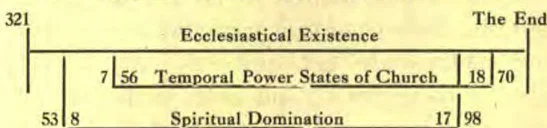
"And they shall be given into his hand [power symbolized by the little horn] until a time and times and half a time." A "time" is a year; "times," the dual number, two years; a "half a time," half a year; or three and one-half years, given in other prophecies as forty-two months, and 1,260 days. See Rev. 11:2, 3; 12:6, 14; 13:5. Three and one-half years equal forty-two months, and at thirty days to the month, the Bible reckoning, 1,260 days. As the short-lived beasts represent long-existing kingdoms, so the short periods of time represent long periods. The Bible rule is "a day for a year." Num. 14:34; Eze. 4:6. The "little horn" power should therefore continue its domination over saints, times, and law 1,260 years. Is this true of the Papacy? Let us see. There are three great phases to Roman Catholicism: (1) Its ecclesiastical organization, beginning about the time of Constantine and continuing to the end. This is entirely independent of the civil power. (2) The temporal power of the Papacy, beginning under the reign of Pepin of France in 756, and continuing till 1870, when the last vestige was taken away by Victor Emmanuel. This was temporal dominion over the States of the Church. Neither of these are referred to in the above prediction. (3) Spiritual domination over the minds and consciences of men by the consent of the civil power. In 533 Justinian, emperor of Rome, decreed that the bishop of Rome should be "the head over all the holy churches," and "true and only corrector of heretics." This was confirmed and acknowledged.
But this did not immediately go into effect. The Arian Ostrogoths stood in the way of the Roman bishop's assumptions. They were subdued and fell in 538. Here began the 1,260 years. They extend to 1798. That period of time is known in the world's history as the Dark Ages. During that period "the wearing out of the saints" took place, and God's law was trodden underfoot by those who professed to be His servants.
Jesus declared that the persecution, or tribulation of those days should be shortened. Matt. 24:21, 22, 29; Mark 13:20, 24. The same thing is referred to in Dan. 11:33, 34; Rev. 12:15, 16. The shortening of the persecution of those days was caused indirectly by the influence of the Reformation, the decree of toleration by Maria Theresa, Empress of Austria in 1776, and the opening of America the same year as the home of the oppressed of all nations. The French Revolution, a reaction from the Papacy, further weakened her power, and when Pius VI. was taken captive in 1798 no power was so poor as to bow to her mandates. This threefold aspect of the Papacy may be better comprehended by the following diagram:
Specifications 11 and 12 must be left to a future study.