WE have given in past numbers from our own representative the report and the meaning of the American Federation of Catholic Societies which held its fifth annual convention in Buffalo the last days of July. We give in this some pertinent extracts from a report in the Catholic Mirror of August 11. We are first told that the convention „was undoubtedly one of the most successful movements ever made by United Catholicity in this country,” that the mass meeting that day included „more Catholics than ever assembled in Buffalo at any one time, and graced by the presence of some of the most learned churchmen in the country.” The secretary’s report showed „the gigantic strides already made by the Federation, and the brilliant future that is before it.” The secretary reported various things accomplished. We note these among those quoted by the Mirror:
„In Ohio the obnoxious Wynne free text-book bill was defeated and one of the non-Catholic members of the Ohio Legislature said to a Federation official that „if that unknown Federation had not made such a strong and convincing argument against said bill, it would have been passed by the Lower House.’ In Ohio the Lucas County Federation has gained permission to have holy mass celebrated in the workhouse and other public corrective and charitable institutions.”
“„In New Jersey, Indiana, and Missouri the Catholic Societies some time ago caused the defeat of the free text-book bills.”
“„In Pennsylvania strong protests were made against a series of paintings violating the truth of history and offensive to Catholics. The paintings are placed on the walls of the State Capitol building at Harrisburg.”
“„The Catholic Societies of Iowa, especially the Staats Verband of that state, were successful in having the Ritter bill adopted, giving free access to Catholic priests to all state institutions for the purpose of administering to the wants of Catholic inmates.””
Aims and Meaning.
The object of the Federation is thus stated by Bishop Canerin, from whose address we take the following:
„This Federation may be considered as an organized representative of every form of Catholic activity, and, within certain limits, the guardian of Catholic rights and interests, which are threatened and violated by materialism and secularism, and the false and pernicious practices which spring from them.
„The aims of the Federation are religious and patriotic; they are public interest of all American citizens who believe in the Divine Lawgiver and in the revelation of a divine religion through Christ our Saviour.”
It is well to remember that the only true representative of that Divine Lawgiver, as held by Rome, is the pope and hierarchy of the Roman Catholic Church. To quote again:
„To carry out the purpose of this association, every force of religious activity, pastors and people, bishops, priests, and laymen, speakers and writers, must be solidly united to speak with one voice and act with one will for God and our country. We must make the Federation an Apostolate of Catholic truth, to aid the Church in teaching her children to think as Catholics, to speak as Catholics, to live as Catholics.
„We are not a political party or a sect; we stand for the Christian life of the nation itself, and we are ready with our whole energy, to co-operate with all loyal citizens, with our government, and with all political and social energies which work for truth and virtue. The more consistent the Catholics, the more loyal the patriot. It is not patriotism, but cowardice, to minimize Catholic teachings in regard to our civic rights and duties, or to surrender any essential principle of Christian doctrine concerning the relations of the church to the state, the family, the school.
„This is federation. It means the union of Catholics of every race and language in the United States for the preservation of Christian principles, and the progress and elevation of men to higher spiritual life and more unselfish citizenship; it means that we stand together for the defense of right and the redress of great wrongs in the family, in the school, in the social, economic, civil, or political conditions of the country. It represents and fearlessly proclaims Catholic public opinion on the most important questions of the day. It needs a center and an organ that it may be the propagator of Catholic literature among all classes.
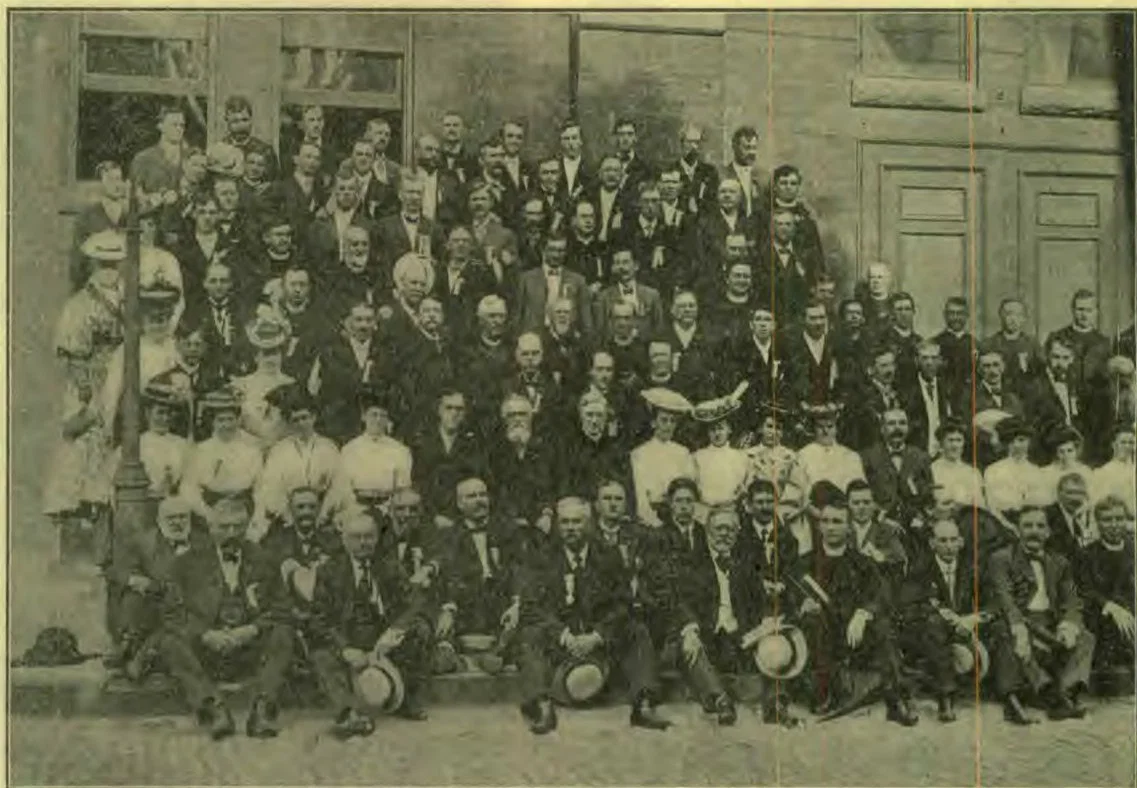
Prelates and Delegates at the Federation Meeting.
„We wish Christian principles to rule everywhere; in the state, in business, in labor unions, in all the civic, social, financial, and industrial relations of men.
„The disregard of the Lord’s Day is one of the signs of the materialistic spirit and godlessness of our times. It is a subject worthy of serious consideration. Thousands of Catholic men employed in iron and steel mills, in mines and factories, on railroads, street-cars, docks, and wharves, in different departments, on many large contracts, have no opportunity, I will not say to rest, but even to worship God for one hour by attending mass on Sunday. If they have a day, or half a day of rest during the week, it usually is on Saturday. Work and pleasure and material progress are made of supreme importance and the mad sacrifice to mammon proceeds on Sundays, as if laboring men had no Sabbath, no public worship to offer, no souls to save. Against this unnecessary labor, this athletic profanation of the Lord’s Day, this paganizing and brutalizing of the laboring man, and shutting out from his life all religious light and grace, this Federation should resolutely use its power, in civic, as well as in social and private life.
„Already the light is breaking, and the best minds of this country are realizing the truth of Catholic principles of civil, social, domestic, and private virtue. Heretofore there has been wanting a united effort and expression of Catholics for the rights of religion and the welfare of society. In many places we have needed educated and religious laymen, trained to compete and lead in public careers of American life. We are one in six or seven of the population; the proportion of our numbers in the higher offices ought to be one in six or seven.
„Never in the history of the country, was there a better opportunity for the Catholic laymen to prove the value and power of religion in citizenship and to show how religion alone can conserve the majesty of the law and the stability of the state.
„There are members of our Catholic societies in all the trades and labor unions of the United States. Let this Federation be a school to prepare these men to be apostles of honesty and respect for law, of truth and morality to those about them, so that we may count every member of this union an opponent to the anti-Christian, materialistic, and socialistic doctrines of all sects and societies which rise up against religion and just government.
Bishops and priests and the laity should be foremost in all movements for education, political and social purity, and the improvement of the condition of the poorer working classes; improvement in their dwellings and manners of living, in their moral environment, in their efforts to obtain fair wages, without recourse to violence, and where possible, without recourse to strikes; to prevent the cheapening of labor by the employment of children and women in occupations unfit for them; in encouraging among the people useful societies; in opposing all unnecessary work on Sundays.
„By our faith in Jesus Christ and its unchanging doctrines, we hold in our hands the future stability and peace of this country, and the principles of conscience, honesty, and personal responsibilities upon which it rests. Religious education, Catholic faith, and Catholic morality, are the only living forces which can save marriage, save the family, protect property, defend the poor and weak—save the state itself, from the perils15of materialism, secularism, and the cruelty and sensuality of Paganism.”
In all this we believe Roman Catholics to be sincere. But if the „state itself” is to be preserved only by „Catholic faith and Catholic morality,” if „the future stability of the country” rests upon the „unchanging doctrines” of that church, surely Catholics ought earnestly to work for it. But the effect of the „Catholic faith and Catholic morality,” and the „unchanging doctrines” of that church may be seen in those countries where she has held full sway, as for instance Spain and Italy. Surely they have been utterly wanting in stability in the past, and the future makes no promise of better conditions. May God save America from such „stability,” from such salvation.