The special subject of these studies at present is the book of Daniel. In its study we need not concern ourselves with the discussion or strictures of the higher critics. Let it suffice the believer of the Gospel of Jesus Christ to know that Daniel's prophecy had the indorsement of Him who spake as never man spake. In His prediction of the destruction of Jerusalem and of future judgments upon the world, the Great Teacher cites Daniel's prophecy as authority, and declares, "Whoso readeth, let him understand." Matt. 24:15; Mark 13:14. Of what account should be the babel of a multitude of "higher critics," or lower critics, when the Master has spoken?
Moreover, the book itself, confirmed as it is by God in history, is its own evidence of its divine origin and absolute truthfulness. History demonstrates its prophecies. All this we will learn as we study its lessons.
The Purpose of the Book.
While ages past could find many precious and practical lessons in the book of Daniel, it was written especially for the latter times,—the last days, the very age in which we are living. Even the prophet himself did not understand much of what God had given thru him; and when he had written the greater part of his prophecy, he was told, "But thou, O Daniel, shut up the words, and seal the book, even to the time of the end; many shall run to and fro, and knowledge shall be increased." Dan. 12:4. And when in the prophet's anxious interest to know more, he sought God further to enlighten him, he was again told, "Go thy way, Daniel; for the words are closed up and sealed till the time of the end. Many shall be purified, made white, and tried; but the wicked shall do wickedly; and none of the wicked shall understand; but the wise shall understand." Dan. 12:9, 10. Both of these affirm that the prophecy was written for the future, and both contain the implied promise that when the time of the end shall be reached, those who are wise in God ["Behold, the fear of the Lord, that is wisdom; and to depart from evil is understanding." Job 28:28.] shall understand the prophecy, knowledge of which was denied to the very one thru whom it was given simply because it could not be understood till the events predicted had been fulfilled or were in process of fulfilment.
The same truth is thus stated again: "There is a God in heaven that revealeth secrets, and maketh known . . . what shall be in the latter days." Dan. 2:28.
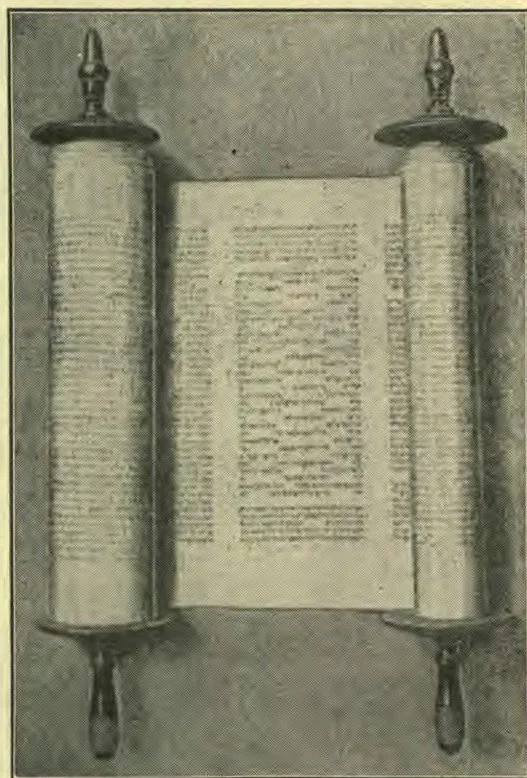
An Ancient Scroll of Scripture.
"The vision of the evenings and mornings which hath been told is true: but shut thou up the vision; for it belongeth to many days to come." Dan. 8:26, A.R.V.
A Key to the Book.
Difficult problems are often easy when we find their simple secrets. From certain points of view certain lines form what is to the beholder an intricate maze, but looked at from the right angle, every line is in harmony with the rest, and the whole is simple. This principle is true in the study of God's word. Every book has its divine purpose. Every subdivision has its central thought. Every lock has its key; every seeming snarl the clue, which, when found, will unwind its precious golden cord to the devout student.
One of the great purposes for which the book of Daniel was given is to teach that "the Most High ruleth in the kingdom of men, and giveth it to whomsoever He will." While this is stated in but one chapter—the fourth—it is taught from beginning to end, a lesson that God would have every ruler and statesman and politician on earth learn, and learn without the sad experience of many of earth's rulers in the past.
Keys to Chapters.
Every chapter, or rather subdivision, has its key, generally embodied in some expression found in the subdivision itself. Sometimes the subdivision is complete with the chapter; sometimes the chapters should be combined. This is true to a certain extent of chapters 8 and 9, for both deal with the same subject and vision; and emphatically true with chapters 10 and 11.
The book of Daniel is written in two languages: From the first to the first clause of chapter 2:4, it is written in Hebrew; thence to the close of chapter 7, in Aramaic; from the beginning of chapter 8 to the close it is again written in Hebrew, with both of which languages the prophet was doubtless well acquainted.
The time of writing the book was from B.C. 603 to 534. The writer was Daniel, whose name means, "God is my judge," who was renowned in Israel for his greatness and piety (Eze. 14:14, 20), and God characterizes him as "a man greatly beloved" (Dan. 10:11).
How He Came to Babylon.
One of the noblest and greatest of Judea's rulers was Hezekiah, who reigned twenty-nine years, from B.C. 726 to 697 ("Usher's Chronology"). Of his faithfulness it is said, "He trusted in the Lord God of Israel; so that after him was none like him among all the kings of Judah, nor any that were before him; for he clave to the Lord, and departed not from following Him, but kept His commandments." 2 Kings 18:5, 6.
In his faithfulness God prospered him. Hezekiah threw off the yoke of the Assyrian, recovered the cities taken by the Philistines, erected public buildings, improved the water-supply system of Jerusalem, and encouraged education in art, science, literature, and religion. It almost seemed as tho Israel would come back to that place in the world which God gave her as light-bearer, as God's missionary to lead other peoples and nations to Him, but the idolatry of self and nature was too deeply rooted in the hearts of the people. And even in Hezekiah we are taught again the lesson of man's frailty. In the middle of his reign God restored him to health from a sickness unto death, prolonging his life fifteen years. The king of Babylon, sending ambassadors to congratulate him and learn of the miracle wrought at that time, Hezekiah, instead of giving God the glory, in foolish pride showed them all the treasures and richness of his kingdom and thus aroused their cupidity. The vast treasures of Jerusalem thus became an ever-dazzling temptation to the Babylonians, till Jerusalem was taken by Nebuchadnezzar, and the treasure-houses of Jerusalem were robbed of their riches. And thus, more than a century before it occurred, the Lord told the foolish king that it would be:
"Behold, the days come, that all that is in thine house, and that which thy fathers have laid up in store until this day, shall be carried to Babylon; nothing shall be left, saith the Lord. And of thy sons that shall issue from thee, which thou shalt beget, shall they take away; and they shall be eunuchs in the palace of the king of Babylon." Isa. 39:6, 7.5
This was Babylon's answer to Hezekiah's folly. Had Hezekiah showed the riches of God's grace, as he had the opportunity, the sequel would have been of a different character. He had the opportunity to preach the Gospel to the inquiring heathen, and failed.
The sad prophecy was fulfilled when Nebuchadnezzar, who became the greatest king of Babylon, came against Jerusalem, plundered it of its treasures, burned the city and its glorious temple, and took the youths of the royal seed for his servants. Among these were Daniel, Hananiah, Mishael, and Azariah. Their deportation to Babylon took place at the time Nebuchadnezzar first captured Jerusalem, B.C. 605.
As Israel had utterly apostatized, as God could do nothing else for them or thru them, He sets up His light, the center of illumination on earth, in the persons of the faithful in the heathen city of Babylon, and purposes to use that great empire for the promulgation of His truth in the earth. The book of Daniel is the divine record of God's work in this respect. And as we study it, we shall find that a Divine Hand shaped the events, a Divine Foresight selected the lessons for later times, a Divine Inspiration penned them; and may the Divine Spirit guide in their study, even as Divine Power will attend their infinite truths to the lives of all who receive them.