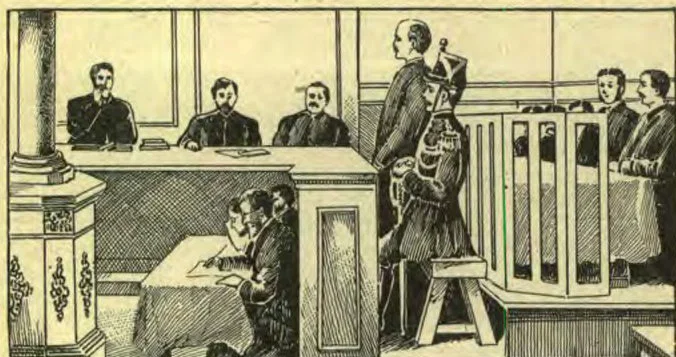
(Threatened by the Police, but Went On with His Work — Arrested and Cast into Prison — Magistrate Impressed and Non-plussed at the Trial — His Victorious Success)
By ROSS C. PORTER
Superintendent Asiatic Division of Our Work
ONE of our European missionaries related an experience that impressed me as an illustration of how God directs and overrules in mission advance. I will give it as I heard it related, as nearly as I can remember it.
A company of people in Rumania, who had been reading the Bible, and literature bearing upon the second coming of Christ, and upon the last gospel message, which is to prepare a people for that event, wrote to Hamburg, Germany, for a minister to come and baptize them into their newly found faith.
“You Are Warned Not to Baptize”
Rumania is one of the most strongly Catholic countries of Europe. When the missionary arrived, as he stepped from the train, a policeman tapped him on the shoulder, and inquired if he were from Germany. He answered that he was. The officer asked him if he were a Protestant minister. Again the answer was in the affirmative. He then said, “I am instructed by the magistrate to inform you that you are warned not to baptize any persons in this state except you baptize them into the state church.”
To this warning the minister courteously replied, “I have not baptized any person in this state into any church.” The policeman responded, “No, sir; but I give you warning.” The missionary replied that he was to hold a service on the hill, and gave him an invitation to attend it if he wished to do so.
The Officer Witnesses the Baptism
The service was held, the officer attending. At the close of the service, the missionary announced another service to follow immediately, which was to be held down by the waterside, and to which all were invited. After the usual opening, the missionary walked into the water until he reached the usual depth for performing the baptismal ceremony, when he invited those who desired baptism to come into the water. The candidates came. They were immersed, in keeping with the gospel commission.
The officer witnessed the baptism from the bank. When the service was concluded, and the congregation dismissed, the missionary came out of the water. The officer stepped up to him, and taking him by the arm, said, “You are my prisoner,” and led him to jail, and locked him in a cell. The magistrate who gave the warning against baptizing candidates except into the state church, was the magistrate from whom the missionary must obtain his passport to return to Germany. Since he had offended him, how was he to get his passport?
Believing that he was acting as a missionary must under divine commission, he decided to ask God to give him his passport and hasten him on his return journey, as other important engagements awaited him. There in his prison cell, like Paul, Silas, Peter, and John, of apostolic times, he prayed and gave thanks to his God that he was counted worthy to suffer shame for Christ’s name. He prayed for an early release from his confinement, and a passport to return to his work in Germany.
The Enraged Magistrate
The officer reported the case to the magistrate, who was greatly enraged to think a stubborn German missionary had defied his authority. He summoned the offender to appear before him at once for trial. He expected to see a hard, defiant looking man when the prisoner was brought before him, and he was quite surprised when the officer brought in a very pleasant looking, calm, and perfectly composed Christian gentleman.
The magistrate said to the missionary: “You do not look like a bad man. Why did you disregard my warning, and baptize into another than the state church?” The missionary replied: “I am preaching the gospel and baptizing believers under a commission from the King of kings, which authorizes me to preach the gospel and baptize believers in every nation under heaven. No magistrate or officer of the law has a right to interfere with my carrying out that commission so long as I conduct myself civilly.”
He gave the commission as follows: “And Jesus came and spake unto them, saying, All power is given unto Me in heaven and in earth. Go ye therefore, and teach all nations, baptizing them in the name of the Father, and of the Son, and of the Holy Ghost: teaching them to observe all things whatsoever I have commanded you: and, lo, I am with you alway, even unto the end of the world. Amen.” Matt. 28: 18-20.
Commissioned by the Same King
The missionary then said: “This commission gives the gospel minister the right of way to preach and baptize believers in every nation, and to instruct them to observe all the teachings of Christ, unqualified by any requirement to surrender the rights authorized in this commission if opposed by the civil authorities.
“You, as a magistrate, are acting under a commission from the same King; and as a civil officer, you are a minister of God to keep the peace in the state, while I, as a minister of the gospel, preach the gospel and baptize believers. If we both keep our proper places, and each acts in his legitimate sphere, we will never conflict while in the performance of our duties, as we are both under commission from the same King.”
Turning to the officer, the magistrate said: “I have never had a prisoner before me who talked to me as this man has. I do not know what to do with him. There is a train just leaving for Germany, and I think we would better give him a passport and put him on that train, so sending him out of the country.” The passport was written, and the officer escorted the missionary to the train, giving him his passport, and he left for Hamburg, Germany, on the first train leaving the city after the baptism.
Magistrate Asks the Missionary to Return
One year later, the magistrate instructed his clerk to write to that missionary, inviting him to return and hold a series of meetings in the court room in which he was tried, saying that that talk about the gospel commission had remained with him ever since, and he desired to hear more of such gospel preaching.
This was a most remarkable overruling of divine Providence. He who from His throne in the heavens superintends His work on earth, declares that “all power is given unto Me in heaven and in earth.” This is the prelude to this authoritative commission. He heard the prayer of His missionary, reversed the decree of the magistrate, opened the prison doors, secured from an offended magistrate a passport, and sent His servant on his homeward way rejoicing in the omnipotent power of the commission which superintended his mission, and then impressed the magistrate to send for the minister to come back to tell him more of the sweet gospel story.