Is It Peace or War?

1%

Is It Peace or War?

By Our Own Correspondent

The Second Peace Conference at The Hague.

The Organization of the Conference.
T​HE second Peace Conference at The Hague has come and is about to adjourn. For the first time in the history of ancient and modern times, have the nations of the world come together in a sort of "Parliament of Humanity" to discuss the paramount questions of war and peace.
At the first conference, in 1899, only twenty-seven nations were invited. This time, forty-five nations sent their duly authorized plenipotentiaries accompanied by a full staff of military and technical delegates, not counting secretaries; in all, two hundred and fifty delegates and a grand total of five hundred envoys. Some countries had from ten to fourteen delegates, like France, Russia, Germany, the United States, and China; other countries had less in proportion to their political importance. Here is the full list of countries by continent:
Europe: England, France, Germany, Austria-Hungary, Russia, Italy, Spain, Portugal, Belgium, Holland, Luxemburg, Sweden, Norway, Denmark, Switzerland, Servia, Greece, Bulgaria, Montenegro, Rumania, Turkey.
America: United States, Mexico, Guatemala, Honduras, Nicaragua, Salvador, Cuba, Haiti, Dominican Republic, Panama, Colombia, Venezuela, Ecuador, Peru, Brazil, Bolivia, Chile, Argentine, Paraguay, Uruguay.
Asia: China, Japan, Siam, Persia.
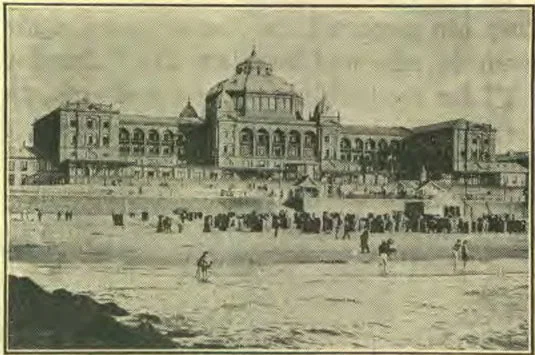
Palace Hotel, Headquarters of French, Austrian, and German Delegates.

A Stormy Conference.

It may be well to remind the reader that the conference was called at the request of President Roosevelt, whose request was immediately joined by that of England. The program was furnished by Russia, and was sent by her thru one of her jurists, Mr. Maartens, to all the European capitals for approval. The two great questions which everybody expected would be the main theme of the conference—limitation of armaments, not to say anything about disarmament, and compulsory arbitration—were missing on that program! The United States and Great Britain thought that they should be considered. So did Japan and Spain, to speak only of the great powers. Germany, Austria, and Russia opposed this view, while France and Italy declared that they were ready to examine these questions should they come up at all. Agreement seemed impossible, and it was feared that the conference must be given up. "At the very time when all the world is talking of disarmament," said "Le Siecle" of April 22, "men of foresight are afraid that these very efforts may bring trouble instead of peace."
This state of things was beheld with no small alarm by the men who had the greatest hopes of the coming conference. One of the foremost among them, Baron d'Estournelles de Constant, a French senator, said in a discourse before the Interparliamentary Union in London: "This conference, should it fail, will partly destroy the hopes to which the first one gave birth. Think of The Hague Conference casting discredit upon itself; becoming responsible for its own abortion by burying the limitation of armaments! What a sad and unexpected failure this would be! And yet, this is exactly what awaits us, should we commit the folly of going once more to The Hague without study, meditation, or due preparation. . . . Compared with the limitation of armaments, expected by the whole world, everything else it may do will be insignificant. The conference will then be reduced to a declaration of its own impotence and bankruptcy."

Negative Results of the First Conference.

Indeed, since the first conference, two facts had occurred which might well shake the confidence in such councils and blast the hopes which they had at first awakened; first, England, who in July, 1899, had appeared before the world as the champion of arbitration, had, in October of the same year, begun a war on the Boers; second, Russia, who had called the conference together, entered, four years afterward, into a disastrous war without any thought of arbitration.
Again, the first peace conference had closed by voting a resolution in favor of reducing armaments. What has been the result? A double diagram published in the "Peace Conference Messenger," July 17, gives the following dismal answer. Between the years 1897 and 1907, military expenses have risen:
Italy, . . . . . . . . from $ 46,800,000 to $ 57,200,000 Austria, . . . . . . . . " 73,400,000 " 94,400,000 Great Britain, . . . . . . . " 90,000,000 " 148,800,000 France, . . . . . . . . . . " 129,000,000 " 144,400,000 Russia, . . . . . . . . . . " 151,200,000 " 209,400,000 Germany, . . . . . . . . . " 159,800,000 " 215,200,000 Japan, . . . . . . . . . . . " 32,800,000 " 56,800,000 United States, . . . . . . " 42,800,000 " 91,200,000 Totals . . . . . . . . . . . $726,400,000 $1,017,400,000
Increase in ten years of the annual army expense, $291,000,000.
Naval expenses have increased as follows:
Italy, . . . . . . . . . . . from $ 19,800,000 to $ 27,800,000 Austria, . . . . . . . . . . " 5,600,000 " 6,400,000 Great Britain, . . . . . . . " 109,000,000 " 167,800,000 France, . . . . . . . . . . . " 51,000,000 " 62,400,000 Russia, . . . . . . . . . . . " 31,800,000 " 47,800,000 Germany, . . . . . . . . . . " 21,800,000 " 66,600,000 Japan . . . . . . . . . . . . " 27,800,000 " 41,200,000 United States, . . . . . . " 30,800,000 " 107,200,000 Totals . . . . . . . . . . . $297,600,000 $527,200,000
Increase for the ten years of the annual naval expense, $229,600,000, which being added to the increase in army expenses makes over half a billion more being expended annually on the armies and navies of these seven nations than they were spending ten years ago.
Thus, during the eight years since the first peace conference, instead of decreasing, war expenses have increased all along the line. Germany and the United States have even doubled and almost trebled their naval expenditures. As a burning comment on the foregoing, July 15, on the very eve of the opening of the conference, a mass meeting in The Hague, organized by one hundred anti-military societies, branded the conference as "a farce."

Is the Conference "a Farce"?

Coming together under such circumstances, what could be the real object of the conference? In what sense could it be called a "peace conference"? Was it indeed "a farce"? It may have been a farce as far as peace was concerned; but there must have been some kind of definite object in view on the part of the great powers. The real fact has already been pointed out by your correspondent, Mr. Olsen: the nations of Europe are crying for peace. They are tired of carrying the indescribable load of "armed peace." This regime, under which Europe has now been living for the last thirty-seven years, absorbs one-half the national resources of continental powers. Look at this picture:
Italy spends annually for its fleet and standing army, $85,000,000; Austria, $100,800,000; Germany, $281,800,000; France, $206,800,000; Russia, $257,200,000.
Do you wonder that under this crushing burden the nations are beginning to grow tired? Do you wonder if at last their groans are turning into threats and curses? M. d'Estournelles de Constant recently referred to these threats as follows: "Governments have no choice left. To continue the present system is impossible. . . . Limitation of armaments is the only salvation possible. Adjourning it is bankruptcy, is revolution."
One of the conservative members of the English Parliament said last spring: "The moment may arrive when our people will prefer to eat their daily bread in distress rather than to starve in all security."
In France, Germany, and Italy, this restlessness is represented by the progress of the antimilitarist movement and revolutionary socialism.
Thus, the most natural conclusion would be that in order to avert the danger of general uprising, European governments have decided to pause a while and think, or at least to give the masses the impression that their great desire for peace was being given serious consideration. Hence the idea of the first and of the second "peace conference" at The Hague.
But let us come to the conference proper. Its work was so different from what its name indicated, that of necessity some explanation had to be given, and the true reason sought out. The conference had very little to do with peace. Indeed, in his opening speech, President Nelidoff was careful and candid enough to warn the world against expecting too much from the conference, and merely allowed us to "dream of the ideal of a universal peace!"

A War, Not a Peace, Conference.

Really and honestly, to an unsophisticated observer, the conference was a war conference. From the very start, the delegates went soberly to work at organizing war, that is to say, reconstructing its rules and adapting them to the latest improvements and inventions in the line of war implements.
This is not the impression of the writer, merely, but a general impression resulting from a positive fact. During the conference, the "Independence Belge" said editorially: "People are from day to day giving up the hope of seeing the conference reach practical results. . . . To tell the truth, the conference has been called together with the avowed intention of more strictly regulating war."
July 7, the "Peace Conference Messenger" (at The Hague) said: "There are three committees exclusively devoted to war, and half of the committee entrusted with the question of arbitration is busy with organizing the court of appeal on seizures, which will operate only in times of war."
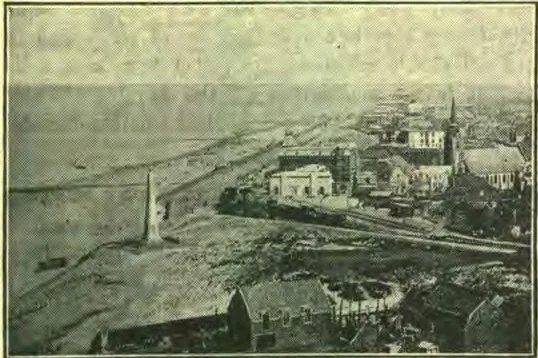
General Vice of Scheveningen Beach with the Various Grand Hotels Where Many of the Delegates Live.
In a discourse delivered at The Hague during the conference, Baronness von Suttner declared: "War has made its home at this conference. War has been announced before the world as unavoidable. To war, nine-tenths of its labors are being devoted, while one-tenth is devoted to peace, taking care at the same time to leave the doors open for war to rush in. . . . The conference has legislated as to how the future war is to be conducted."
This paper not being a military paper, the reader will excuse us if we pass rapidly over the numerous and complicated war regulations which occupied the meetings of the four committees and their sub-committees. As one pores over the long columns of matter made up by the reports of these committees, the impression received is that of a well-organized Military Chautauqua with the best specialists from all over the world as instructors. All the details and emergencies of war, all its brutalities and horrors are coldly weighed, calculated, and regulated. Here and there some infernal weapon is considered rather too cruel for this civilized age, and is thrown out by a small majority, or even by a unanimous vote. Some cruel bullets (like the dumdum, forbidden in 1899) are ruled out, but the "new bullet," equally as barbarous as the explosive bullet, has been retained as allowable. Here is a list of the leading topics of the program for discussion at the conference: declarations of war, when made and if to be made; the right of making war for the recovery of private or public debts (Drago doctrine); the right of seizures; war contraband; destruction of neutral property; transformation of trade ships into war-ships; conditions of a siege and of bombardment of cities and fortresses; floating and submarine mines, when and where allowable, and what kinds; the prohibition of explosive bullets or missiles throwing asphyxiating gases; the prohibition of throwing explosives from balloons; war indemnities to neutrals; organization of a court of appeal on seizures, etc., etc.

Interviews with Delegates.

The writer had opportunity, toward the end of July, of meeting personally with some of the delegates at The Hague. I found that the representatives of the greater powers were quite loath to speak on the matter of the conference and could hardly refrain from smiling when asked what were the prospects for disarmament and general peace. On the other hand, the delegates of smaller powers were more inclined to utter their mind. One of these, representing one of the small Central American republics, answered as follows to my question if he believed that disarmament would be brought about:
"No, I do not; there is among the great powers a whole class of people who live by the military career and who derive pride from it. These old traditions can not be uprooted."
A member of the French delegation to whom I was speaking of disarmament, interrupted:
"Disarmament has not been mentioned; the question is not on the program. As to the question of permanent peace, it is, like the former question, a philosophical matter which everybody is at liberty to solve as he may please."
"In this peace conference which deals only with war," said to me with a smile the delegate of a leading South American nation, "the word disarmament has not been pronounced; as to a permanent peace, some wishes in that respect will be expressed. Only, these wishes are rather unfortunate, to judge by the last conference so soon followed by war."
"What do you think of a European war?"
"It may break out at any moment. It is an unforeseen thing, like an earthquake, there are so many rivalries among the nations."

"Pacifists" Alarmed.

The negative attitude and labors of the conference caused a profound disappointment to those who were watching it with anxiety and were expecting from it the end of the terrible nightmare of general war. The "Independence Belge" received from one of its correspondents the following lines of sad irony:
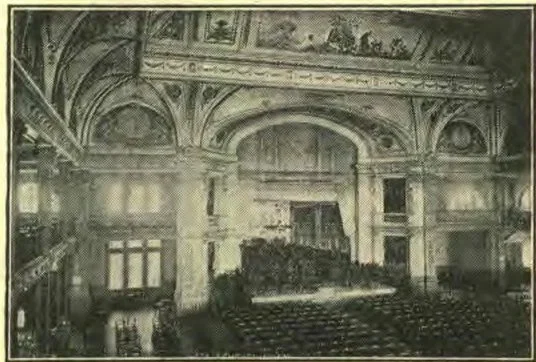
Concert Hall Where Delegates Hold Evening Meetings.
"Those who have read the notes which the presidents and secretaries of the committees and sub-committees of the so-called peace conference have daily passed over to the news agencies, have had opportunity for bitter reflections on the impotency of nations great and small as to peace-making. The propositions of the delegates are indeed intensely pacific: seizures at sea, war declarations, bombardment of ports, villages, and cities, floating mines, war contraband, blockades, etc. If those two hundred and fifty plenipotentiaries imagine that the nations will present them with laurels and triumphal honors for legislating on the most correct manner of killing, mangling, and mutilating their neighbors, they are strangely mistaken."
The International Peace Bureau at Berne, the central organization for the peace societies in the whole world, conveyed to M. d'Estournelles de Constant the "general disappointment regarding the deliberations of the conference," asking him to submit its remonstrance to President Nelidoff.
The Interparliamentary Union—a peace society made up of members of various parliaments—also sent in its protest to delegate Beernaert from Belgium, stating that "public opinion would cast a severe judgment on a tribunal called a peace conference which proved unfaithful to its mission."
The most outspoken expressions of disappointment are possibly those of the "Peace Conference Messenger," edited and published at The Hague by that ardent pacificator, Mr. W. T. Stead. Just two quotations from a hundred:
"The nations of the world which are bending under the growing load of armaments have conceived vague hopes that the governments would succeed in securing them some relief, be it ever so small. If all that the governments can do is simply to express some unimportant, common-place resolution, after which they will give up the problem as unsolvable, the popular mass will draw their own conclusions. They will consider this hypocritical declaration as a public confession of the moral bankruptcy of the existing order. And they will throw themselves into the arms of socialists, who are at the head of the discontented in all the countries of the world."
The same paper compared the conference to an edifice built on a layer of ice growing thinner every day, and thus threatened with being plunged into the deep. "This deep is the dwelling-place of those who own nothing, the abode of the immense majority of humanity, the men and women who perform the hard labor of this world, the workers in the fields, in mines, in factories."
Then aptly quoting our Lord's prophecy, the same paper goes on: " 'Likewise even as it came to pass in the days of Lot; they ate, they drank, they bought, they sold, they planted, they builded; but in the day that Lot went out from Sodom it rained fire and brimstone from heaven, and destroyed them all: after the same manner shall it be in the day that the Son of Man is revealed.' The same thing can be said to-day of the conference now marking the close of the old order of things. They eat and drink and concoct small regulations to perfect the rules of war, not knowing that we are in the last days . . . But, when the old order of things refuses to adjust itself to the new, convulsions, earthquakes, and revolutions take place. These it is precisely the object of politics, endowed with foresight, to foresee and forestall. But when there is no remedy and the time has come to cast off an old regime, there falls upon the great men and statesmen a blindness of judgment, and, happy in their ignorance, like dumb dogs, they await their end. The signs of the times are not lacking for those who have eyes to see. One of them is the expansion of socialism, the nightmare of conservatives. . . . Before the meeting of another conference, the revolution will have broken out."

The Conference Wakes Up.

Finally, the conference woke up. On July 23, a Central American delegate said to me: "At the present moment, neither Germany nor England cares anything about arbitration. And, strange to say, France, always so ready to march toward high ideals, allows herself to be carried along by England, to whom she seems to be allied."
Here something must have happened. A tremendous pressure seems to have been brought to bear upon the great powers by "pacifist" influences. Baron d'Estournelles de Constant was seen taking a fast train to Paris.
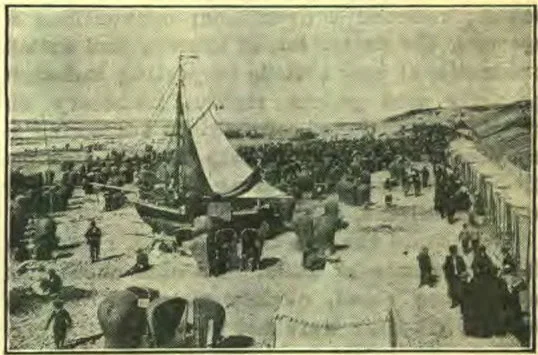
Pauline on the Beach at Scheveningen.
The foregoing protests from peace societies were brought into the conference. A few days previous, on July 17, a deputation composed of members of the English Parliament, headed by Lord Weardale, had been received in the office of Sir Henry Campbell Bannerman, to whom they expressed their astonishment at the cowardice of the English delegation.
Louder and louder in the "Peace Conference Messenger," Mr. Stead thundered the "alarm," "amazement," "disgust," "consternation," and "rage" of peace societies. According to the same paper, the British delegates, who had been instructed to oppose the general arbitration treaty proposed by the United States and the compulsory treaty proposed by Portugal, were then suddenly required to approve both the American and the Portuguese treaties.

A Meaningless Arbitration Treaty.

What are these treaties? Three arbitration projects were presented before the conference and submitted to committee Number 1, of which M. Leon Bourgeois is chairman: one each by Russia, North America, and Portugal. But note: every project and all the amendments proposed expressly excluded from the jurisdiction of compulsory arbitration all conflicts in which vital interests, the honor or the independence of the contracting powers should be involved. One single and noble exception is to be made for the Dominican Republic—the smallest State represented at the conference—which has deposited a wish in favor of "compulsory international arbitration and that without restriction."
The first delegate of Germany, Baron Marschall von Bieberstein, delivered on July 23 a discourse before committee Number 1, in which he said:
"There are conflicts which, precisely by reason of their importance are beyond the jurisdiction of compulsory arbitration. Even the most fervent advocates of the latter recognize that arbitration can not be enforced if the question at issue involves the vital interests and independence of the State. . . . Indeed it could hardly be expected that a State would admit of a third party as a judge in its honor and vital interests."
Listen to the following heroic exhortation addressed to the committee on arbitration by its chairman, M. Leon Bourgeois:
"As to political differences, it does not seem possible at the present time to recognize compulsory arbitration by a universal treaty; but can we not all accept compulsory arbitration in differences of a purely legal character in which none of the States would risk a bloody encounter?"
Think of the Christianity of a decision to resort to arbitration in all such cases where it would be decidedly unprofitable, financially, to go to war! Thus it can be seen that the conference has not aimed with any degree of seriousness at the suppression of war. It has only agreed to arbitrate questions over which the nations would not have thought of going to war even if they had never heard of such a thing as a peace conference.
Here are the leading questions incorporated in the arbitration treaty: Treaties on commerce and navigation; conventions respecting the international protection of laborers; postal, telegraph, and telephone conventions; conventions respecting the protection of submarine cables; railroad conventions; conventions respecting the protection of literary and artistic productions; conventions respecting industrial property and patent rights; monetary and metric conventions; conventions respecting reciprocal and gratuitous help to poor, sick people; conventions respecting diseases in cattle, and agriculture, etc., etc.
Well could the late Count Nigra, member of the conference of 1899, at which these same cases were voted, qualify them as "so miserable that they were not worth mentioning."
And yet it has not been an easy thing for the conference to agree on the above points. Several cases of the same nature had to be struck out of the list.

JEAN VUILLEUMIER.

(Continued Next Week.)

[The above article will be followed by one which sets forth a most beautiful dream of mankind, the City of the Kingdom of Peace. Plans have already been drawn for this city. See also note on our last page. Ed. S. of T.]