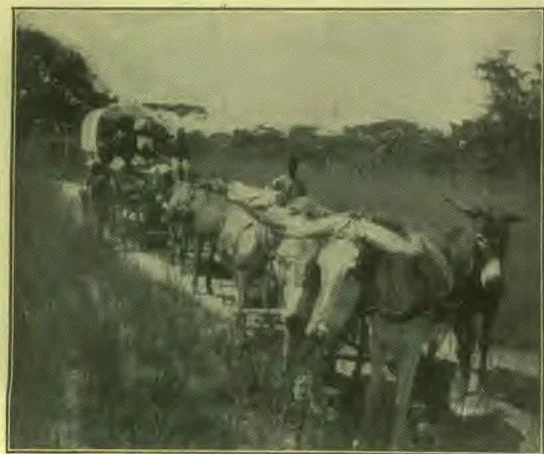
THIS mission is now nearly six years old. Elder F. B. Armitage had been at the old Matabele Mission, now called Solusi Station, four years. He desired to open another mission farther north, so he obtained ten donkeys, and a big emigrant wagon. Then, like Abraham, he took his journey toward a land which the Lord would show him. After eight days of steady travel, partly by day and partly by night, over sand and stones, often with no roads, or but a cow-path, a suitable place was found among kraals of the Shuna tribe. The mission site is 150 miles northeast of Solusi, in the Somabula Forest. Gwelo, on the Beira-Mashonaland Railway, thirty miles away, is the nearest station and post-office. Gwelo resembles one of the frontier towns of the West, set in the open country, and bounded only by space. Its people number about fifty white and two hundred black.
The "forest" mentioned above is so unlike those of the States you would not recognize it as such. The average height of the trees is twenty feet. One scarcely ever reaches thirty feet. Eighteen inches is the maximum diameter, and many of the trees have flat, spreading tops. The soil is sandy, and very little underbrush grows here, so with the trees growing far apart, the forest looks considerably like an orchard when seen from a distance. Most trees here are deciduous, the leaves falling in June. The boards used for seats in the school are sawn by hand from the mletindaba tree. These boards are one foot wide, fourteen feet long, and one inch thick. The wood is hard, very heavy, and resembles walnut somewhat. The impaca is a more common tree, the wood of which is very hard, and is used for repairing wagons and things requiring great strength. The mangwe tree is used for making ox-yokes.
No land is sold here, so Elder Armitage rents as much as he desires to cultivate. The rental is fifty cents an acre a year. This Somabula district is a native reserve, which is the reason land will not be sold. The British South Africa Company governs the vast territory named Rhodesia under charter from the king of England. This company reserves certain regions where minerals are supposed to exist in which mining rights are sold for revenue, besides the native and game reserves.
Much complaint is heard from all classes against government injustice. You will notice on the stamp of this letter the motto, "Justice, Commerce, Freedom." The people of the country would render the motto thus: "Injustice, Extortion in Trade, Bondage." One complaint of the natives is against the poll-tax. Each man and each boy above a certain size must pay five dollars tax yearly. The size of boys is the standard, because neither the boy nor his parents know his age. No record is kept of the time of birth nor of any event whatever. The tax is excessive, being double that in most parts of South Africa. Besides this poll-tax on men, those having more than one wife must pay $2.50 on each one besides the first. So a man having ten wives and ten boys over about twelve years of age must pay $77.50 taxes.
District
## CERTIFICATE OF NATIVE MARRIAGE.
Under Ordinance No. 2, 1901.
No. 84. Date 16th August, 1905.
Name of Husband Warbaga
Kraal Warbaga's
Chief Mpabangi
Name of Wife Malalu
Wife's Father or Guardian Movelepi
Chief Washiya
No. of Wife Fifth
Name of Deputed Headman (if any) Goboba
No. of cattle or other consideration paid Three head of cattle.
Whether wife freely consented to marriage Yes
Signature—
Native Commissioner or Marriage Officer.
Few men here are able to afford more than five wives, and the average is probably three. Girls are practically auctioned off to the highest bidder. When a girl arrives at a marriageable age,—which is very young, only fourteen or fifteen, and often younger,—a man who wants her goes to her father and offers what he can afford, called lobolo. It may be three cows, worth $25 each. The father puts him off. Soon another suitor comes with an offer of four cows, and the girl becomes his property. Usually the girl is agreeable to the arrangement, but if not, the father's will rules. It is the ruling desire among native girls to marry at the earliest possible age. Many native young men find it quite a hardship to get means for even one wife. A man can earn only $3.50 to $5.00 and food a month for his work. A young man must pay his taxes, clothe himself, buy wedding-clothes for his bride (in case they wear clothes), build a house, buy pots, etc., besides paying lobolo. One maiden at this mission objects to being sold. Her intended has a house built and all is ready for the marriage when some relative
of the girl informs them that lobolo must be paid. I am told the government has a law requiring its payment. So the couple are waiting.
The writer knows the chief named herein and saw the original legal certificate of which the above is an exact copy. But the natives seldom report marriages until discovered by infrequent visits of the police, thus avoiding the wife's tax.
Marriage customs in this country tend toward degeneracy of the race. As a rule, agreement of the parties is the only ceremony required, civil or moral. It is thought by some writers that since tribal wars and the slave trade have been stopped by European influence, there will be a great increase in population. While this may be the case, with the increase of population comes an increase of physical and moral weakness. Morality is at a low ebb and chastity almost unknown.
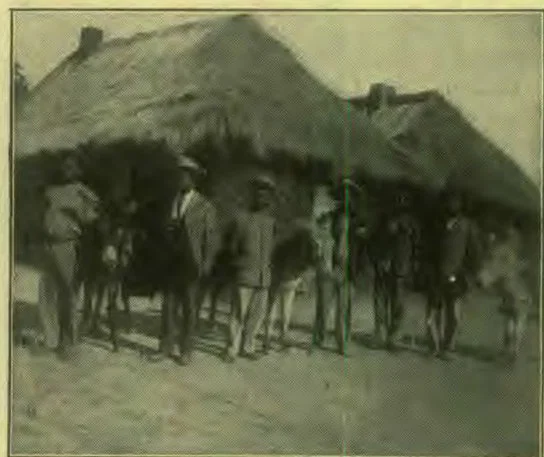
In the Somabula (Rhodesia) Mission, there are seven or eight young men who are to go out as teachers. I want to tell you the conditions under which they must work. The native kraals where they start schools are altogether heathen. Nearly all the people are unclothed. They know almost nothing of God and His salvation. They do not even know enough about education to understand the value of a school. I was greatly surprised to learn that these teachers sent out from our mission must provide their own food, buy school supplies, and teach for nothing. They receive no pay whatever from the natives. They even put up their own schoolhouses. Fortunately, this is not a very difficult or expensive affair, as it is a building of poles. It is made of "mud and wattle," with a thatch roof and no floor. So you see that our native teachers have very little to encourage them. They are paid a small wage by our mission, which is just enough to supply them with clothing; their food is also furnished by the mission, the teachers themselves being obliged to grind this grain for their own use while out teaching. I am told that the natives in some places provide the food for the teachers. You see, we must first teach these native people the value of learning to read the13Bible. They can not appreciate what learning will do for them. It is our plan to train a few young men in the common branches and the Bible, and send them out to teach their own people. These teachers are taught to read English, so they may read our books, and thus be learning more and more of the truth.
Yet out of these unpromising conditions some bright, beautiful characters are formed. The transformation seen in some boys and girls is marvelous. Within a mile of this mission are many kraals where unclothed natives live in all the degradation of heathenism. Beer drinks, with drunken quarrels, are periodical. Killing of infants is a common practise. But from these same kraals boys and girls are now in the mission, clothed plainly but cleanly. They read and speak English, in which they are rapidly improving. And best of all, they are converted members of the church. Some have already held successful schools in the native kraals, and after further training they are to be sent out as evangelists. Native young men conduct regular services here at the mission and preach creditably in their language. This is our hope of quickly carrying the message to Africa—to train native evangelists in our mission schools. But carrying this everlasting Gospel to the heathen world is a mighty problem to be solved. It will exhaust all our resources, and happy we are in having the resources of the Infinite at our demand. Shall we bend to the task, and put our all into accomplishing our God-given commission?
Cholo, B. C. A., July 15, 1907.
On the Move in Rhodesia, Africa. Pastor Armitage Driving.
Mission Houses. Teachers Starting to Their Village Schools with Mules Laden with Supplies.