WHILE the Koreans have been greatly influenced by their neighbors, they nevertheless have many customs and ways of doing things that are quite peculiar to themselves. Some account of these peculiarities may be of interest to the readers of the SIGNS OF THE TIMES.
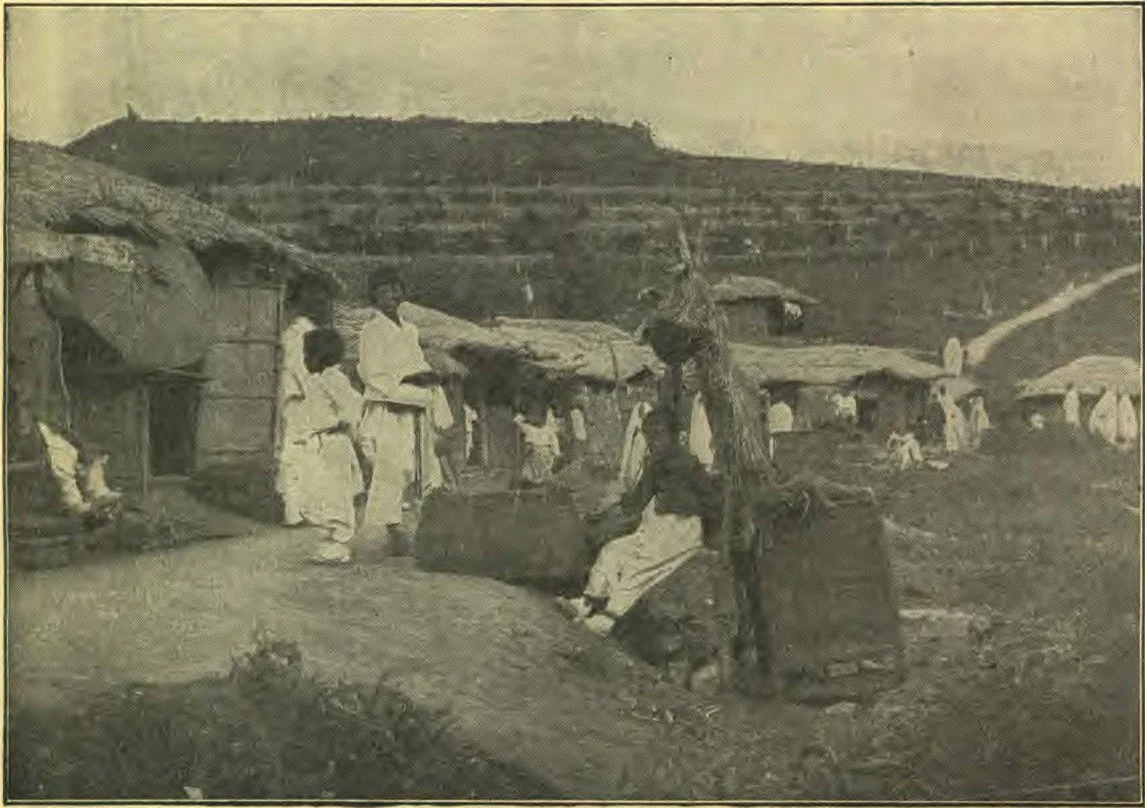
Korean dwellings are not peculiar in that they are almost invariably grouped together in villages, even in the country districts; for this custom prevails thruout the Orient. But Korean houses are peculiar, both in structure and meanness; for it has been said that of all civilized people the Koreans have the poorest dwellings. The walls are made of mud plastered onto a lattice work of small poles, or of stones or tiles laid in mud plaster. The roof is a thatch of straw or reeds over rafters of small, crooked poles. The doors and windows are of latticework, covered with white paper to admit the light. The mud walls dry and crumble, and need frequent repairs.
Queer Houses.
But the most peculiar part of the house is the floor, with its arrangement for heating. The kitchen, usually located in one end of the rectangular structure, has no floor except the solid earth. Here is the fireplace, over which the food is cooked, and which furnishes the heat to warm the other rooms. The floors in the rest of the house are constructed as follows: Parallel walls of stone and mud about a foot high and a foot apart, are first built; then the spaces between these are bridged over with flat stones, and the surface is leveled up with a layer of mud plaster. The resulting flues beneath the floor are connected with the fireplace in the kitchen, so that the hot air and smoke traverse the flues, and warm the floor. This method is said to be a very effective way of heating, but is very expensive; for fuel is scarce and dear. When the mud cracks and lets in the smoke, it must be repaired with fresh mud. In the better class of houses the earthen floor is covered with oiled paper, which is a decided improvement.
Korean Dwellings of the Humblor Sort.
The houses of a country village are crowded close together without any regular arrangement. In place of streets, narrow paths wind here and there, to suit the location of the houses and the lay of the land. In the larger towns there are streets, but these are narrow and crooked. Some of the older and more important cities are enclosed by walls, after the ancient manner. Among these are Pyeng Yang, the old capital, and Seoul, the present seat of government. The walls of Seoul are in a fair state of repair; but those of Pyeng Yang show many marks of wear and war.
Agriculture and Primitive Methods.
Agriculture is the principal occupation of the people, and the methods of labor are very primitive. An outfit for plowing the soil consists of a small wooden plow with a shovel-like iron point, drawn by a small cow.
Another arrangement for turning the soil is an iron shovel with a long handle, and a rope fastened to each of its corners. One man works the handle, while two or more persons pull the blade into the ground by the ropes. It has been pointed out that this shovel is a fair sample of what the Koreans regard as a labor-saving machine; for it saves one man from doing the work that five men can do with much greater ease.
Human Transports.
Wheeled vehicles are practically unknown in Korea. All sorts of commodities are transported upon the backs of men, even for considerable distances. Women carry their burdens upon their heads. Ponies and donkeys are also used to carry burdens; and it is a somewhat ludicrous sight to see a portly Korean riding on a pony or donkey but very little larger than himself. The ordinary roads thru the country are only narrow footpaths, but they are quite in accord with the methods of travel.
Korean Dress.
The most striking peculiarity of the Korean costume is that nearly every garment is white. The summer clothes of the common people are of undyed cotton or linen; the winter garments are of the same material, made warm by being quilted with cotton. The wearing of white clothes imposes an arduous task upon the wives and mothers of Korea. As we stood upon the slopes of Nam-San overlooking the city of Seoul, the sound that rose above all others was the whack, whack, of the laundry sticks. The clothes are first boiled in lye, then taken to the nearest well or stream, soaked in the water, and beaten with a club upon a flat stone. When dry they are folded and laid on a smooth, flat stone, and again beaten with light clubs till they take on a polish resembling that of dull satin. The process thruout is quite effective, and one is surprised at the whiteness and glossiness of the well-dressed gentleman's garments; but it requires an immense amount of labor. However, the government has recently taken action, advising the people to wear clothes of darker colors; and a few of them are beginning to act upon the suggestion. This action of the government is interesting as indicating the force of custom in Korea, as well as the peculiar realm of Korean law.
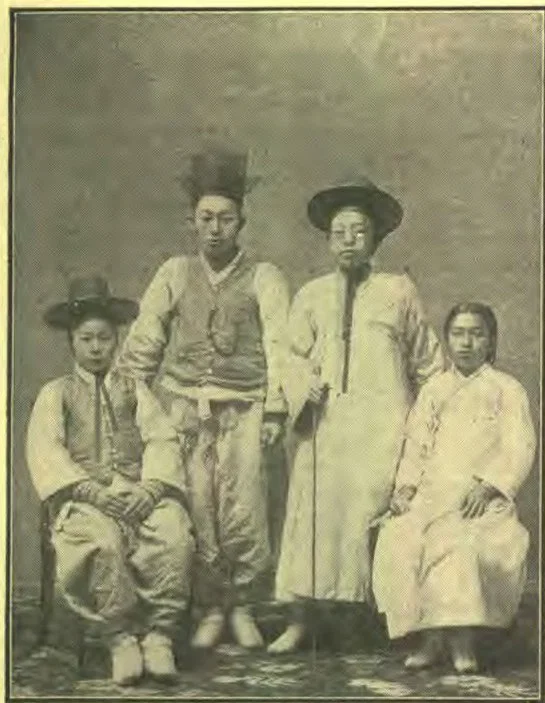
Perhaps nothing better illustrates the force of custom in Korea than the matter of wearing hats. Boys wear their hair in a long braid down their backs, the same as girls. But when the young man marries, his hair is combed up and twisted into a slender coil or "topknot" on the crown of his head. At the same time he assumes the dress of a man, which includes a peculiar head-gear of black horse-hair, and a straight-rimmed, taper-crowned hat. The boy has become a man; but an unmarried man may not dress his hair into a topknot, nor wear any kind of hat or hair head-dress.
There is quite a variety of hats and head-dresses worn; and it would require a lengthy chapter to describe them, and to enumerate all the rules and customs connected with their use,—black hats and white13hats, mourning hats, and mourning caps, servants' hats, and head-dresses for old men, young men, and scholars. But all this might seem trivial and tedious. These old customs seem to be losing their force to some extent, and it is not uncommon to see young men with their hair cut after Western fashion.
Korean Men in Native Dress.
The Custom Concerning Marriage.
In Korea as in other oriental countries, marriage is not the result of mutual love and choice, but is arranged for the young people by their parents. The usual age at which both men and women marry is seventeen or eighteen years; tho it is not at all uncommon for boys not yet in their teens to marry. Marriage in Korea is anything but a love affair. It is proper for a husband to treat his wife with respect; but he would become an object of ridicule were he to show affection for her. Among the higher classes it is "good form" for him, three or four days after the wedding, to leave home for a length of time to show his indifference toward his wife. Conjugal fidelity is a feminine virtue only, and concubinage is not uncommon. A marriage once contracted is not easily broken; for if a man divorces his wife, custom forbids him to marry again.
The Seclusion of the Women.
From the age of seven a Korean girl is carefully secluded in the women's apartments of her father's house; and when she marries, she passes to a similar seclusion in her husband's home. Among the middle and upper classes, this seclusion is as complete as in the zenanas of India. Only servants and the lowest class of women may go abroad by daylight without restraint. Women of the common people are often seen upon the streets; but at such times they wear a long garment thrown over the head, and held closely about the face. The native Christian churches are usually divided into two rooms by a partition or curtain, the women occupying a room by themselves.
This custom of secluding the women evidently must greatly affect the social life of the people. There can be no promiscuous gatherings of men and women. If women make or receive calls, it must be done with the utmost privacy. Men receive and entertain their friends with neither mother, wife, nor sister present, to add charm and grace to the occasion. While on a missionary tour in the country, we were entertained at a certain village by a well-to-do man, who was interested in Christianity. The rooms assigned to us were not connected with any other rooms of the house. Here we ate and slept, received callers, and held our meetings. At meal-time our food, prepared in the kitchen and served upon tiny, tray-like tables, was brought around the corner of the house to our room by some of the men folks. And during our stay of several days, neither woman nor girl was seen, heard, nor even mentioned. This circumstance brought forcibly to our minds the need of women Bible workers and evangelists to carry the Gospel to their secluded Korean sisters.
They Are Hospitable.
While there are many things among this people to call out adverse criticism, it must not be thought that they have no virtues. On the contrary, they are kind and hospitable to guests, providing the best that their humble homes have to offer. The unsalted mixture of rice and beans may be unsavory to our cultured palates, and the thin mattress spread upon the hard floor may supply scant comfort for a night's rest; but the welcome we receive proves that true hospitality is not dependent upon affluence. Such a hospitable people ought to be especially susceptible to that divine truth expressed in the familiar words of the Saviour,—"It is more blessed to give than to receive." In holding up to view some of their faults and deficiencies, I have not meant to excite blame or ridicule, but rather a kindly sympathy that may lead to efforts for their uplifting.