A writer of the sixteenth century in the vigorous style of that period described Calabria as “the trembling land.” This province forms the toe of the Italian boot and there very often the shoe pinches. In fact all of Southern Italy is more or less subject to the dangerous caprices of nature. One moment the country is heaving to and fro like a ship at sea, in the iron grasp of the earthquake giant, and in another, smoke, fire, and lava are being belched forth from the bowels of the earth thru the mighty crater of Vesuvius.
Only two years ago Calabria passed thru a fearful earthquake experience which left a large part of the province devastated and desolate. But the people are courageous and the work of restoring the towns and villages destroyed by the earthquake was soon begun. From all Italy came contributions of money and provisions. The city of Milan alone helped to erect two new towns near the site of the ones that had been shaken down by the earthquake.
Just as the Minister of Finance and other governmental and provincial officials were on the point of inaugurating some of these new towns, the earthquake giant again arose in his might and shook violently that section of the province adjoining the one previously devastated.
It has been said that during the interval from the earthquake in 1905 to the present one, the earth has been in a continual tremor, as shown by the seismographic instruments, but not sensible enough to be felt by the people. The seismograph registered from the time of the earthquake of 1905 to July, 1906, the space of about a year, as many as 300 distinct shocks in this region.
This last earthquake, it is claimed, came as a culmination of the uncertain state in which Calabria has found itself ever since the previous great scourge. But be that as it may, yet we see that the old earth, as a man at advanced age, is becoming unsteady in its gait and is in a state of tremor because it also is approaching the end of its days.
The towns and villages that suffered the heaviest in this last earthquake were for the most part situated high up among the mountains, overlooking the blue waters of the Ionian, the sea of Pythagoras and Praxiteles. The well-cultivated vineyards and groves of orange and olive trees that clothe the mountainside indicate that the people are thrifty and industrious.
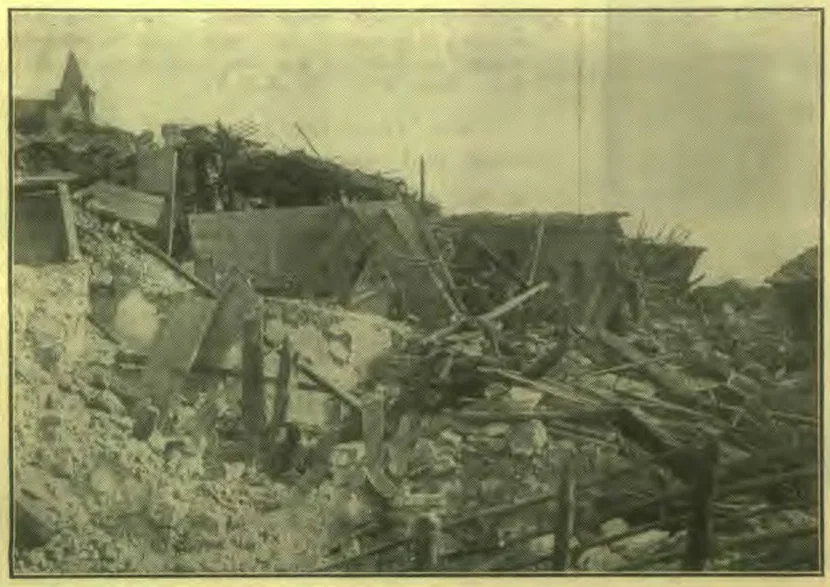
A Section of Ferrazzano as It Appeared after the Earthquake.
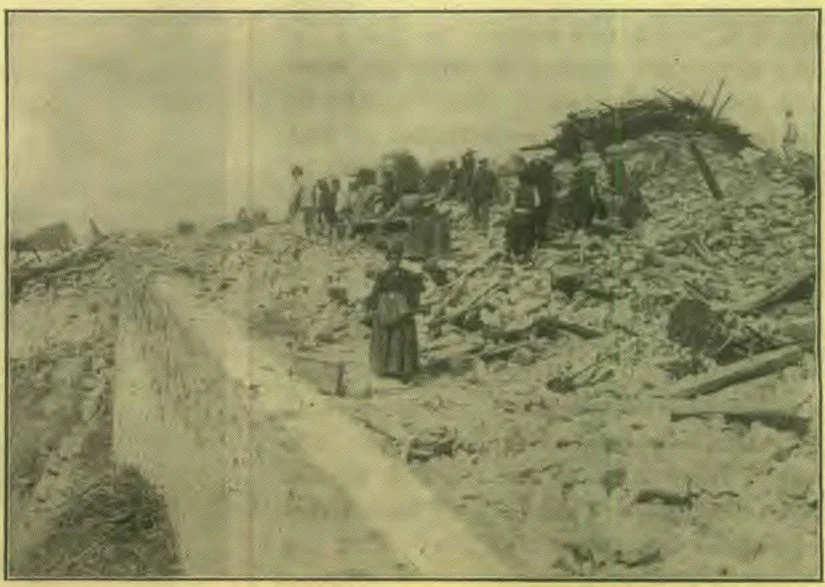
In the Wake of the Earthquake: Not a House Left Intact.
Calabria formed a part of the ancient Magna Grecia, which derived its name from the powerful Greek colonies that in very early times studded this part of Italy. Pythagoras here founded a school of philosophy to which even the great Plato came to cultivate his mighty genius. And also in its magnificent scenery Calabria partakes much of the nature of Greece. The oranges of Calabria are among the finest to be had anywhere.
The people of the stricken districts, living mostly among the mountains, were accustomed to retire early and were therefore wrapped in deep sleep on the evening of October 23, the fatal night that marked the death knell for many of them.
About nine o’clock that evening the earth began to rock to and fro and play havoc with its slumbering children. There was first a slight shock which was quickly followed by a very severe one. And in ten seconds the earthquake had transformed flourishing towns and villages into cemeteries and heaps of ruins.
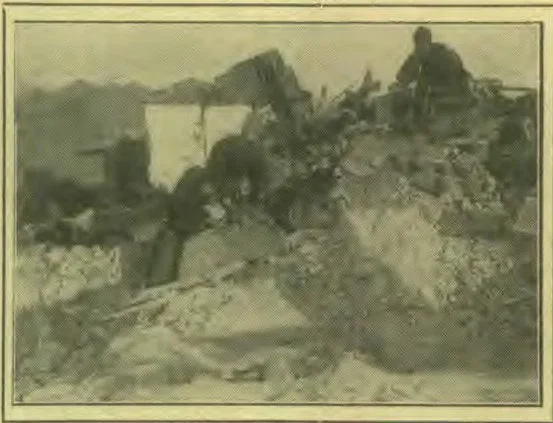
Hunting for Their Scanty Belongings after the Calabrian Earthquake.
Upon the town of Ferrazzano, with its 2,500 inhabitants, the earthquake struck in all its fury. Many of the inhabitants were buried under the roofs and walls of their own houses, while wrapped in slumber. Some, as if by miracle, escaped; others ran out into the open country, while some badly wounded perished during the night for lack of assistance.
The earthquake throwing down the homes of the people and spreading death and distress everywhere was assisted in its destructive work, as if by the cruel irony of nature, by the blackened skies that poured down their abundant stores of rain in drenching torrents. In that terrible moment those that had escaped with their lives, terrified beyond measure, sought refuge in the open fields, where the rain beat mercilessly down upon them. With the clayey constituency of the soil we can well imagine that there must have been desolation personified.
When the morning dawn shed forth its gleams upon the grewsome spectacle, crowds of pale, terrorized people could be seen thoroly drenched from the rain and trembling from the cold, as these towns are situated high up among the mountains. Almost all the houses were razed to the ground while the few that remained standing were in danger of falling at any moment. Pieces of walls and roofs were balanced in air as if by a miracle of equilibrium. The town was literally deserted. On the heaps of ruins some old women were endeavoring to gather up a few of their scanty belongings. One old lady sat on a desolate pile that once represented her home crying, “My poor boy, my poor boy!” Entire families were wiped out, and in some instances there were children left orphans or a lone father wandering about deprived of his entire family.
As the work of rescue began the people crowded upon the spot, each anxious to find a lost relative or friend. One man that had been for some time buried under the ruins was pulled out by the soldiers and found to be alive. He looked about him for a moment and then ran down the street crying for joy. One can hardly imagine the touching scenes that took place when some one that was thought to be lost was found safe and sound and joyfully embraced by his dear ones.
In one town called Gerace Marina four-fifths of the houses are down, while Brancaleone was almost entirely destroyed. Without11going into detail on the extent to which the different places suffered, suffice it to say that twenty-seven towns and villages suffered heavily in the earthquake while there were twenty-eight others that were less severely damaged.
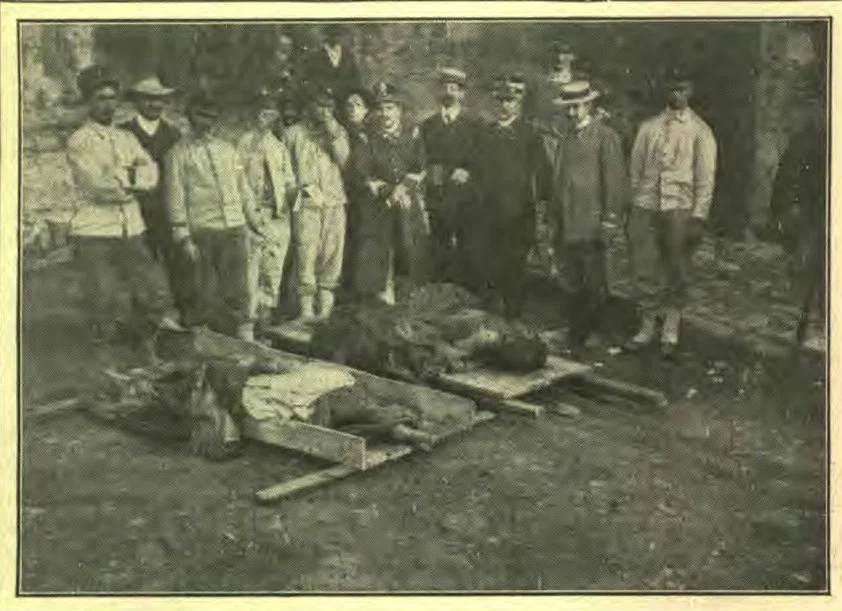
At first the number of those that perished in the earthquake was reported to surpass five hundred. But an accurate and careful examination revealed that the death-list is not much over 200. However, besides these, many were wounded, hundreds of houses have been destroyed, and thousands are camping in the open air.
The government immediately despatched a war-ship and a large number of soldiers to the scene of the disaster. Thus was quickly begun the work of rescuing those buried under the ruins, and giving aid to the wounded and suffering. Lumber was also sent from northern Italy which was accorded free transportation by the railroads, to be used for building temporary huts for sheltering the homeless people from the storms.
The different cities of Italy contributed liberally to aid the inhabitants of the earthquake-stricken districts. The king of Italy immediately sent $20,000 to alleviate the suffering of his afflicted subjects. The students of the different large universities of Italy went thru the streets of their respective towns soliciting money, provisions, and clothing for the homeless of Calabria. In Milan alone they gathered about $7,000.
Victims Extracted from the Ruins.
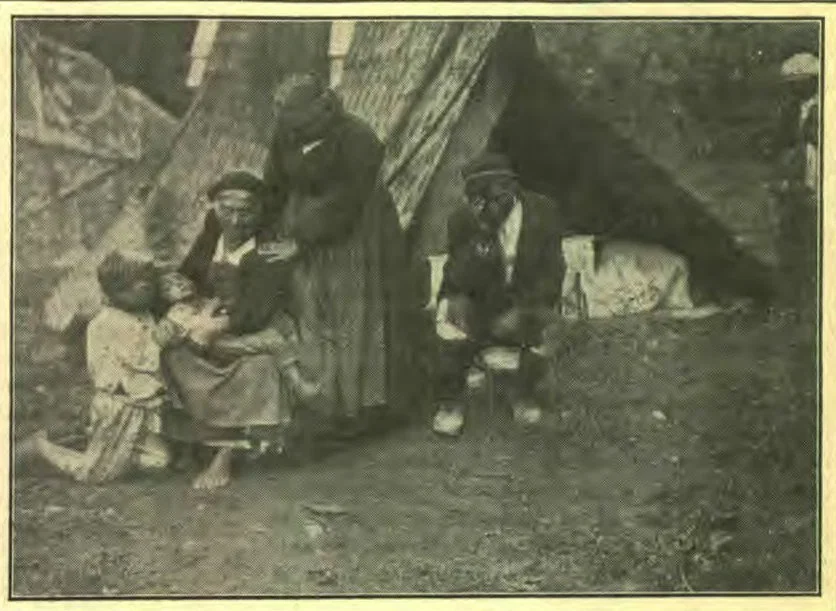
A Forlorn Family Rendered Homeless by the Earthquake.
The Catholic Church came forward and loudly lamented the sad fate that had overtaken the poor inhabitants of Calabria. It generously offered its aid; however, in caring for the dead rather than the living. So solemn masses were proclaimed for the suffrage of the souls of those that perished in the earthquake. The emissaries of the church went around from house to house collecting money to pay for these masses. A goodly sum was thus gotten together. The masses were celebrated with much pomp and ceremony, and the money collected went to pay for the same and consequently safely found its way into the coffers of the church. Thus the church helped the victims of the earthquake by helping itself. But I might add that something was done by the Catholic Church toward collecting money also to help rebuild its churches that were destroyed or damaged by the earthquake. The church of Rome knows how to turn ever the calamities of the people to its profit.
Also in Italy the earthquake played its caprices. In one place it left the upper half of the town untouched, while in the lower half not a house was left intact.
On the morning following the earthquake a reporter met a lady carrying a nine-months’-old baby in her arms. The babe opened its bright eyes and smiled sweetly at him, happily unconscious in its innocency that it was alone in the world. On the evening of the earthquake the father, mother, two brothers, and a gardener were crushed by the house falling upon them. But the mother by the maternal instinct of her nature bent herself over her babe and in that position perished. The babe was found the next morning, alive and unhurt, lying between the right hand and body of its dead mother.
A boy was deprived of his parents and all his relatives by the earthquake. The small savings of his people were lost; the home was carried away and dashed into an abyss, 1,300 feet below, and even the ground upon which it stood was altered beyond recognition.
These momentary tremors of the earth involving but a corner of its surface can give us some slight idea of what that day will be of which it says, “And EVERY mountain and island were moved out of their places.” These are forerunners of that time, announcing in no uncertain tones that that day hasteneth greatly.