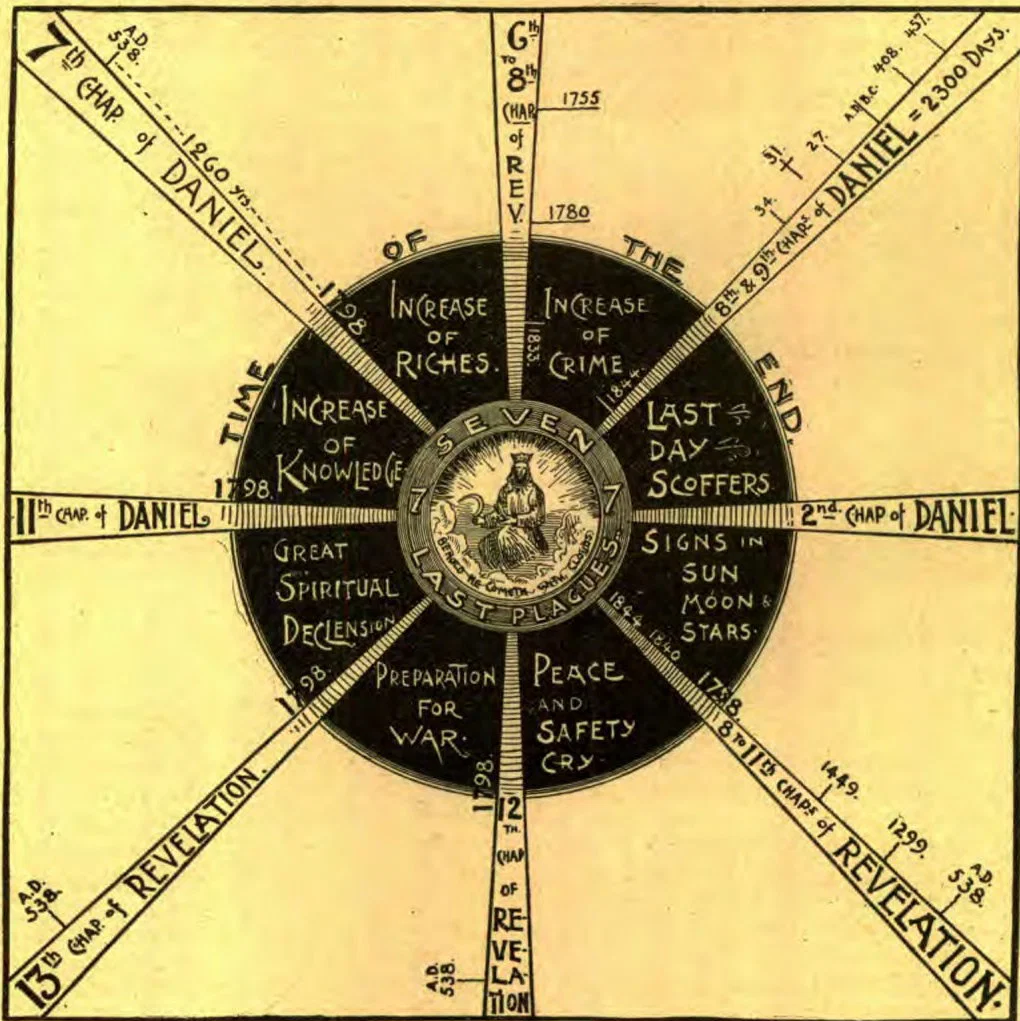
THAT the coming of our Lord in glory is near, is manifest in fulfilled and fulfilling prophecy. And this is especially true in the culmination or closing of the prominent lines of prophecy, which were given centuries ago for the very purpose that those who should observe the progress of events might discern the signs of the times, and be ready for the great event to which they pointed.
In the Book of Daniel.
In Daniel 2 we have, in the prophecy of the great image shown to Nebuchadnezzar in a dream, the advance history of the world from that time to the establishment of the kingdom of Christ in the earth. In the four sections of the image were the representations of four universal kingdoms, beginning with Babylon. These were to be the only kingdoms of such extent until the eternal kingdom should be ushered in and fill the whole earth. The prophecy has been fulfilled in the rise and fall of Babylon, Medo-Persia, Grecia, and Rome. The territory of the Roman Empire is now in the divided state indicated by the iron and clay of the feet and toes. The only unfulfilled part of the prophecy is that the God of heaven will set up a kingdom which will fill the whole earth, and will stand forever.
In the seventh chapter of Daniel the same ground is covered by another line of prophecy, the difference being that the characteristics of these four great kingdoms are given by symbolic beasts. As the four universal kingdoms before mentioned are the only ones the world has known, the fourth must be Rome. The last phase of this empire was the domination of the Papacy, symbolized by the little horn, of which the prophecy says, "He shall speak words against the Most High, and shall wear out the saints of the Most High; and he shall think to change the times and the law; and they shall be given into his hand until a time and times and half a time." All of this is in the past, and the next view the prophecy opens is of the judgment, and the everlasting kingdom.
We have this history line upon line, that it may be deeply impressed upon our minds. In the eighth and ninth chapters the story is repeated with further variation. The prophecy is given just as Babylon is passing away and Medo-Persia comes into actual view, and for this reason Babylon is omitted. Medo-Persia and Greece are specifically named in their order; therefore the succeeding one is Rome, as Rome followed Greece in history. The description also fits Rome, and fits no other; for "he"—the "king of fierce countenance"—"shall stand up against the Prince of princes." But, as in the case of the great image, "he shall be broken without hand."
This prophecy also shows a definite time that ended in 1844, at the close of which would begin the investigative judgment.
The eleventh chapter of Daniel is a prophecy beginning in the time of the Persian dominion and reaching to the time when Michael shall stand up (chapter 12:1). Events which have transpired during the past century, up to the present time, are described in this prophecy as pertaining to "the time of the end."
Predictions of Our Lord.
In Matthew 24, in Mark 13, in Luke 21, our Lord has set forth what should come to pass, covering the time from the destruction of Jerusalem to the second advent. Certain signs in the heavens were given to indicate the approach of the end. All but one of these are in the past, and "this generation shall not pass, till all these things be fulfilled." Certain conditions were foretold, and these conditions are everywhere manifest to-day.
What Paul Declares.
In the second chapter of 2 Thessalonians is a brief prophecy covering the period from the time of its writing to the coming of Christ. The "mystery of iniquity" was working in the church at that early day, and would increase until it developed "the working of Satan with all power and signs and lying wonders, and with all deceivableness of unrighteousness," just before the coming of the Lord. The world to-day is overrun with these deceptions, which are permeating the nominal churches of Christ to such a degree that they would deceive, if possible, the very elect.
In the Revelation.
Chapters 2 and 3 of the Revelation contain a prophetic history of the church from John's day to the time when the Lord stands at the door and knocks. The conditions described as obtaining in the last period of this history are significantly prevalent in our time. The message of Inspiration says: "I know thy works, that thou art neither cold nor hot; I would thou wert cold or hot. So then because thou art lukewarm, and neither cold nor hot, I will spue thee out of My mouth." Lukewarmness in the churches is the general complaint of church officials and journals in our time.
Chapters 5–7 present in a prophetic line the Gospel work, both in heaven and on earth, from the ascension of Christ to the time of His return. The successive phases of this work and the experiences of the church are set forth under the symbol of a seven-sealed book. The sixth seal (or chapter) closes with the sealing of the people of God—placing on them the mark of final approval. This is the judgment work, and it is marked in the prophecy by events in the earth that lçcate it beyond doubt in our own time. The seventh sea¹ opens to the advent of our Lord.
The Seven Trumpets.
In chapters 8–11, another prophetic line presents an outline history of political events from the breaking up of the Roman Empire to the coming of the Lord in glory. In this revelation of then future events we have the symbol of seven trumpets. It is well to note that the number seven in all these features of the Revelation implies completeness—the end of the prophetic story. These seven trumpets sound in succession, revealing successive events. The sixth, which ends with the ninth chapter, discloses the passing of the Turkish Empire under the control of the European allied powers, August 11, 1840. This is followed by the great advent movement, as foretold in chapter 10 and chapter 11 to verse 14. Then the seventh trumpet announces the kingdom of Christ, with the assurance that "He shall reign forever and ever."
The Great Controversy.
The twelfth chapter opens to view the great warfare of Satan against Christ and His church, from the birth of Christ till the time of the "remnant" of the church. The remnant must be the last of the web—the closing generation. It is said that Satan makes war with this remnant because they "keep the commandments of God, and have the testimony of Jesus Christ." For fifty years the people who answer this description have been subject to this warfare.
In the prophecy of chapter 13 we have the symbol of a great composite beast, which represents the principle of church and state government, especially as represented by Rome under the guise of Christianity. There is represented the wounding unto death of this power, and its eventual restoration, which in chapter 17 is shown to be but for a short time. There is also a two-horned beast, or government, which at first manifests a mild, lamb-like character, but in time assumes the dragon-like character of the "first beast." It practically becomes the servant of the "first beast." All this is being fulfilled in a marked manner by the increasing influence of Rome in the governments of earth, and especially in the great American Republic, which, in every particular, answers the prophecy of the two-horned beast. But the near consummation of the careers of these two powers is so plain to the student of prophetic history—as also to the student of current political events—that the end is virtually in sight. The next scene opened by the prophecy is "the Lamb standing on the Mount Zion." Chapter 14: 1–5.
All these lines of prophecy culminate in "the time of the end," and bring us to the conditions noted by special predictions—such as the increase of crime, spiritual decline in the churches, the accumulation of wealth, the rise of false prophets, and their working of deceptive signs and wonders. These conditions are matters of general remark, and no one need be mistaken as to their portent. "The coming of the Lord draweth nigh."