EN ROUTE TO CHINA

5%

EN ROUTE TO CHINA.

A Glimpse of Japan.
BY A. C. SELMON, M.D.
We sailed from Vancouver, British Columbia, October 5, on the royal mail steamer, "Empress of India," en route for the province of Honan, China. This is one of the three fastest trans-Pacific boats, making the trip of forty-three hundred miles to Yokohama in thirteen days. On this trip she carried two hundred first-class passengers, twenty intermediate, and four hundred steerage, besides the officers and crew.
We had very nice weather, with the exception of two stormy days. The route lying so far north brought us into a very cold climate, and we were obliged to put on all our winter clothing. We sighted several islands belonging to the Aleutian group, which were very barren-looking places. A race of little people called the Aleutians makes its home here. Crossing the hundred and eightieth meridian, we dropped one day. Retiring Monday night, we awakened on Wednesday morning.
As we neared Japan, one of the first things that attracted attention was Mt. Fujiyama. It is twelve thousand three hundred and sixty-five feet high, and its snow-capped summit, towering up into the clouds, can be seen for hundreds of miles in every direction. It is an old volcano, and even yet occasionally grumbles and belches out smoke and ashes.
October 20 we anchored in the fine harbor of Yokohama. Here a busy scene was presented. There were large freight and passenger steamers, and several war vessels, among them two American men-of-war.
No sooner had we cast anchor than the ship was fairly besieged by every kind of Japanese craft, from a steam launch to a sampan. The sampan is a Japanese boat but little larger than the ordinary rowboat. It is propelled from the stern by a peculiar bent oar, that is moved from side to side in the water in a manner they call sculling.
Going ashore, we had our first real taste of Japanese life in taking a ride about the city in a jinrikisha, which is a two-wheeled cart that carries one passenger. The seat is provided with a good spring, that breaks the force of the jolts and jars, and the motive power is furnished by a sturdy little 'rikisha man, who steps into the shafts and starts off at a rate almost as fast as a horse will trot. These men have wonderful endurance, for they will keep up this rate for hours at a time. We paid them twenty sens for an hour's ride. This is equivalent to ten cents, United States money.
It is remarkable to see how the Japanese are imitating American and English ways. Every Japanese is eager to learn the English language. They have quarantine laws as strict as those of the United States. They have a gold standard for their money. The streets are well paved, tho only half as wide as those we have been accustomed to see. Bicycles are a great favorite, and they are very numerous. At present large numbers of automobiles are being introduced.
Passing along the streets, one sees an endless variety of shops. The front of the shop, facing the street, is open, and in this way the whole stock of goods is displayed in such a manner as to catch the eye of the would-be purchaser. Looking in, you see the shopkeeper seated on the raised floor, with samples of his goods all about him. When you go to make a purchase, you can count upon it that he will ask you double the price he expects to receive.
On our tour of the city, we did not see more than a dozen horses, and the majority of these were used by the foreigners for carriage horses. Some few are used by the Japs for dray horses. They are always hitched single, and are led by a halter, and never driven.
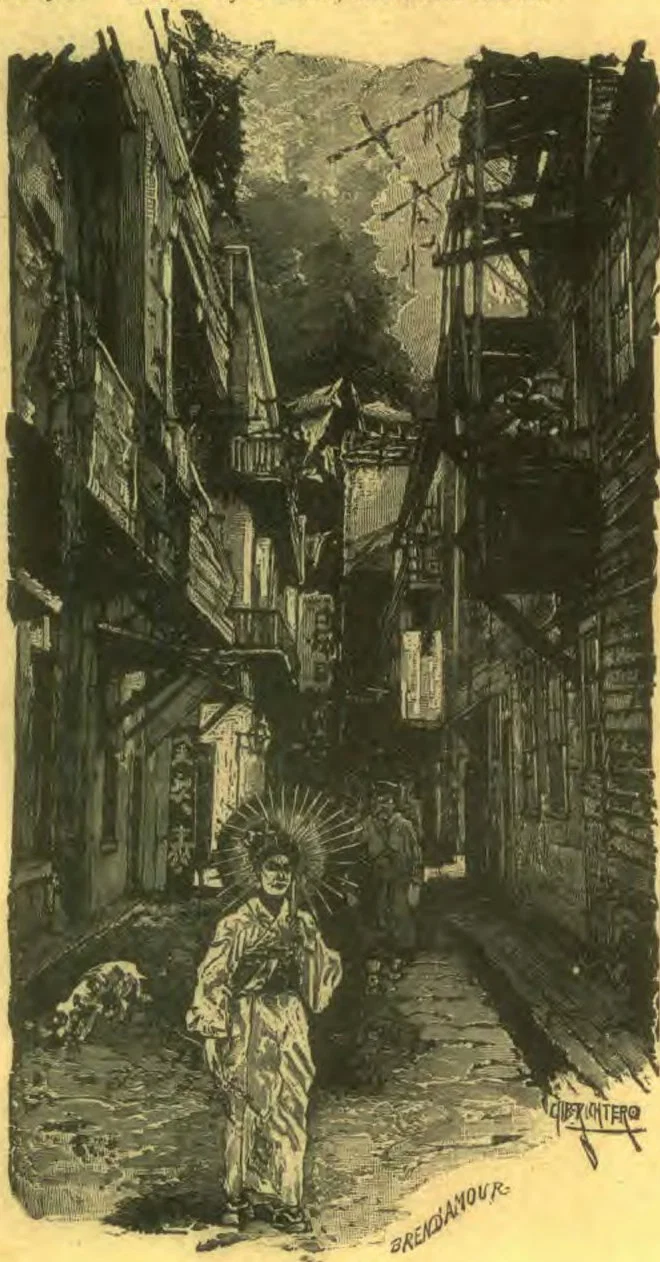
A Street Scene in Yokohama.
The women dress in a kind of kimona, with flowing sleeves and a large sash. The loose sleeve is made to do service for a pocket, as well as a sleeve.
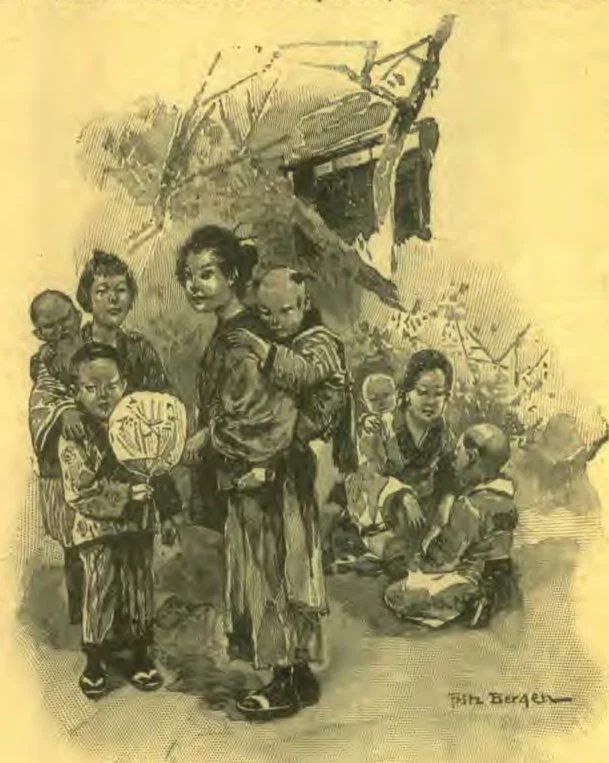
Children of the Flowery Kingdom.
Mothers carry their babies on the back, slipped inside the kimona, and held up by the sash. One mother we saw was washing at the tub, and the baby on her back was sound asleep. Most of the business men and scholars also wear long kimonas. The dress of the laboring classes, which include the coolies, 'rikisha men, and boatmen, is very simple, and consists of a shirt and a narrow cloth about the loins.
There are very few saloons. The only intoxicated men we saw were some of the sailors from the war vessels. Cigaret-smoking is becoming the national vice, and is very common among all classes.
Leaving Yokohama, our next stop was at Kobe, a city of two hundred thousand population. It has a fine harbor on the Gulf of Osaka, and is one of the most important export cities of Japan.
Our vessel touched next at Nagasaki. The way lies in and out, among the islands of the Inland Sea, a most picturesque stretch of enclosed ocean. The ship seems to float enchanted on its placid surface. The sea throughout the greater part of its extent is but a few miles wide, and in many places the channel is so narrow that the boat can barely pass. It is a day's travel, with mountains and hills on either side laid out in one grand landscape garden. The energetic little Japs farm most of these hills and mountains, from the base to the very top. The whole side is cut into terraces, and the appearance is that of a huge stairway, the treads of the stairs being carpeted with various shades of green and brown, and here and there a bushy tree is dotted in to add to the effect. The people live in villages made up of quite a compact bunch of houses all one story high, most of them brown, but a few white. The land lying about the villages is farmed.
This Inland Sea, and in fact all of the harbors of Japan, are strongly fortified, and one can not help but notice the rapid strides that are being taken in the preparation for war. Nagasaki is a large city on the island of Kyushu. The large coal mines are here, and make this an important port of call for the Asiatic fleets of all nations.
It was an interesting sight to see the coal loaded into the bunkers of the large steamers. The coal barges are drawn up alongside. Ladders reach from these to the port-holes of the ship. On the ladders there is a double row of men, women, and even little children. The coal is passed up from the barges in baskets which hold about a bushel. These baskets stream into the port-holes at such a rate thatfifteen hundred tons of coal can be loaded in five hours.
Leaving Nagasaki, we crossed the Yellow Sea, en route for Shanghai, October 24. Excluding two stop-overs, the trip thus far, of eight thousand five hundred miles, from our home in Iowa, has been made in twenty-three days.