Dedicatory Exercises

2%

Dedicatory Exercises

of the

New Pacific Press Factory

September Eight, Nineteen Hundred and Seven Mountain View, California

Program.

Chairman . . . . . . . . . . . . . . . . . . . . . . Elder H. W. Cottrell Song . . . . . . . . . . . . . . . . . . . . . . . . . . . . . . . . Congregation Scripture Reading . . . . . . . . . Elder W. T. Knox Invocation . . . . . . . . . . . . . . . . . . . .Elder J. O. Corliss Song (Written for the Occasion) . . . . . . . . . . . . . . . Double Male Quartet History and Work of the Institution . . . . . . . . . . . . . . . . . . . . . . . C. H. Jones Our Branch Offices . . . . . . . . . . . . . . . H. H. Hall The Erection of the Building . . Elder A. O. Tait The Cost . . . . . . . . . . . . . . . . . . . . . . . . H. G. Childs Dedicatory Hymn . . . . . . . . . . . . . . Congregation Original Poem . . . . . . . . . . . . . . Elder M. C. Wilcox Address . . . . . . . . . . . . . . . . . . . . . Elder M. C. Wilcox Dedicatory Prayer . . . Elder J. N. Loughborough Remarks . . . . . . By Directors, Ministers, and Others Song—Doxology . . . . . . . . . . . . . . . . . . Congregation Benediction . . . . . . . . . . . . . . . . . . . Elder W. T. Knox (Inspection of the Building)
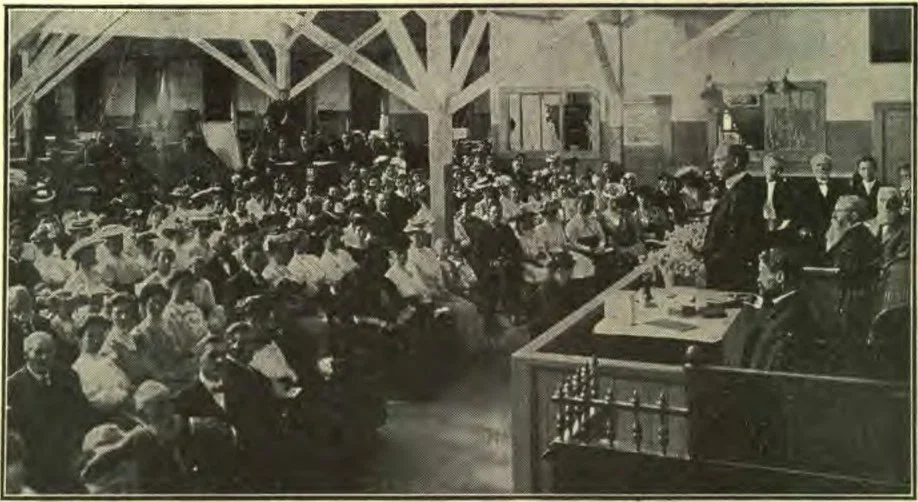
A goodly congregation gathered in our factory on seats improvised for the occasion to attend the dedication of the building and its equipment.
The chairman opened the exercises with a few appropriate remarks in which he said: "This institution stands for a very definite object and a very definite work." Elder Knox read from the Scriptures Matt. 7:24-27, Ps. 127:1, and 121:1-8. Following this Elder J. O. Corliss led the congregation in prayer. A double male quartet sang a song that was written for the occasion by Brother Max Hill. The words of this song are found elsewhere in this issue. A quite full report of the remarks that were made on the occasion are in the following columns.
A number of the prominent citizens of the town showed their interest by being present, and making remarks commendatory to our work.

History and Work of the Institution.

By C. H. Jones.
THE Pacific Press Publishing Company was incorporated under the laws of the State of California, April 5, 1875, and the following year a factory was erected at the corner of 12th and Castro Streets, Oakland.
Prosperity attended the work. The institution grew. New buildings were added from time to time, and the Pacific Press came to be recognized as one of the largest and best equipped publishing houses west of Chicago.
In October, 1888, a branch office was established in the city of New York; and in August, 1889, another branch was opened in London, England.
Both of these branches were successfully operated for several years, but were finally turned over to local organizations.

Commercial Work.

In addition to issuing our own denominational publications, a large amount of commercial work was done. As the years passed by, it became evident that this commercial work was interfering to a great extent with our own denominational business. At a meeting of the stockholders held in Oakland, April 28, 1902, this matter was carefully considered, and a resolution adopted instructing the Board of Directors to curtail the commercial work, to sell the real estate in Oakland, and to move the plant to some rural place away from the noise and confusion of the large city where the surroundings would be more congenial to our employees.

Moving the Plant.

In harmony with this resolution, and after thorough investigation, it was finally decided to locate in Mountain View. Five acres of land were donated to us by the citizens, a fine, large brick factory was erected, and the whole plant moved to this place in the autumn of 1904—just three years ago. It was a tremendous undertaking and the move was made at great expense.

The Great Earthquake.

The past three years have been eventful ones. Just as our plant here at Mountain View was getting into good running order, the great earthquake of April 18, 1906, came. The brick walls of our factory were thrown down, but, providentially, the roof was left standing and the machinery remained intact. Temporary walls were put up. Within an hour after the usual time of opening, business was being carried on about the same as usual.
View of the Congregation and a Corner of the Interior of the Factory while the Dedication Was in Progress.
We believe that this calamity came to us as a warning, but the warning was not heeded. In moving the plant to Mountain View it was with the avowed purpose of cutting out commercial work and devoting our whole time and attention to denominational business, but this was not done. The fact is, commercial work kept increasing right along, and interfered materially with our regular denominational work. After the earthquake the conditions were aggravated. Commercial work came in like a flood and claimed the largest part of our attention.

Consumed by Fire.

Only a few short weeks, however, were we allowed to go on in this way, for on the evening of July 20, 1906, our entire plant was consumed by fire, entailing a loss of about $200,000. The loss was appalling. Not only was our beautiful factory laid waste and our entire stock of paper, books, machinery, etc., destroyed, but nearly two hundred employees were thrown out of employment without a moment's notice.
Never will we forget the sensation that came over us that night as we stood helplessly looking on—there being no water with which to fight the flames—and saw the building consumed inch by inch; we hope we will never be called to go thru such an experience again.

A New Date from Which to Reckon Important Events.

It has been said that in the South, after the close of the Civil War, they took a new date from which to reckon all important events, and that was so many months or so many years "before the surrender" or "after the surrender." They had staked their all upon the outcome, and, having lost, they had to face a new situation and grapple with new difficulties.
So with us, only we have two dates from which to reckon important events: one is from the earthquake, April 18, 1906, and the other from the fire, July 20, 1906.
July 21 was a dark day. Altho the sun shone as brightly as usual, all nature seemed to be covered with a pall. There were the smoking ruins of our once splendid factory; here were nearly two hundred employees thrown out of employment; and there were hundreds of our faithful canvassers in the field waiting for books. The situation was desperate. It was enough to make the stoutest heart quail. However, notwithstanding the fact that the buildings were in ruins, we knew very well that the institution still lived in the hearts of our people and that the work would go on.

Plans for Continuing the Work.

But not a moment was to be lost. Before the embers had cooled, or even the fire had stopped burning, a meeting of the Board of Directors and leading brethren was called, and definite plans outlined for carrying on the work.
Arrangements were at once made with other printing-offices to print the SIGNS OF THE TIMES and Our Little Friend, two of our weekly publications. Brother B. R. Nordyke, an experienced bookman, was sent to Kansas City and Chicago to arrange for printing and binding our subscription books to supply our canvassers; and work was at once begun on temporary buildings to house what little of new material we were able to secure.
It must be remembered that only three months before this every printing-office in San Francisco had been destroyed, and we were told that it would be impossible to secure machinery, but within a few weeks we had in operation two large cylinder presses, one job-press, two linotype typesetting machines, paper-cutter, folding-machine, wire-stitcher, etc., so that we were able to print and bind our regular periodicals as well as some other work.
The day after the fire every employee was interviewed, and definite arrangements were made with each. Some secured work in near-by offices; some took long-looked-for vacations; and some were employed on the temporary building. But all that left went away with the understanding that they would return on call.

Expressions of Sympathy.

Telegrams and letters of condolence, expressions of sympathy and offers of assistance, came pouring in from every quarter, and we were urged to rebuild at once. The good people of Mountain View called a public meeting and adopted resolutions expressing their sorrow and sympathy and urging us to rebuild, promising material assistance. All these things were a source of great encouragement to us.
But, before taking any steps toward rebuilding the factory, it was thought best to call a special meeting of the stockholders and friends of the institution to consider the whole question.

Stockholders' Meeting.

This meeting was held at this place on Monday, September 10, 1906, and by a unanimous vote it was decided to rebuild the factory here in Mountain View at once.The plans for a new factory had been carefully drawn, and with slight changes were approved by the stockholders. The work of clearing away the débris and putting up the new building on the old foundation began at once. Brother A. O. Tait was requested to superintend the erection of the factory. He will explain to you in detail the manner of construction, and Brother H. G. Childs will tell you the cost.

The Lesson to Be Learned.

We think that one of the lessons the Lord wanted us to learn by this terrible calamity was that we should not have a divided interest, but that we should devote our whole time and attention and all our facilities to denominational business, and have nothing more to do with commercial work in this institution.
In harmony with this thought, the following action was taken at a meeting of the Board of Directors held soon after the fire:
"Whereas, Giving the last Threefold Message to the world demands the best energies and the undivided attention of God's people, more especially of those directly engaged in its organized work; and,
"Whereas, This office was established for the purpose of giving this message to the world; and,
"Whereas, Whatever may have been expedient in the past, the time now demands that all the facilities of the office and the talents, energies, and ability of its employees be devoted solely to the work for which the institution was established;
"Therefore, Be it resolved that from henceforth commercial work shall be eliminated from the office of the Pacific Press, and that by commercial work shall be understood all work outside the regular organized work of the message, or such work as shall not be approved by the publishing committee of the institution."

Great Prosperity.

Some thought that in taking this action the Directors were a little too radical, and feared that we would not have work enough of our own to keep the plant running. But how has it turned out?—Altho our facilities are practically the same as they were before the fire, they have been taxed to the utmost and it has been almost impossible to meet the demand. In fact, we have been obliged to get a large amount of our work done in outside offices, simply because we could not handle it ourselves.
The circulation of our weekly paper, the SIGNS OF THE TIMES, has increased from about 14,000 to nearly 50,000 copies.
Our subscription book work has advanced by leaps and bounds. Never before have we seen anything like it. Here at the home office our sales last year amounted to about $74,000, and we thought that a very good record. But the first eight months of this year the sales amounted to over $100,000, and we still have four of the best months of the whole year to go on. For several weeks past we have been turning books out of our bindery at the rate of about seven hundred per day.

Books Issued since the Fire.

For the first six months after the fire we were greatly handicapped and carried on our work at great disadvantage, being housed in a small temporary shed. About six months ago we moved into this new factory, altho it was not finished by any means. For several weeks the carpenters, painters, printers, and binders were working here together. But notwithstanding all this we have, during the past year, printed and bound over 150,000 cloth and leather-covered books, and over one million tracts and pamphlets.
Besides this we have printed during this same time nearly two million copies of our weekly paper, the SIGNS OF THE TIMES, and one million copies of Our Little Friend, a weekly paper for the children.
During this same period we have had printed and bound for us in other offices over 60,000 copies of subscription and trade books.
We now have in hand, to be completed within the next six months, nearly one hundred thousand subscription and trade books.

Amount of Stock Used.

During the past year we have purchased nearly forty car-loads of paper, amounting to about $40,000, and $7,000 worth of binders' material. We have just placed an order for five car-loads of paper for the Missions Number of the SIGNS OF THE TIMES soon to be issued.

Branch Offices.

We have established branch offices at Kansas City, Mo., Portland, Ore., and Regina, Saskatchewan, Can. Brother H. H. Hall, manager of the Book Department, will tell you something of what these branch offices are doing.

Equipment.

We have a well-equipped factory, embracing the following:
Two modern linotype typesetting-machines. Five cylinder presses, one large rotary Web perfecting press, and three job-presses. A complete electrotype foundry, and a splendidly-equipped bookbindery, with two book sewing-machines, two folding-machines, two embossing-presses, and other necessary machinery. All our machines are run by electric motors, and we have a plant of our own for generating electricity.
We also have a good corps of earnest, faithful, skilled employees that can be depended upon in every emergency.
We have attempted to give you only a very brief history of the institution and its work, but we can truly say that notwithstanding the terrible calamity that came upon us a little over a year ago, the Pacific Press was never in a more prosperous condition, and never was the outlook brighter and more encouraging than it is at the present time. The Lord has blessed the work wonderfully. He has given us the sympathy and the hearty cooperation of our people and the good-will of the public generally; and, out of what seemed to us at the time to be a great calamity, the Lord in His goodness and mercy is bringing a great blessing, and to Him be all the praise and glory.