CURRENT ARGUMENTS AGAINST THE RESTORATION OF THE TEMPORAL POWER.
Love of a United Italy.
THE most potent argument brought against the return of the temporal power is the one that deals with the effect that such a change would have upon the present united Italy. With the surrendering of Rome to the Papacy, and the loss of this strong capital, it is believed that the kingdom would fall to pieces again. The hope of continuing Italy as a united kingdom rests on retaining the city of Rome as the home of its central government. Therefore the Catholics who would otherwise be in favor of the return of the temporal power are unwilling to grant it at such a price. And, consequently, thus far a love for a united nation has overbalanced their desire to listen to the plea of the church for a return of the temporal power.
Then there are many that contrast the government of Rome as it exists to-day, and as it existed under the Papacy, and they are persuaded that the present aggressive government is far superior from every point of view. Under the papal government the city was neglected, the streets filthy, disease was very prevalent, and business was continually interrupted by the numerous church-days in which all business was suspended. In other words, the people are generally well satisfied that the Papacy ruled more to its own interests than to those of the people. However, the question is ever kept agitated from both sides, and there do not lack those of the clerical party who are continually sighing for the return of the temporal power, and who recall the days of yore as a golden dream of the past. Every calamity that befalls the people or the slightest difficulty that besets the city is quickly ascribed by them to the absence of the pope's blessing. For under the pontifical government the pope passed through the streets of Rome imparting his blessing to the people and the city, which is not permitted at present. The people are carefully taught by the priests that the lack of this blessing on the part of the pope causes a great curse to rest upon the city, and consequently calamities and difficulties can not be averted.
These are, and have been, in main, the arguments current for some time on the point, but of late
The Affair Has Taken on a New Form
which has tended to revolutionize the whole question. This attempt has come from within the church itself, and is very interesting as determining the present attitude of the papal government on the position taken. The new attempt at solving the question has come about largely as a result of the separation of the church from the state in France. As all of Europe has looked on with much interest and attention at what has recently been accomplished in France, many have speculated as to what would be the outcome as regards the interest of the church. Some argue that the church will lose, and others that it will gain, by the separation.
As a result of the agitation, a bishop has revived the question in Italy, in a discourse given in the large cathedral in Cremona. This address has been very extensively commented upon by the public press. He suggests that the Roman Church also in Italy would profit by a separation from the state. His ideas of the separation of church and state are well developed and define the correct position splendidly. I quote as follows from his definition of what ought to constitute a separation of church and state:
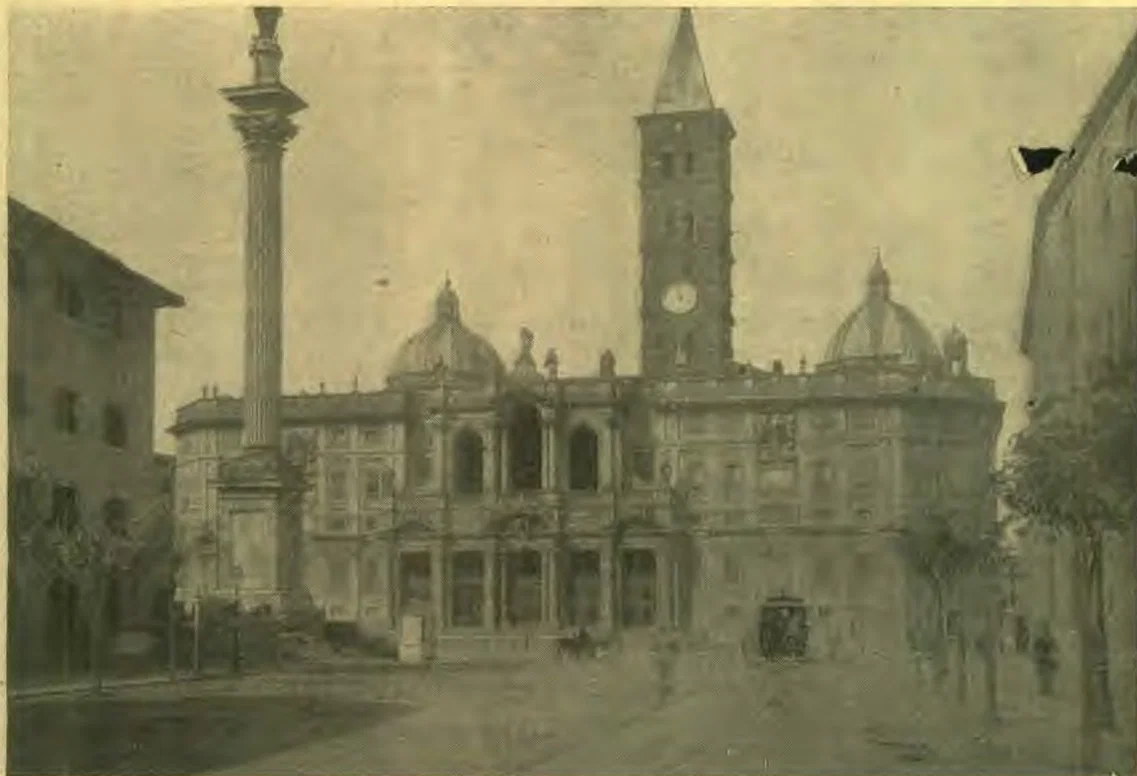
Santa Maria Maggiore, Rome.
Separation of the state from the church is the perfect indifference or entire neutrality of the state in regard to religion and worship. The state in clear terms says: I, civil society, as civil society, have not, do not wish to have, can not have, and ought not to have, any religion; however I am neither for nor against religion. The religion as religion has nothing to do with me. I do not fight it, defend it, nor judge it; if I should do so I would violate the limits assigned to me and would become a usurper. I, as state, must not favor any religion, but maintain respect for all religion without distinction; and if under certain conditions I shall wish to take part in any holiday or demonstration of a religious nature, I shall do so solely for the purpose of honoring certain individuals or celebrating certain great events that have brought glory to the country, but never for the purpose of professing any belief of which I have none. In such a case I would make use of the Catholic worship if the Catholic religion be in the majority, or the Protestant, or the Russian, or, if need be, also the Jewish, because to me they are equal, politically and patriotically considered. I ought to have but one aim, and that is, to make good laws, and govern wisely the public instruction, the public trusts, justice, the army; promote industry, commerce, agriculture, the arts; maintain public order; lead the citizens to a better condition materially and morally, and to that earthly happiness that is possible, without paying any attention as to whether they practise the Christian Catholic religion, or the Protestant, or the Turkish, or the atheistic. Religion is a matter of conscience, and pertains to the inner man and also to the outer, but in the limits fixed by the law. To me the citizens are all respectively equal, and I, the state, am duty bound to give all justice and guarantee to all their rights. The state is not the church; it has not for itself any religion. In other words, we may say that the state is atheist. The men that compose the government as citizens can have the religion that they desire, and it is well that they have it, but as to the government, it ought not to make any distinction between one and the other.
I have given this definition thus at length that we may see just in what terms the question has been put, and thus the attitude of the Papacy on this point can be better appreciated. This declaration of the relative positions that the state and church should occupy seems all that could be asked on the subject, even by the most advanced advocates of the total separation of church and state. Therefore the Papacy has had a chance to commit itself with a very clear statement of the case before it. It might be interesting to inquire if the bishop himself accepts his position as desirable for the church in Italy. In answering this query allow me to quote from his own words as follows:
Yes. The church does not demand this change and would not provoke it, as it does not wish to be the first to break with the conditions of the past; but if it comes, as everything seems to predict, the church will accept it, relying confidently upon its own forces. It seems to me that God addresses these words to the church which were spoken to Abraham, "Get thee out of thy country and from thy kindred, and come into the land which I shall show thee." Get thee out from the chains with which you are bound by those that call themselves your children; loose yourself from
The Legal Shackles Which Hinder You,
and which have made the past difficult; enter into the immense field of liberty and there, in the full light of the sun, develop all your forces, which are divine, and fear not. The victory will be yours, and those who have thought to kill you with liberty will have prepared for you the most magnificent triumph. And this advantage of the separation, I believe, will turn out more glorious for the church than otherwise.
All know and see that the other churches and religions, without exception, are not only unhealthy, also fused with the state under which they are found. It is sufficient to observe that the supreme representatives of these churches, as the Russian, the Lutheran, etc., and of those religions, as the Turkish, and Buddhist, are themselves also heads of the state; and the life and power of those churches and religions are derived from the civil power. To the unbelieving and skeptical world is reserved this flaming proof of the divine origin of the church; a9church deprived of material force, which lives under powers very diverse, and yet does not need them, and does not ask of them either a penny or a soldier. This will be a new and miraculous spectacle, and one that will gather to the church the real sympathy of all men of heart, because it will live its own free life in the midst of the people. And then, perhaps, those that rule the people will be glad to ask of her the moral help of which they shall feel the need, and she, ever generous, will be pleased to concede it.
As I have already said here, the question is well launched, and the Catholic Church has presented before it the way to a sure triumph along the right lines. In passing, we might observe that the bishop has evidently overlooked the fact that in America we have already practised these principles for many years; for we have prosperous churches that have never received a penny from the government.
C. E. MILTON.
[How the Vatican regards the separation of church and state will be considered next week.]