I MUST not fail to note the entry of the labor question into the discussions of the International Conference of the Christian Endeavor Society, and the important role it played. It was instantly recognized that this important and world-wide question of our modern times could no longer be kept from entering the domain of the religious, and from receiving the respectful and careful consideration of the church as to the best and final solution of, perhaps, the most serious problem of the age. It was Rev. Charles Stelzle, superintendent Department of Church and Labor of the Presbyterian Board of Home Missions, New York, who interjected the question with his address, "The Laboring Man and the Church of the Carpenter." It was one of the stirring addresses of the convention, delivered by a man intensely in earnest; and it received due recognition, both by the delegates and the public press of Seattle, as a matter that must be dealt with by the church. To show that it is the church that is, in fact, reaching out to secure the forces of the labor movement, I need only to quote a portion of Mr. Stelzle's speech. He said:
"Some day the church will awake to the fact that the labor movement IS THE MOST SIGNIFICANT MOVEMENT OF MODERN TIMES. When I speak of the labor movement, I do not refer exclusively to the labor-unions. There are some people who imagine that if the labor-unions could be abolished, the labor question would be settled. If every labor-union in existence should be wiped out to-day, the labor question would still be present; and, I believe, in a more aggravated form than we have to-day. There are forces organized which are comprised in the labor movement. IT INCLUDES THE TWENTY-FIVE MILLION SOCIALISTS OF THE WORLD; IT EMBRACES THE EIGHT MILLION TRADE-UNIONISTS OF EVERY LAND, THREE MILLION OF WHOM ARE IN THE UNITED STATES AND CANADA; it includes the movement among the Russian peasants; it includes the social movement in Germany; it includes the movements we are hearing about among the people in Italy, in Belgium, in Australia, as well as the social unrest which exists in our country. This is the era of the common man. When the hour strikes that shall proclaim the victory of the common people, this is the question which will confront us as a church: Will they be inspired by a high religious ideal given them by the church of Jesus Christ, or will they go on to even nobler and better things independent of the church, because of the consciousness that they have won all in spite of the church?—for win they will. No human power can prevent it, and no divine power will. This, then, is the labor movement that confronts the church of Jesus Christ to-day."
"There is so much religion in the labor movement and so much social spirit in the church, that some day it will become a question as to whether the church will capture the labor movement, or whether the labor movement will capture the church.
"There are four fundamental facts in this connection to which I desire to call your attention:
"First, working people almost universally honor Jesus Christ as their Friend and Leader, and most of them believe in His divinity. Secondly, working people are naturally religious, even tho their religion is not always expressed in the most orthodox manner.
Thirdly, the labor question is fundamentally a moral and a religious problem. History has prophesied it. Our best labor leaders are coming to recognize it. Present reform measures which working men are hearing most about to-day, indicate it. Fourthly, there has rarely been a time in the history of the labor movement when working people have responded more readily to the appeal of the church than they do to-day.
"For these reasons, the church is already supreme in the matter of capturing the labor movement for Christ. Some day God will raise up a prophet who shall again win to himself the masses of the people. That day shall reveal whether the church will capture the labor movement, or whether the labor movement will capture the church."
As in many instances great labor-unions have sent delegates to great religious conventions, and as many of the leaders in the labor movements have publicly contended that the support and help of the united forces of the religious bodies should be sought and, if possible, obtained,—to the end that labor may become victorious in its long-drawn struggle with capital,—and inasmuch as in every religious gathering like this one of Christian Endeavor organized labor has its strong advocates and champions not a few, who plead that the forces of the churches should be thrown upon the side, and in the defense of, organized labor and its demands against the greed and avarice of organized capital, who can fail to see, and is it not fair to presume, that soon or late these two vast forces—the forces of the church and the forces of united labor—will, in some way, come together. It may remain to be seen, as Mr. Stelzle declares, whether "the church will capture the labor movement, or whether the labor movement will capture the church." One thing is certain, and that is that the church and the labor movement are rapidly nearing the point where they shall see a common cause. And when they do, will they not unite? Will they not link their respective forces together in one vast federated power that will demand and secure governmental recognition? Nothing is easier. No event of the near future seems more certain than the federation of the church power and the labor movement. It will be remembered that Mr. Samuel Gompers, president of the Federation of Labor, stated, as reported in the Buffalo Sunday Courier, that he trembled for the safety of the American Government and for the revolution that might come if ever the Federal power attempted to crush the labor movement. Mr. Stelzle is quite right. "The labor movement is the most significant movement of modern times;" and when once these two great representatives of religious faith and of public opinion shall amalgamate, confederate their powers, and focus their combined strength upon the sphere of the civil government, what may we expect—rather, what may we not expect—from the workings and influence of such a mighty dynamic force! Mr. Stelzle has set a wave of thought agoing amongst Christian Endeavorers that can not be arrested. His remarks revealed a touchstone of power—power for the church—that will not be lost sight of.
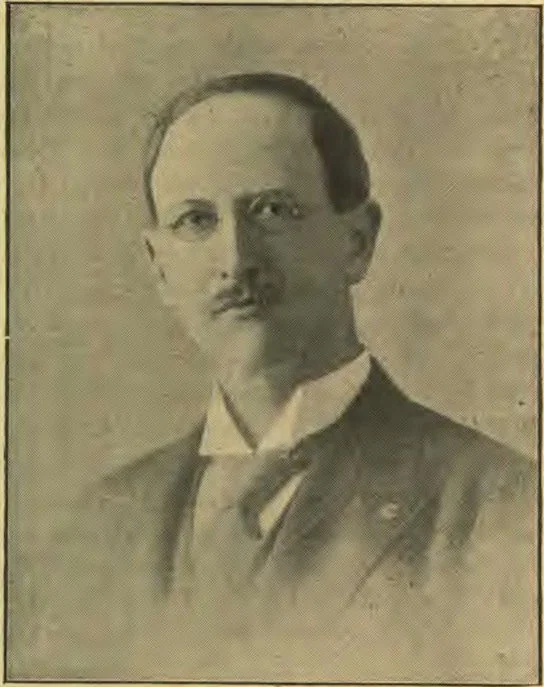
Amos R. Wells.
The Patriots' League.
Good citizenship is a good thing. None may deny that good government results from good citizenship and every legitimate means of securing a better citizenship. Every laudable effort to reach one step nearer the standard of ideal citizenship should receive the hearty approval and support of every citizen desirous of a better and more improved system of government. But Christian citizenship is quite another thing from good citizenship, and the terms may mean vastly different conditions; yet to the Christian Endeavor Society, good citizenship is Christian citizenship; rather, good citizenship must necessarily be Christian citizenship. With them the terms are compatible. They are used interchangeably. Analyzed, Christian citizenship is good citizenship; hence, good citizenship would be Christian citizenship. As Doctor Clark stated in the very beginning of the conference: "Christian Endeavor stands for good citizenship; and I believe this will be noted as preeminently the good-citizenship convention."
Speaking upon the subject of "Good Citizenship," Dr. Alexander Francis, pastor of the British-American Church, St. Petersburg, Russia, called attention to the difficulty of securing a common standard of citizenship in a nation like America, where population was so diverse in race and religion; what a huge problem it seemed to be where individual occupations and interests so widely differed. There are common bonds, such as those created by law, custom, and executive government, but they are not original factors in the cohesion of a people in the same degree as such natural ties as7community of race, of language, of religion. Because of the tremendous and rapid changes owing to an immense immigration here from everywhere, these latter ties "of race, of language, of religion," must be recreated; and to effect this problem is a political, moral, and natural, not to say a human, necessity. "To find a common denominator," said Doctor Francis, "which shall solve the problem of your cosmopolitan and complicated life—that is the need of the hour of this nation. And, therefore, the Christian Endeavor proposes to form a Patriots' League, whose aim shall be to awaken and train the civic conscience in each of its members and in the nation at large. Right citizenship in political relations involves reverence for law and the demand for its enforcement.
"Citizenship endeavor, to be fully successful, must be Christian Endeavor. Organic Christianity has often proved to be a divisive force; but by the spirit of Christ—the true religion of Jesus Christ—the human as well as the divine harmony may be restored to mankind. Right relations make good citizens; and only the power of Christ can destroy the sin which disrupts and prevents harmonious relations, . . . so civics, economics, and politics must be related to Christ. Now the ballot is the one final and absolute vehicle of political expression in a modern democracy." Doctor Francis invoked strongly the aid of the ballot that religious ties might be recreated, and declared that obedience to new laws, as well as the old established laws, was absolutely necessary, whatever the sovereign will of the people might be; and "dianegard for these laws is not merely lawlessness, but immorality, deserving to be visited by severe social condemnation." Thus the discussion of the problem of good citizenship begun with a plea for the Christian feature of good citizenship, the use of the ballot, the training of the "civic conscience," uniformity of opinion, recreation of religious ties and the "finding of a common denominator" to solve the problem and the need of the hour of this nation. And to accomplish this metamorphosis in the affairs of a nation, the Patriots' League is the agency, and the ballot is the vehicle. So civics, economics, and politics might properly be "related to Christ!" Just what that "common denominator" is to be, remains to be seen. It can, however, hardly be anything other than a religious common denominator, for no other kind of a denominator could obtain in the "complicated" political and commercial life. And it is as plainly to be seen that it must be a religious common denominator upon which all denominations, however they may differ in the main, may easily agree.
But what is the Patriots' League, and how is it to operate upon the public civic life? What does this League—launched at the Seattle convention, and having for its first member President Theodore Roosevelt by consent of his letter of June 2, receiving the prayers and benedictions of the many pastors from all over our land, and accepted with the loud "huzzas" of the many thousands of delegates—what does this auxiliary to the great Christian Endeavor movement mean to do? Here is the platform of the League, as adopted by the trustees of the United Society, and unanimously accepted by the convention:
"The Christian Endeavor Patriots' League is an enrolment of those whose aim is the promotion of civic righteousness and national welfare. It is the purpose of the League to take up courageously the duties of a Christian citizen. Its members will seek a knowledge of public affairs, of the laws, needs, and possibilities of their town, their State, and the United States. They will labor for the election of good and efficient office holders, for the observance of existing laws, for the adoption of improved laws, for the encouragement and aid of patriots, and the downfall of all enemies of the country. They will seek to promote the cause of temperance and personal purity, the betterment of municipal politics, the improvement of the conditions of labor, a rational use of the Lord's day for rest and worship. All this they determine to do in the measure of their opportunities and powers, under the guidance and in the strength of Jesus Christ."
If there is any doubt that all this designed in the Christian Endeavor Patriots' League is to be secured by the use of the ballot, and brought in "thru the gateway of politics," and in no other way, the address of Prof. Amos R. Wells, educational secretary of the United Society and managing editor of the Christian Endeavor World, Boston, Mass., will clear away that doubt and leave the political object and political methods of the League to stand out in bold relief. Following are his remarks:
"With this platform as a basis, the Christian Endeavor Patriots' League is left free to take up in any locality just the work that the members and their pastors feel to be most needed.
"Primarily, that work will be everywhere, as is fitting for young people, study and investigation. THE CHRISTIAN ENDEAVOR PATRIOT MUST FIRST KNOW THE LAWS, THE POLITICAL CUSTOMS, AND THE SOCIAL CONDITIONS OF HIS TOWN, COUNTY, STATE, AND THE NATION, BEFORE HE CAN DO ANYTHING TO BETTER THEM. The Patriots' League will become, we hope, the school of the young citizen and prospective voter.
"What is this Christian Endeavor Patriots' League?—In a word, it is to consist of all that are willing to study and work for a better country. While Christian Endeavorers will naturally make up the greater part of its membership, it will welcome to its ranks all that are in sympathy with its purposes and will labor toward its ends. The Chris-8(Continued on Page 11.)
The Christian Endeavor Convention.
(Continued from Page 7.)
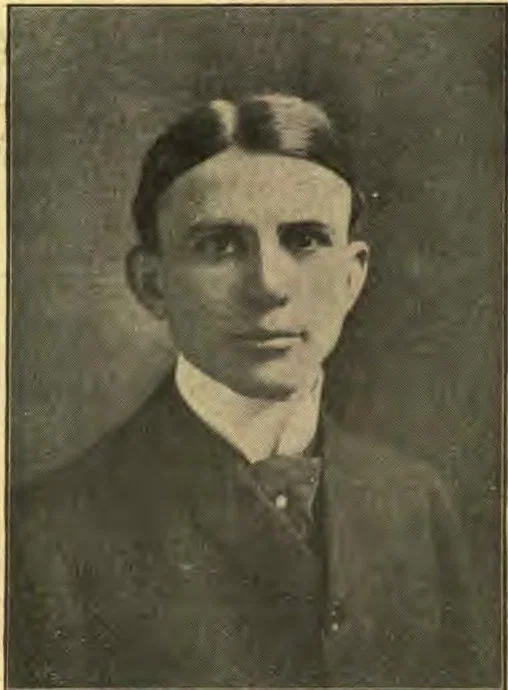
Von Ogden Vogt, General Secretary United Society of Christian Endeavor.
Roads, as far back as 1829, recognized the danger to be apprehended in these movements to make men good by law, forwarded by zealous yet misguided reformers, and said:
'Extensive religious combinations to effect a political object are, in the opinion of the committee, always dangerous. . . . All religious despotism commences by combination and influence; and when that influence begins to operate upon the political institutions of a country, the civil power soon bends under it, and the catastrophe of other nations furnishes an awful warning of the consequence.'
"A nation's greatest need," said Rev. Oliver W. Stewart, of Chicago, "is patriotic zeal more than a fighting spirit. Of unmeasured value to a country is a citizenship with proper conception of the interrelation of citizen and government. When one wrongs the government, he wrongs his neighbor; when he cheats the government, he cheats his neighbor. Then it would be remembered that the law is the will of the people to be respected and obeyed, not because it is right, for it may not be, but because it is the will of the people and its violation and injury wrong our fellow men."
Said Dr. E. H. Delk, of Philadelphia:
"Not until every churchman goes to the ballot box with the same high devotional duty with which he goes to the communion table—God grant that our women may do it after a while!—will we have a Christian citizenship."
"Enforcement of Law" was the subject of Dr. Hugh K. Walker, D.D., of Los Angeles, Cal. In the "Training in American Citizenship" meeting, he said:
"It is easy to get people to put upon the statute books laws that are best for the interests of the community, but not so easy to have them enforced. A campaign of enthusiasm is needed. It is our duty to see that the laws are enforced. It is just as wrong to keep out of politics as it is to keep out of religion. Equally as wrong to neglect the civic as the religious affairs of our country. Officials must enforce the laws. To get them to do it—let me tell you how: keep patiently picking at them, keep persistently prodding them, and then keep constantly praising them. The greatest evil is unenforced law. We must have courage in this holy warfare. We must fight our enemies here at home, and joining hands with those across the sea, bring out the enforcement of law, and peace to all men."
Thus it appears that the Christian Endeavor Society, in its organized Patriots' League, has definitely and finally set sail upon the great political sea, with all its treacherous shoals and reefs, and the thousand and one unknown dangers of a long and stormy voyage. And in all this, Christian Endeavor is repeating, and must necessarily repeat, the history of Rome. And time, with unerring certainty, and in the lime-light of heaven-born prophecies, will reveal the progress, and the final results.
JOHN S. WIGHTMAN.
Seattle, Wash., July 17, 1907.
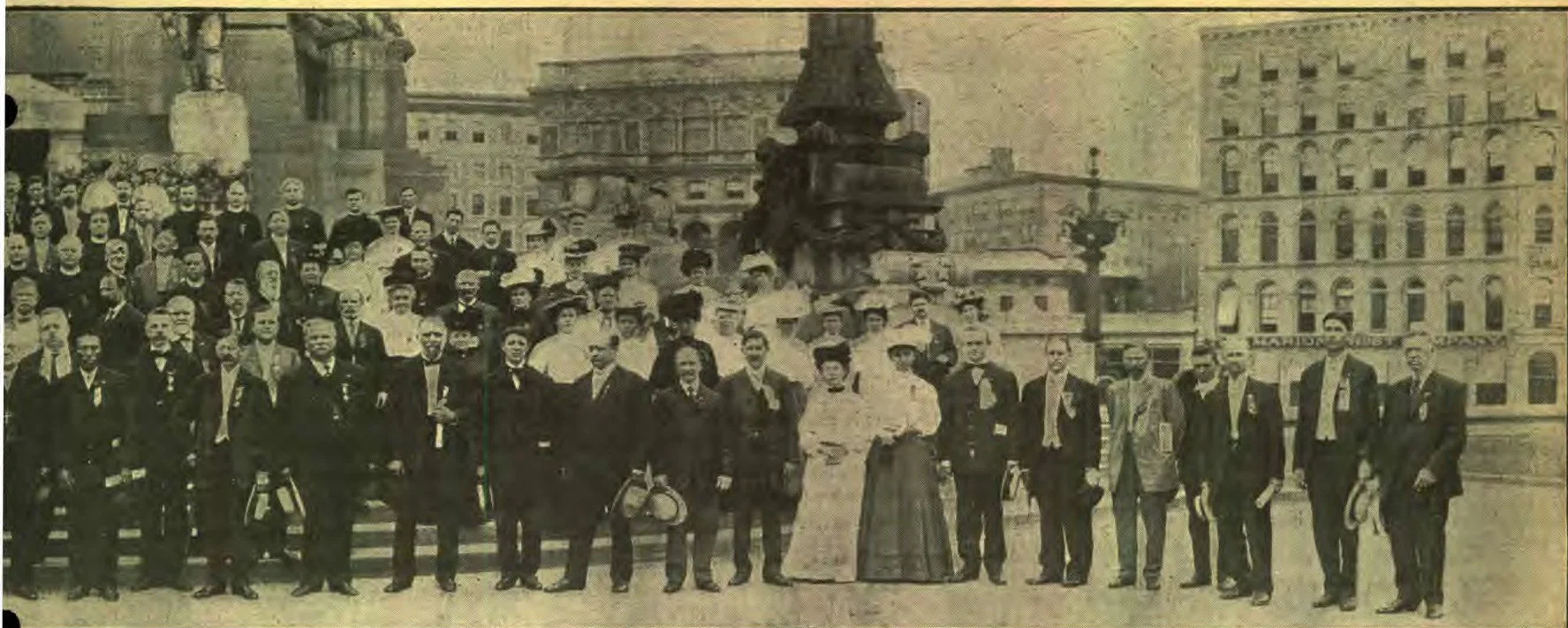
Federation of Catholic Societies, Indianapolis, Ind., July 14 to 17.