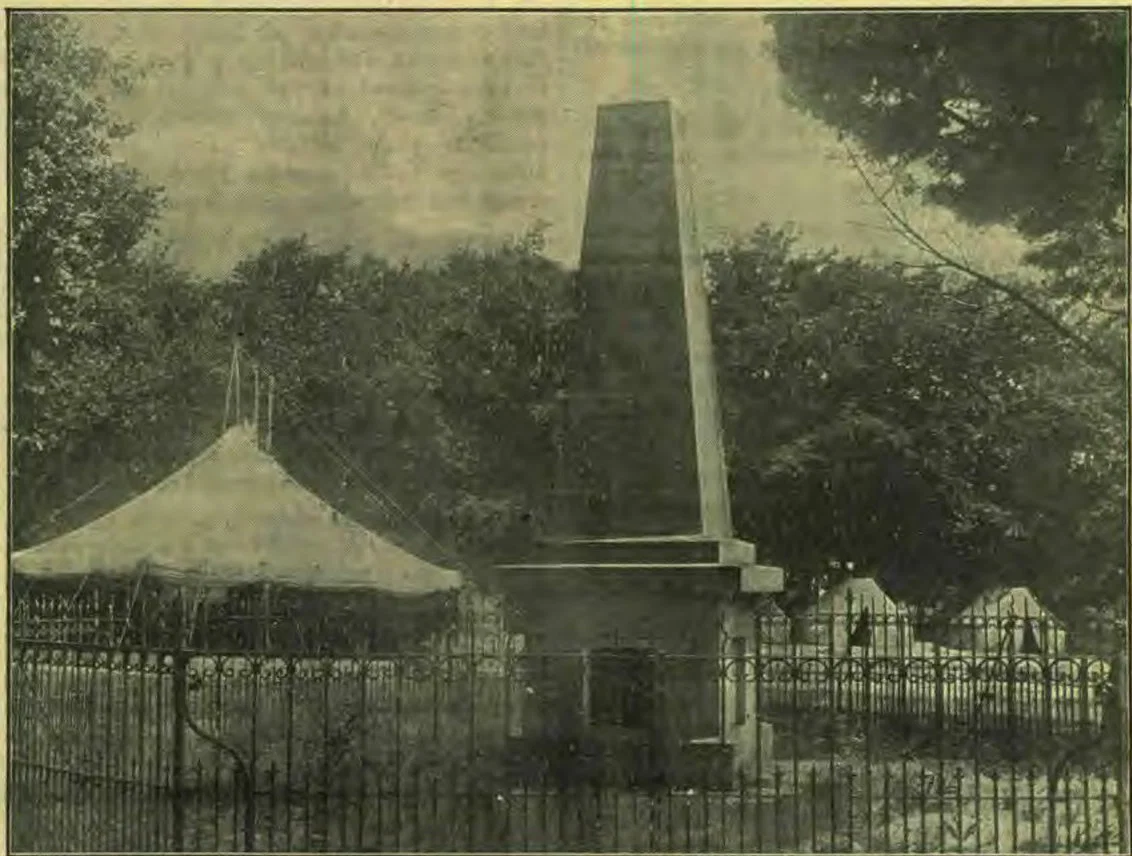
SIR JOHN FREDERICK WILLIAM HERSCHEL, Bart., only son of the astronomer, Sir William Herschel, was born at Slough, 1792, and educated at Cambridge. His first publication was a "Collection of Examples of the Application of the Calculus of Finite Differences," 1820. In 1822 he applied himself especially to astronomy, using his father's methods and instruments in observing the heavens. As early as 1826 the Royal Society had voted to him a gold medal for observations on double stars, but by 1833 his preeminence was beyond the necessity of being marked by acknowledgments. In 1836 appeared his "Treatise on Astronomy." At this time Herschel was at the Cape of Good Hope, where he arrived in January, 1834, with the intention of completing the survey of the sidereal heavens, by examining the southern hemisphere as he had done the northern. Here he established his observatory at a place called "Feldhausen," [in which identical house this extract is being copied] six miles from Table Bay. On March 5, 1834, he commenced his observations; and in four years, working all the time at his own expense, he completed them.
Quoting Herschel's own words on his work in Africa: "I resolved to attempt the completion of the survey of the whole surface of the heavens, and for this purpose to transport into the other hemisphere the same instrument which had been employed in this (the northern) so as to give a unity to the results of both portions of the survey, and to render them comparable with each other." In accordance with this resolution, he and his family embarked for the Cape on the 13th of November, 1833; they arrived in Table Bay on the 15th of January, 1834. "On the 22d of February, I was enabled to gratify my curiosity by a view of Crucis, the nebula about Argus, and some other remarkable objects in the twenty-foot reflector, and on the night of the 4th of March to commence a regular course of sweeping."
To give an adequate description of the vast mass of labor completed during the next four busy years of his life at "Feldhausen" would require the transcription of a considerable portion of the "Cape Observations," a volume which probably is not surpassed in varied interest or astronomical importance by any scientific work in existence. It was published at the sole expense of the late duke of Northumberland, but not until 1847, nine years after the author's return to England, for the very cogent reasons assigned by himself—"The whole of the observations, as well as the entire work of reducing, arranging, and preparing them for the press, have been executed by myself."
There are 164 pages of southern nebulae and clusters of stars. There are then careful and elaborate drawings of the southern appearance of the great nebula in Orion, and of the region surrounding the remarkable star of Argo. The labor and the thought bestowed upon some of these objects are almost incredible; several months were well spent upon a minute spot in the heavens, containing 1,216 stars, but which an ordinary spangle, held at a distance of an arm's length, would eclipse. He confirms his father's hypothesis that these wonderful masses of glowing vapors are not irregularly scattered, and without apparent law, hither and thither in the visible heavens, but are collected in a sort of canopy, whose vortex is at the pole of that vast stratum of stars in which our solar system finds its position.
Then follows his catalog of the relative positions and magnitude of the southern double stars; the double stars and their stately revolutions and lustrous colors dismissed. In the next chapter he proceeds to describe the observations which he had made on their varying and relative brightness. "The variations from time to time," he remarks, "in the luster of our sun to the extent of half a magnitude, would account for those strange alterations of a semi-arctic and semi-tropical climate, which geological researches have disclosed as having occurred in various regions of our globe."
Herschel returned to his English home in the spring of 1838. He died May 11, 1871, and after his death appeared his catalog of 10,300 multiple and double stars.
In private life, Sir John Herschel was a firm and most active friend; he had no jealousies; he never discouraged, and still less disparaged, men younger than, or inferior to, himself. It was said of him by a discriminating critic, "His was a life full of the serenity of the sage and the docile innocence of a child."
HERSCHEL'S MONUMENT, SOUTH AFRICA, ERECTED 1841.
His remains are interred in Westminster Abbey, close to the grave of Sir Isaac Newton.—Cape History.