CALIFORNIA enjoys the distinction of being the only state in the union without a Sunday law. Repeated efforts to secure the enactment of restrictive legislation have failed, owing to the liberal sentiments of the foremost legislators and the unceasing watchfulness of some devoted Christians whose logical remonstrance thus far has proved an effective bar to such enactment.
Foiled as often as they have appeared at the State capitol, the Sunday agitators have been obliged to content themselves with local issues upon which they have been concentrating their energies of late. Los Angeles, having now a population of 300,000, has been the scene of the most recent crusade.
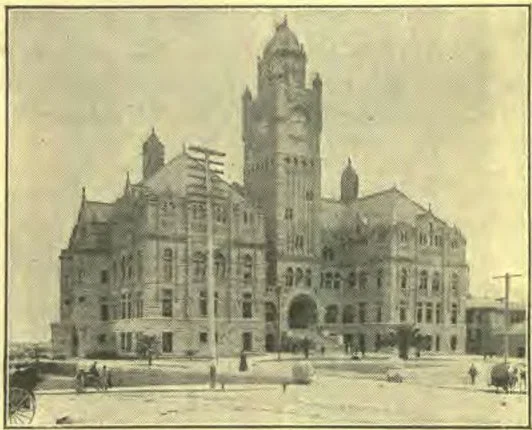
Court-House, Los Angeles, Cal.
Rev. W. F. Ireland, a cousin of Archbishop Ireland of the Catholic Church, tho himself a minister of the Baptist denomination, has been taking the lead in this movement. In early life Mr. Ireland was an actor. Without going to the theatrical people in this city to ascertain their views regarding the proposed crusade to be undertaken ostensibly in their interest, he seized upon the pretext that they would be benefited by a day of rest, to press the Sunday issue to the attention of the city council. This championship of their cause and its palpable insincerity was resented by the theatrical people, who were not long in finding out that petitions demanding the desired legislation had been distributed by Mr. Ireland at a meeting of the ministers of the city, the associated clergy assuming the sponsorship for his act.
They secured the cooperation of one of the daily newspapers and proceeded to canvass the churches for signatures, heralding from day to day their success, and it was reported that "thousands" were signing the petitions. Published interviews from leading citizens disclosed a lamentable ignorance of the principles of religious liberty and the silence of the five other daily newspapers regarding the Sunday-closing proposition afforded no defense.
The time was opportune for presenting the truth. Communications were addressed to the various newspapers, outlining the fact that the campaign in the assumed behalf of the actors and employees of theaters and playhouses was a poorly masked effort to commit the city council to religious legislation that might be made more drastic after a precedent had been established. Several of these letters were published by the other papers and elicited hearty personal responses from those not of the same faith, but whose appreciation of religious liberty was sincere.
A counter petition was filed with the council even before the much-vaunted demand for legislation reached that body. The theatrical people supplemented this with petitions from actors, stage hands, bill-posters, musicians, and from about a dozen trade unions, such as the teamster's union, the shirt-waist workers, the painters, the plumbers, and various other gilds, who vehemently demanded that the council should not attempt to dictate what day, if any, should be observed by them as a day of rest, and attorneys were employed by the theatrical managers' union to plead their cause if matters should come to a pass where such defense should be required. Literature covering the principal issues from a religious standpoint was placed in the hands of every councilman, the mayor, the city attorney, and the newspaper reporters being supplied, as well as the editors of the newspapers, with material facts regarding Sunday legislation elsewhere and the Scriptural and constitutional objections to interference with matters of religion by the civil power.
The commercial bodies were on the alert, and the secretary of one of the most influen11tial of those organizations stated that should there be any likelihood of the enactment of such legislation the matter would be taken up vigorously by the merchants and manufacturers who would not tolerate any such dictation on the part of any body of religionists. Back of the outward seeming indifference there was a strong determination to protect the personal, civil, and religious liberty of every citizen in Los Angeles without respect to the dogmas of any sect or the clamor of any people however respectable or influential in the community.
In response to a letter sent to him, Mr. Ireland replied: "I want it distinctly understood that we are not making a religious issue of this matter. We are circulating the petition entirely on moral grounds, for it is undeniable that mankind requires one day of rest in seven, and we are determined that he shall have it."
A Political Guillotine.
In the course of the conversation it developed that he had been advised to leave the matter to the Federation of Churches, now organized in Los Angeles, but he declared he would not consider that plan, "for," said he, "the Federation is controlled by four or five persons who are running it for their own personal advancement. I am going back to Washington to confer with Rev. W. F. Crafts. We purpose to organize a Sunday-Rest League and to erect a guillotine in the United States in view of which every politician will recognize the fact that he is destined to political beheadal if he does not give to us the legislation we demand for the protection of the moral welfare of the people."
Incidentally, he said the petition asking for the adoption of a Sunday-rest ordinance in Los Angeles would be presented to the council Monday afternoon, October 7, and in accordance with such plan he presented himself with about twenty or twenty-five clergymen and others at the afternoon session of the council on that day. But it was noticeable that not one of the prominent ministers of the city was in the company. They had nothing to gain and much to lose.
Mr. Ireland contented himself merely with reading the petition and making an appeal for legislation that would enable the actors and others employed at the theaters and playhouses to have a day of rest in each week. Mr. McVey, the secretary of the Y. M. C. A., read certain resolutions that had been adopted by that body. Prof. E. S. Ballenger made a short but effective address in the interest of religious liberty. "This petition reminds me of the action taken many years ago in Rome," said Mr. Ballenger. "There the theaters were the first to feel the demand for religious legislation, and a law was passed closing them on Sunday, but then the people would not go to church and more stringent legislation followed, leading up, as you well know, to the centuries of persecution of the Dark Ages and to the horrors of the great Inquisition. I would favor any plan that promised to benefit mankind, for I am interested in the advancement of religious work and I am interested in young men, but I am opposed to the restriction of religious liberty by the civil power, and I trust your honorable body will take no action in the interest of any religious institution." Attention had been directed to the fact that six or seven thousand Jews reside in Los Angeles, as well as about six hundred Seventh-day Adventists, all of whom denied the sanctity of the first day of the week.
Repeated efforts were made by the solitary councilman known to be favorable to Sunday closing to induce some of the other ministers to speak to the issue, but not one responded. Some of the councilmen began to oppose the desired legislation, and the theatrical representatives came in while the debate was at its height to add their protest. They repudiated the movement as not of their seeking, and they expressed resentment that any one should have presumed to ask legislation in their assumed behalf without having shown them even the courtesy to inform them of the intended championship. As for being overworked, they declared that Sunday would be devoted to rehearsals if the theaters were to be closed by city ordinance, and the actors and others employed at the playhouses would find that legislation secured in their alleged interest actually would be an injury to them by compelling them to perform more labor than if left to meet their accustomed engagements. Then, too, they said, the stock companies, which alone would be specially affected by the proposed enactment, were not overworked at the present time, instances being of frequent occurrence in which actors were left off the bills for weeks at a time, and held only subject to call should their services be required at any time, they receiving their salaries right along, just the same as when appearing on the stage in parts assigned to them. The protection sought by the clergy in their behalf they did not want, but rather they esteemed their professed solicitude as an impertinence.
The owners, managers, actors, and friends of theaters, all were heard in opposition to the petition, and finally the attorney for the theatrical managers' union appeared and made a forcible plea for freedom to perform on Sunday acts that were regarded as legitimate on the other days of the week, and one of the councilmen clinched the argument by declaring if the theaters were guilty of presenting attractions that were injurious to public morals on Sunday, the same attractions could not be otherwise than injurious to public morals on days other than Sunday, and the playhouses tolerating them ought to be closed every day in the week as a measure of public safety. But he evinced a dislike to have nine men—the number composing the city council—decide a matter affecting the interests of the entire community, and he suggested that the demand for Sunday-closing of the theaters be submitted to a vote of the people at the next general election. Subsequently it was explained that this was a device to prevent the Sunday advocates from resorting to the initiative, and by the filing of subsequent petitions forcing the calling of a special election to determine the issue.
While the issue would be deferred in the manner indicated, the constitutional objection to submitting to popular decision an issue that clearly could not be determined even by Congress, the highest lawmaking body in the land, was pressed to the notice of the council. Assurances were given by the president of the council, however, that the matter would not be made the subject of determination by popular vote if it should appear that the constitution prohibits the passage of an ordinance regulating the time that the theaters may be open, and with this assurance the council voted to defer the question to the next general election, which is due to be held in December, 1909, more than two years hence, thus affording the petitioners opportunity to withdraw with less embarrassment than if denied outright. It is not expected that the matter will be presented for a vote of the people, but the opportunity afforded for educating the public in principles of religious liberty will not be disregarded. Should the vote be taken, it is evident that the proposition would be defeated by a large majority.