THE following are excerpts and condensations from an open letter addressed to Congressman Richard P. Hobson by Rev. John H. DeForest, for thirty-three years a missionary in Japan. Mr. DeForest utterly repudiates the war talk of Captain Hobson. The letter appeared in the Hartford (Conn.) 'Courant' of January 13:
"'You said: 'Japan has had the war habit for more than eight hundred years; it is with her a question of heredity. It is inevitable that, as the Japanese emerge from wars of their own, they engage in wars with other countries. Japan uses the science and knowledge of the world chiefly for war.'
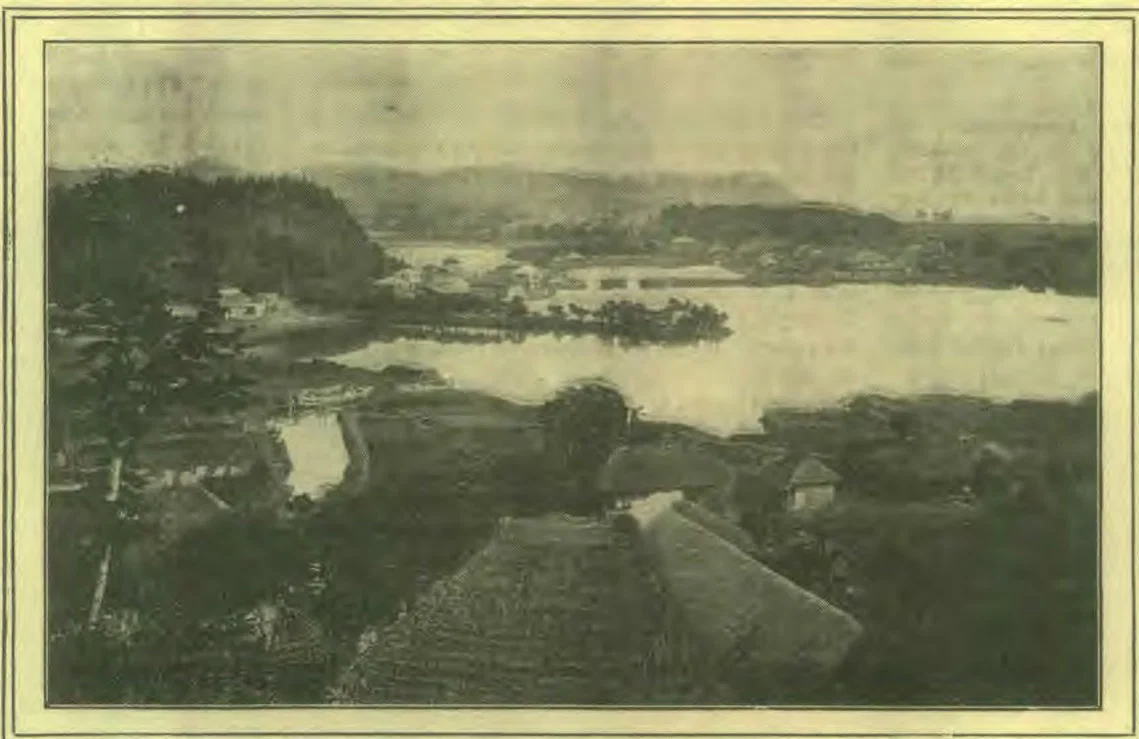
Kanazawa, Japan.
"'Please let me ask you, Captain Hobson, where did you learn this? I should suppose that a congressman would know that for two hundred and fifty years before Commodore Perry's visit, there was no nation on earth that could compare with Japan for the peace habit. While Europe and America were in the midst of long years of bitter wars, revolutions, and mutual slaughters, there was for two hundred and fifty years neither internal nor external disturbance of peace in the empire of Japan.
"'Your sweeping judgment of the national character is that they have the war habit. For ages it has been the traditional teaching in Japan that the cherry blossom, which fills valleys and plains with its delicate perfume, and then in self-sacrifice gives itself to die, is the symbol by which they have always interpreted themselves.
"'Probably you did not know that, when Perry opened Japan to the knowledge of Western history, one thing that shocked the Japanese was the awfully bloody histories of the nations on this side of the globe. And one of their great moralists, Yokoi Shonan, expressed this wide feeling when he begged his government to send him on a mission to the West, that he might plead with those nations to put an end to the brutal wars which two hundred and fifty years of peace had made Japan profoundly dislike.
"'Have you ever compared the national hymn of Japan with those of the nations of the West? Her hymn is of very recent date, hardly thirty years old, and you would expect to find something of 'the war habit' that has grown 'for eight hundred years' in this hymn; for hymns, to be national, must express the deepest and strongest sentiment of the nation. Not a shadow of war here. We of the West have to be careful how we sing our national hymns where representatives of different nations are gathered. But Japan's national hymn is so absolutely without the war spirit that it can be sung anywhere in the world without giving the slightest offense.
"'In the course of your address, your vivid imagination led you to picture the millions of China, too, as virtually possessed with this same war habit, and you painted in fiery colors those five hundred millions of yellow men, 'where countless soldiers could shoot as straight as we can, and could live on one-tenth of what we should need,' descending on our Pacific Coast with irresistible force. Are you not as far afield here as with Japan? I had the honor recently of an interview with the Hon. John W. Foster, who kindly presented me with a copy of his 'Present Conditions in China.' With his long and honored diplomatic service in the East, whose peoples he knows, and whose trusted adviser he has been for decades, he has a right to say in this pamphlet: 'For many generations China has been the least warlike of any of the great nations. Her most venerated philosopher and statesman, Confucius, taught her people that nations as well as individuals should settle
their differences by appeals to right and justice.'
"'In view of these facts, it seemed to me that you had somehow gotten the wrong perspective, and that you should have reversed your vision and told your audience that we Westerners have the war habit badly, and might well learn something from those oldest and most peaceful nations of the East. I was in Manchuria as a guest of the army for six weeks, and was given in my passport the grade of a colonel. I had letters of introduction from the premier, Count Katsura, to all the generals and Marshal Oyama. The premier is a general of the regular army, and he said to me in all solemnity: 'I am a soldier, but I hate war. I tried every possible way to come to a settlement with Russia thru peaceful means, and after six months of useless diplomatic correspondence we simply had to fight for our national existence.' This is a true expression of the heart of Japan's generals.
"'Mr. Foster is right in his estimate of the peaceful character of the peoples of the East. What he says agrees with the conclusions I have reached, after thirty-three years of residence out there.
"'Let me now refer to the charge you repeatedly made that Japan is trying to bring on war with America at the earliest possible moment, knowing that we are unprepared and that she could win easy victories provided she can get a pretext for beginning the fight.
"'Our Secretary of War, Mr. Taft, unqualifiedly stated in Tokyo only last October that the two governments and the two peoples are perfectly secure in their friendly relations, which no local disturbances can affect. He says, with reference to war talk: 'It would be a crime against modern civilization if Japan and America went to war, and it would be at once hateful and insane. The people of both countries are alike repugnant to the idea, and the governments of both countries may be trusted to be faithful in this matter to the people's wishes.'
"'You say that Japan virtually gave 'an ultimatum' to our government, and made 'demands.' Secretary Root said in his address before the American Society of International Law: 'The government of Japan made representations to the government of the United States that, inasmuch as the children of residents who were citizens of all other foreign countries were freely admitted to the schools, the subjects of Japan residing in the United States were, by that exclusion, denied the same privileges, liberties, and rights which were accorded to the citizens or subjects of the most favored nation.' The difference between a diplomatic representation and an ultimatum or a demand is the difference between impending war or peace. An ultimatum is the last diplomatic word before the beginning of active war. Secretary Root has told the world that there11wasn't a shadow of an ultimatum. And he adds: 'It is a pleasure to be able to say that never for a moment was there, as between the government of the United States and the government of Japan, the slightest departure from perfect good temper, mutual confidence, and kindly consideration.'
"'Our ambassador, Luke Wright, on his return from Japan last September, said to Americans thru the papers: 'The talk of war between this country and Japan isn't even respectable nonsense. There is no situation between Japan and the United States other than the very pleasant and friendly relation which has always existed. Japan no more wants a war with us than we want one with her, and the idea that there is an impending conflict between the two countries is ridiculous. Japan regards us as her best friend, and there is a perfect understanding between the two countries.'
"'Our new ambassador in Tokyo [Hon. Thos. J. O'Brien] asserted before the Oriental Association on December 11 that 'so far as our two countries are concerned, there is not now one serious question that remains unsettled.'
"'I will quote the missionaries who speak the Japanese language, live with the people, have strong friendships among the educated classes, read the papers, and are agreed on this one vital point—the way the Japanese think about us. They have watched not without anxiety the irresponsible jingo utterances of a section of the American press and their slanders of Japan. And they have openly sent their formal message to the people of the United States; and, in view of such utterances as you feel impelled to make, the public should have the saner views of men who have first-class opportunities for knowing what you can get only in less direct ways. Here is their message:
"'While we, as missionaries, have nothing to do with questions of national economics or international politics, yet in matters affecting the mutual good-will of nations, we, as messengers of God's universal Fatherhood and man's universal Brotherhood, are peculiarly interested; and, as Americans now residing in Japan, we feel bound to do all that is in our power to remove misunderstandings and suspicions which are tending to interrupt the long-standing friendship between this nation and our own. Hence, we wish to bear testimony to the sobriety, sense of international justice, and freedom from aggressive designs exhibited by the great majority of the Japanese people, and to their faith in the traditional justice and equity of the United States. Moreover, we desire to place on record our profound appreciation of the kind treatment which we experience at the hands of both government and people; our belief that the alleged "belligerent attitude" of the Japanese does not represent the real sentiments of the nation; and our ardent hope that local and spasmodic misunderstandings may not be allowed to affect in the slightest degree the natural and historic friendship of the two neighbors on opposite sides of the Pacific.'
"'This document is signed by over a hundred men, many of whom have lived in Japan over a quarter of a century. Every one of these men would repudiate without hesitation every one of your assertions to which I have referred.
"'In thus replying to your public statements, I am not ignorant that the immigration question is a perplexing and also an irritating one. And I happen to know that, because it is irritating, both governments have kept pen from paper. Of course, I am not in the secrets of the government, but, as far as I understand things, I believe there has been no diplomatic correspondence whatever between the two governments until the very recent note of Secretary Root to Viscount Aoki concerning the immigration question, and the Japanese government's reply thru our Ambassador O'Brien. Heretofore it has been simply diplomatic conversations. But meantime, and repeatedly, both governments, thru their most responsible agents, have unwaveringly said to the world,—in the straightest possible use of words,—there is no break in the friendly relations between the two governments. Just a year ago I was in our ambassador's box at the opening of the Japanese Diet, and heard Premier Saionji say: 'I have been questioned with reference to the San Francisco affair and asked what our government is going to do about it. To this I reply that the matter has not reached the diplomatic stage. It is merely a local affair within the jurisdiction of a friendly country, and we trust the government
of the United States to do the just thing.'
"'A few weeks ago I was accorded an interview with Japan's ambassador, Viscount Aoki. His words to me were: 'War with America is impossible. If immigration tends to make an unfavorable economic situation here, or arouses race prejudice, then we will stop our laborers from coming to this country. The good-will and friendship of the great republic is not to be imperiled for the sake of a few emigrants.'
"'Undoubtedly Japan feels hurt over the determination to exclude her laborers while those of other nations are freely allowed to come. It is like a blow from a friend—from one she has always called with profound respect her 'teacher.' But again and again, during the last year's misunderstandings, Japan's great statesmen and warriors, and her great newspapers, have said, with deep regard and gratitude for what America has done for her: 'We can never fight the United States.' You may be sure she will never raise a finger against us, unless we become so unrighteous as openly to insult her, throw away her valuable friendship, and aggressively arouse her war feelings.'"
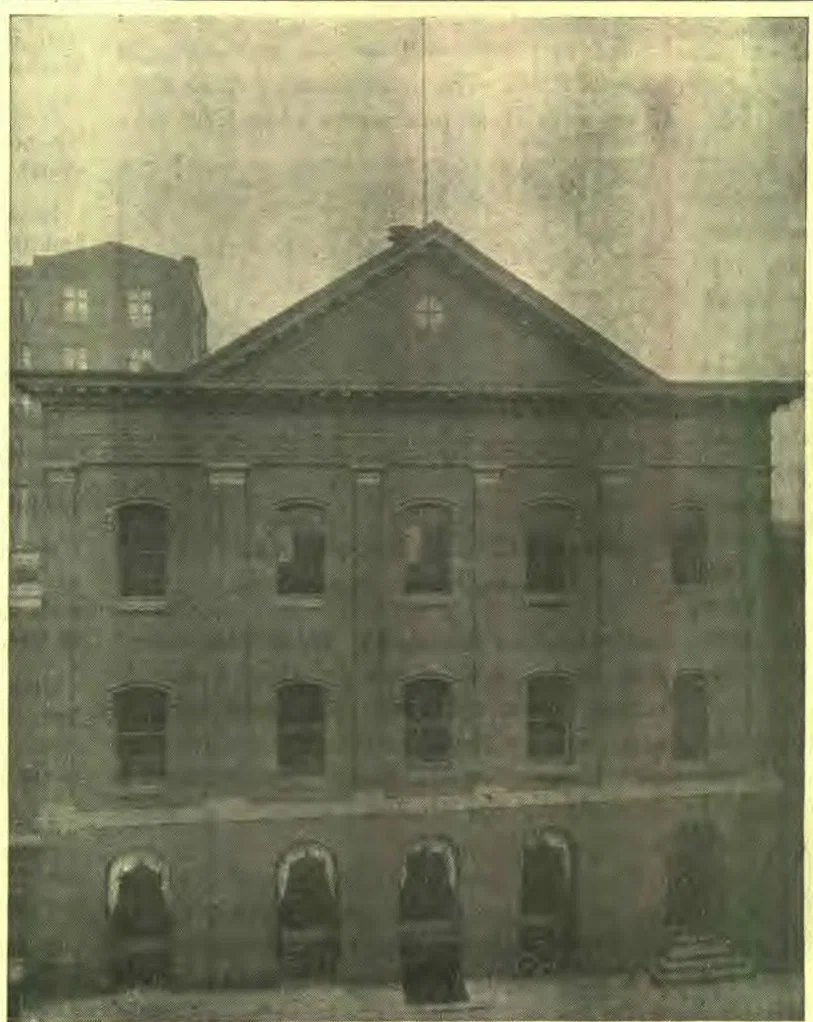
Old Ford Theater, 10th St., Washington, D. C., Where Abraham Lincoln Was Assassinated, April 14, 1865.