The study of last week was of Babylon as an educational center, the extent of her schools, industries, and influence. This article is a continuation of that study.
The eating and drinking of the Babylonians was more or less connected with their religion, the root of which was nature-worship, and the chief of which was sun-worship. Great feasts came continually—weekly, monthly, yearly—in connection with this worship. Licentiousness in various forms was a part of it; and this licentiousness was fed and fostered by rich, unwholesome viands, the exciting condiments and sauces, and the stimulating, intoxicating, maddening wine drunken on all such occasions. The mad revels of students in our great institutions of learning, connected more or less with secret societies, may be easily traced to the idolatrous feasts and revels of the various cults and gilds of ancient Babylon. The Easter and Yuletide festivities, as well as the special feasting on Sundays, are all continuations of the ancient Babylonian feasts in honor of the sun and its "wild solar holiday of all pagan times."
But these religious feasts and revels were expressly forbidden by the law of Jehovah, in which the Judean youth had been educated. They had seen the sad result of this false worship and false education among their own people and their kings; and they themselves were reaping the fruit of the evil sowing in their captivity and enforced exile from beloved Zion, which lay in utter ruin. Even Israel's wisest king, who was famous thruout all nations for his knowledge, to whom all the world sought for wisdom; whose knowledge embraced botany, and zoology, and entomology, and rhetoric, and psychology, and art, and ethics (1 Kings 4:29-34); whose proverbs are even now, in their comprehensive scope, the wonder of the world,—even he, thru the seductive influences of wine and the idolatrous women of his court, fell. Knowing God's law, knowing and seeing the sad results of departure from it thru the popular worship and feasts of the heathen, the noble young men of Judah, the slaves, refused that part of their education which would have connected them most closely with the idolatry of Babylon.
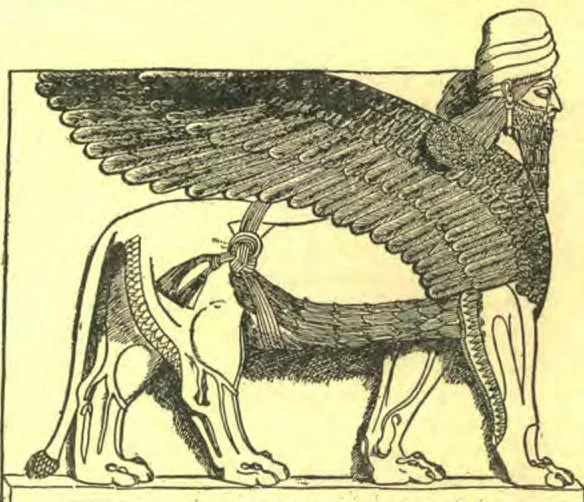
Assyrian Man-Headed, Eagle-Winged Lion.
Above all other considerations there must have come into the lives of the young men as controlling principles their duty and service to God. Their own names continually recalled God's goodness and their duty to Him: Daniel, "God's judge;" Hananiah, "whom Jehovah graciously gave;" Mishael, "who is what God is;" Azariah, "whom Jehovah aids." Nebuchadnezzar, knowing the influence of these, bestows others, in order to bind them to idolatry. Daniel was called Belteshazzar, "Bel favors;" Hananiah was called Shadrach, "circuit of the sun," or "royal one;" Mishael was given the name of Meshach, the first syllable retained, but the Babylonian "Shach," the goddess of love and mirth, substituted for "El," God. It was to connect the youth with the Babylonian Venus. Azariah was called Abed-nego, a "servant of Nego," or Nebo, the god of learning. But the language, the memories, the associations, of heaven-taught youth were stronger than the glittering generalities, the seductive atmosphere, the fulsome flatteries, the strong delusions of the popular education of wealthy, world-renowned Babylon; a lesson which all Christian parents should have taken to heart, but which having been neglected, is responsible for the Bible ignorance, the infidelity, the growingly low standards of morals everywhere manifest in the business and social world.
Temporal versus Eternal.
The education of Babylon promised great temporal advantages to those who excelled. Honorable positions among the Magi and Chaldeans were ever open, in which the growing scholar could wield great influence; and the mighty king was ever seeking such to fill important posts of responsibility in the affairs of his vast empire. But beyond these it offered nothing. True, there were the greater gods, and the promised reward among them in a world no better than this; for the gods, being deified departed heroes, were of like passions with men here; and the better or upper worlds were realms of plot and counterplot, war and strife, rape and marriage. Might and position awaited if a man could win it by strength, subterfuge, or the special favor of some deity; but of power over sin, of the "upright life and pure," of the right of existence because of righteousness, the polytheistic religion of Babylon knew nothing, and taught nothing which was free from condemning and all-destructive error. The very root of that religion, as we have already seen, was rebellion against God, perversion of His ways, rejection of His commands, and trust in the self-sufficiency of the creature.
Daniel and his brave, faithful companions turned from it all, and chose the simple course that would separate them as much as possible from sin-loving youth and all idolatrous associations. They had read in the words of infinite wisdom of the wrong course: "Avoid it, pass not by it, turn from it, and pass away." Prov. 4:15. We can readily understand that this course cost them something. We can easily hear the protests and ridicule of the disloyal Judean youths among the captivity. We hear the taunts of the Babylonians and captives from other nations. We can hear the reproach cast upon the simple diet of pulse (leguminous foods, as peas, beans, lentils, or perhaps seeds of any kind), and pure water. We can see the curled lip and contemptuous sneer; we can note the repressed word on the part of the persecuted; we can read their inward prayers; we can almost join them in their prayer-meetings, when alone, as they poured out their souls to the living God, their personal Friend. They were, like one of old, only bearing "the reproach of Christ," esteemed by them "greater riches than the treasures" of Babylon. They were building characters of eternal worth.
With beautiful Christian courtesy and wisdom, they lay the matter before the king's steward, and ask for a brief time of testing for the proposed diet. The brevity of the time shows clearly that they expected God to work manifestly. They were in Babylon to witness for Him; they would meet every condition so far as slaves could; and then God would vindicate their faith, and witness to His truth. The steward admitted the test, and the ten days of vegetarian diet satisfied him that the youths of Judea could hold their own, and he gave them their own way.10The three-years' university course soon terminated. The Judean princes had studied the language and learning of the Chaldeans, the arts, the sciences, the knowledge, all of worth, and doubtless much, unwillingly, not of worth, which the renowned teachers of Babylon had to impart. The result is told in the following simple record:
"Now as for these four youths, God gave them knowledge and skill in all learning and wisdom; and Daniel had understanding in all visions and dreams. And at the end of the days which the king had appointed for bringing them in, the prince of the eunuchs brought them in before Nebuchadnezzar. And the king communed with them; and among them all was found none like Daniel, Hananiah, Mishael, and Azariah; therefore stood they before the king. And in every matter of wisdom and understanding, concerning which the king inquired of them, he found them ten times better than all the magicians and enchanters that were in all his realm. And Daniel continued even unto the first year of King Cyrus." Dan. 1:17-21, A.R.V.
They had attended the schools of Babylon, but they had had a higher Teacher than Babylon knew. Beyond the voice of heathen tradition they heard the words of truth; beyond the deification of nature, they saw the working of the great Jehovah, high over all. High sounding over the traditions of the priests, the commentaries of the lawyers, the guesses of the scientists, the vague generalities of the evolutionists, they heard the voice of the Ancient of Days. They had opened the heart and soul and mind and flesh to let God in, and He came in with all the life-expanding and truth-progressing power of the Infinite. They were taught of God; how little in comparison were the hypotheses and suppositions and superstitions of man! With the whole being opened to Him who ever seeks entrance to His temple,—man's body,—what wonder is it that "God gave them knowledge and skill in all learning and wisdom;" and that when the king communed with those who studied the prescribed course at his universities, and thus tested them at the end of three years, "among them all was found none like Daniel, Hananiah, Mishael, and Azariah?" "Therefore stood they before the king," as counselors. But this was not all the test; in the affairs of his great and diverse kingdom, "in every matter of wisdom and understanding, concerning which the king inquired of them he found them ten times better than all the magicians and enchanters that were in all his realm."
Babylonian Pilot Instrument Supposed to Have Been Used for Making Cancellous Characters on Soft Brick.
God did more than this for Daniel. He opened to his mind new revelations of the far future. He made him a seer—a see-er of the time to come. In his loyalty to God, Daniel could be trusted with the great prophetic gift, for the warning of the world, and the good of his people, to the glory of God. And these glorious lessons of infinite worth have come down to us. Will we heed them?