BROOK AND BLESSING

5%

BROOK AND BLESSING.

The Brook Jabbok.

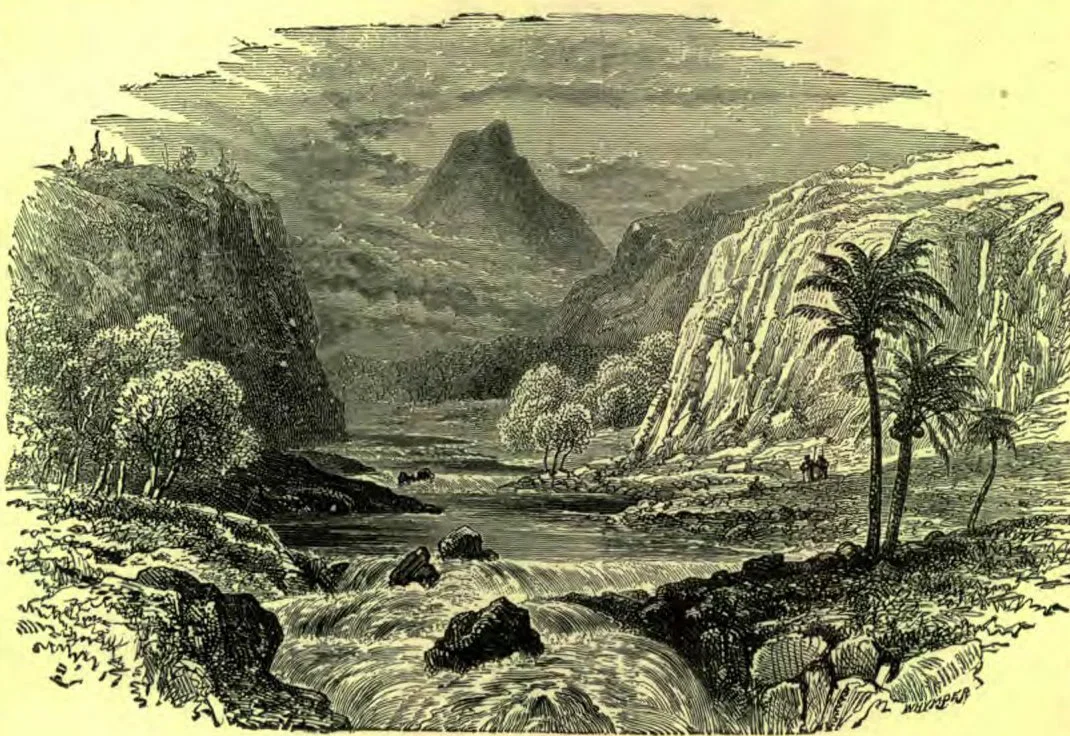
NOT an inviting name is Jabbok, meaning outpouring, or emptying. Not a beautiful picture is the rough woodcut on this page. But the suggestive lesson of the swift-flowing Jabbok is of tremendous interest and vital importance to the Christian pilgrim. The Jabbok was a little river which flowed through Gilead on the east of Jordan, emptying into the latter river midway between the Dead Sea and the Sea of Galilee. At times it was a rushing, roaring torrent. In dry weather the upper part of the bed was dry, while the lower part flowed sluggishly.
AFTER the conquest of Canaan by Joshua, the Jabbok divided between Israel on the north and Amnon on the south. It thus became a dividing line between loyalty and disloyalty, between a people God-led and a people who knew not Jehovah nor cared for Him. On one side was the world; on the other the promised land.
BUT more than this the river Jabbok suggests. It is memorable for a struggle which, in its typical significance, is of more consequence than all the great battles of earth, fought with carnal weapon. This battle by the brook was a conflict of character, which has altered the face of the earth and given hope to the halting and trembling.
ISAAC had two sons, Esau and Jacob. To the elder belonged the birthright and the father's blessing. The birthright included the double portion of inheritance, the priesthood of the family, and the pre-eminence, or rulership. With these went the blessing of the first-born by the old patriarch. The birthright was despised by Esau in comparison to a life of ease and pleasure. He could come in from his hunting, weary and hungry, longing for a dish of Jacob's savory pottage. He childishly complains that he will die if he does not get it. Jacob, ever ready to drive a bargain, demands Esau's birthright for the food, and Esau sells it for the sake of a mere lust of appetite. Even so men are now selling eternal birthrights for messes of the world's pottage.

The Coveted Blessing.

THE RIVER JABBOK
THE RIVER JABBOK
THE next step is the coveted blessing. Isaac, old and blind, is about to die. He would bless Esau before he died. He loved his son Esau more ardently because he ate of his venison. He told Esau to take his bow, go forth into the fields, and secure game and prepare him a savory dish, that he might bless him before he died. Esau went forth, knowing of naught between him and the ancestral blessing. But Rebekah, who read character better, knew that Jacob was more deserving, knew God's design as regards the boys, and felt that she must interfere to secure to Jacob that which God had promised. With the co-operation of Jacob, she deceives her blind old husband; Jacob obtains the blessing; Esau is enraged, and swears vengeance. Jacob is forced to flee, and separates from his mother forever, a direct consequence of his selfish course.
JACOB, "the supplanter," flees to Laban, his uncle, in Syria. There he works fourteen years for his two wives, and meets the same ungenerous treatment from Laban that he had accorded Esau. But with humble heart he bears it, still longing for God's blessing, without which all the gatherings of the years are worthless. Jacob means to do God's will, but he does it in his own way, and always seeks to do it to his own advantage. How many Jacobs there are now among God's people!
BUT the time of crisis, of trial, of victory, draws near. The Lord speaks to Jacob and tells him to return to his own land and He will bless him and be with him. Little does Jacob know what must meet him before the blessing. He starts with his wives and children and flocks and herds. Some of Esau's roving followers hear of Jacob's mighty caravan, and they carry the tidings to their chief. The spirit of revenge is roused in the red chieftain, and mad with cherished hatred and hungry for plunder, he starts with four hundred armed men to meet Jacob.

Hopeless without God.

JACOB, with his great defenseless family, hears of Esau's coming. He knows that his case is hopeless. He knows that he has done wrong in the treatment of his brother. He knows that by no device of his can he now stay the avenger's hand or escape his anger. He is no physical coward. For twenty years he has met with the Syrian wolves and fiercer beasts of the desert in defense of his flocks. He has met the robbers of the wilderness as they came to plunder. But now, after years, he is about to meet the growing results of a sowing of sin in the wrath of an offended brother, and the strong man trembles. He must have more than mortal help to gird him for that meeting, and, therefore, he stays behind to plead with God. "O God of my father Abraham, and God of my father Isaac, O Jehovah, who saidst unto me, Return unto thy country, and to thy kindred, and I will do thee good; I am not worthy of the least of all Thy loving-kindness, and of all the truth, which Thou hast showed unto Thy servant; for with my staff I passed over this Jordan; and now I am become two companies. Deliver me, I pray Thee, from the hand of my brother, from the hand of Esau: for I fear him, lest he come and smite me, the mother with the children. And Thou saidst, I will surely do thee good, and make thy seed as the sand of the sea, which can not be numbered for multitude." Gen. 32: 9-12.
CLEARER light shines upon the "supplanter" after that prayer. He will seek to make amends for his wrongs. He will, if possible, ameliorate the wrath of theoffended one. So he sends forward two hundred and twenty goats, two hundred and twenty sheep, thirty milch camels and their colts, fifty head of cattle, twenty asses and ten colts, a princely present for a man having a family like that of Jacob, worth perhaps in our money now about $10,000. He sends this in four droves in the hand of trusted servants, with a goodly space between them. As each meet Esau, and he inquires its meaning, each servant is to answer, "They are thy servant Jacob's; it is a present sent unto my Lord Esau. . . . Moreover, behold, thy servant Jacob is behind us. For he said, I will appease him with the present that goeth before me, and afterward I will see his face; peradventure he will accept me." There is no more deception. His motive is as open as the day.

The Night Struggle and Victory.

JACOB remains that night with his own, still unsatisfied. He wants the assurance of God. He can not rest. He rises in the night, sends his family over the stream, and he remains alone to plead with God. He is seized with strong hands. Jacob feels that his assailant is a robber. He wants the time for prayer; but he is spending it in an effort to overcome a robber and save his property. All the rest of that night he struggles as only a plainsman can. The morning begins to break. Neither seems to have conquered. Then his assailant reveals His superhuman power. He touches the hollow of Jacob's thigh, and the sinews are strained. Jacob knows now who it is, the Angel of the covenant. "Let me go," said the Mighty One, "the day breaketh." And Jacob having found God, as he could not find Him before in all his years of wandering, replies, I will not let Thee go except Thou bless me."
No uneasiness nor pain must keep him back from the divine assurance.
God can not deny such pleading faith. "In his [Jacob's] manhood he had power with God; yea, he had power over the Angel, and prevailed; he wept, and made supplication unto Him." Hosea 12:3, 4. The Angel asked him, "What is thy name? And he said, Jacob [Supplanter]. And He [the Angel] said, Thy name shall be called no more Jacob, but Israel; for thou hast striven with God and with men, and hast prevailed." Gen. 32: 24-28. And Jacob called the name of the place Peniel, "the face of God," for he said, "I have seen God face to face, and my life is preserved."
JACOB—Supplanter! Israel—the Upright, Prevailer with God! It was not a new name that God gave His servant. Before man was created, God wrote the characters chosen for them in the book of life. And the name of the family was Israel. "God made man upright," literally made man Israel. Eccl. 7:29. That was God's purpose; He had no other for man. Man unmade himself. He became Jacob, a supplanter. He walked in his own way. He perverted God's way. Yet ever God calls him back to be Israel. By kindness, by love, by tribulation, by trial, by affliction, by struggle, God calls him. He may refuse the messages God may send, one and all. He may sell his birthright for a mess of pottage and die with the world. Or he may accept God and live. But then he must meet the trial. He must come to the ford of Jabbok and there plead with God till He who is his Adversary because of sin, becomes his Helper because of self-abasement and faith. Let us take home to our hearts the lesson of the brook Jabbok, and the lonely night of wrestling on its banks.