READER, have seat once more. Take in hand that sovereign of all books, the Bible.
Open it at the first chapter of Judges, where begins the recital of a new period in the marvelously varied—we wish we could say kaleidoscopic—history of Israel, once bitterly enslaved, oppressed, but now free.
FREE to continue their national life on a higher plain; free to choose the right and to avoid the wrong; free to march on in the safe, prosperous pathway of obedience or to stagger, stumble, fall, in the perilous highway of self-will; free to build character and institutions soundly, grandly, vitally; free to shape their national history into blessed lessons for all the world to learn and to practise; yes, and free to waste, to dissipate, character and opportunity foolishly, wantonly, with certain death to freedom awaiting. Free to become, with Jehovah for Leader, the pinnacle nation of the earth, or to become a people scattered, reproached, oppressed, slaughtered, to the end of time.
Note, in the very first chapter, at this telling crisis in their life, the number of tribes which failed to obey the repeated, emphatic command of the Lord to ``drive out'' the evil inhabitants of the land from the territory allotted to those tribes.
What saddening sentences are those which tell of their forsaking, almost immediately, `the Lord God of their fathers;'' of their hasty turning to the gods of the peoples around them; of their refusing to harken to the counsel of their judges; of their quick infatuation for `Baalim and the groves''!
Then follows that startling sentence from the lips of Jehovah, the mighty Deliverer of their fathers: ``I also will not, henceforth, drive out any from before them of the nations which Joshua left when he died: that thru them I may prove Israel, whether they will keep the way of the Lord.''
Then, with but the turn of a leaf, we come upon that triumphant song of Deborah and Barak, wherein is rehearsed, exultantly, the strange part enacted by Jael, the wife of Heber, the Kenite, descendant of Hobab, Moses' father-in-law,—in the deliverance of Israel from the pitiless hand of Jabin, king of Canaan, after a grievous oppression of twenty years.
Thence follow the intensely interesting records of the life of the chosen people during the many long, testing years after the death of Joshua.
One of the most touching of these histories treats of seven years of fierce affliction under the Midianites, Israel's half-brethren—the children of Abraham, like themselves. So extreme, so bitter, was the cup these cruel kindred pressed to the lips of unstable Israel that for shelter and for safety the latter fled to the dens, caves, and strongholds of the mountains.
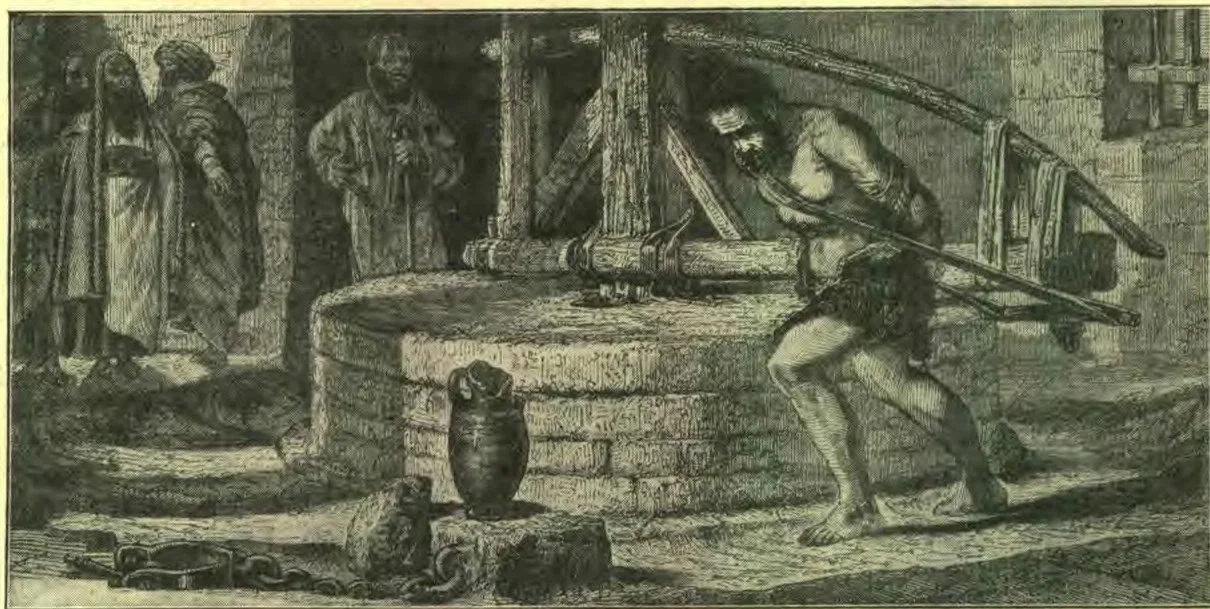
Samson, captive and blind, grinding at the Philistine mill, the sport and moors of people he had conquered when walking with God. What a type was he of backslidden Israel?
The invaders ``came upon the land with their tents and their cattle.'' They came as grasshoppers for multitude. Numberless were they and their camels. But God provided for the scattered fugitives a deliverance most impressive and characteristic. We are told in a style highly picturesque, yet very realistic, how this was accomplished.
Can any writer of fiction to-day paint from his imagination scenes more impressive, more pathetic, lighted up with coloring more exquisite, more vivid, than in that scene which the divine word presents in the interview between Christ and Gideon at the wine-press of Joash, in Ophrah? or one more purposeful, evincing finer zeal, than does that which portrays the destruction of the altar to Baal, set up by the father of Gideon, and of ``the grove which stood by it''?
Then there follows, during the test by the fleece, the comforting, encouraging picture of God's patience with Gideon, who felt too weak to attempt a task so Herculean without help omnipotent.
Next there flash out, into clearest light, the diversified, limitless, and powerfully effective, resources of God—concealed often in seemingly little things—for accomplishing His purposes. Of this we have an illustration in the peculiar yet simple means employed to expel and punish the greedy Midianites, who ``ran, and cried, and fled.'' Reader, put a study of fifteen minutes into that story. Gems of lessons flash in it.
In the eleventh chapter there stands out in fine relief another of the remarkable characters whose lofty deeds of self-denial enriched Israelitish history during that chaotic period when ``there was no king in Israel, and when every man did that which was right in his own eyes.''
We refer to Jephthah, the Gileadite, three phases of whose character elicit admiration: First, the readiness, the heartiness, with which he forgave his brethren their hard, selfish treatment of him under circumstances truly unwelcome, and for which he was in no degree responsible. Secondly, the noble man's just and lofty dealing with the king of the children of Ammon when he declared war against Israel to recover territory which, he claimed, Israel had taken from Ammon three hundred years before. Note his fine grasp of the history of the case, his telling summary of the points in Israel's favor. Read chapter 11:23-27. Could argument be clearer, more conclusive, than that with which he ends their parley before resort to arms?4
Lastly, his absolute, unfaltering fidelity to the striking pledge he made the Lord, that if He would deliver, without fail, the children of Ammon into his hand, whatsoever should come forth from his house to meet him, upon his return, ``should surely be the Lord's.''
That vow cost the conqueror of Ammon the most precious thing he possessed. It was a vow, which, expressed in his own pathetic words, ``brought him very low.'' It smote his very heart, but it brought him to the very summit of giving, to a surrender in the superlative degree. It was the giving up of an only child to perpetual celibacy, and so depriving his name forever of continued posterity.
Can we think the act was at all typical of the yielding up of another only Child, eleven hundred forty-three years later? It may, at least, remind us of that imperial scene on Calvary, which for two thousand years has held supreme interest in the minds of mankind, and must continue to draw wider and deeper attention until it shall be said: ``Behold, He cometh!''
Every chapter of the book of Judges portrays scenes of thrilling interest. Some teach lofty lessons in right-doing; others utter truths, which heeded, may save from endless death.