Dating back to the days when the kingdom of Babylon was in the height of her power, the Chinese have been characterized as a cultured and literary people. The doctrines of Confucius and Mencius continually keep before them the importance of preserving the records of the past. These records are preserved from generation to generation, and details are written with great verbosity. It is a Chinese proverb that "he who would know things ancient and modern must peruse five cartloads of books." Wealthy families have records extending back fifty generations. Even to this day the descendants of Confucius are carefully traced, and are allowed special privileges, and have for them a place set apart by the government in the province of Shantung.
Destruction and Replacing of Literature.
While it is true that all the literature has been confiscated at intervals in China's career by rulers who wanted to blot out the illustrious name of some previous sovereign, still these records have at least partially been replaced. Chinese learning is characterized by memorizing entire books. So if the book should be destroyed they still would be able to duplicate it. So intent have the rulers been to preserve the classics that there is standing in Peking today what is known as the Stone Library. On mounted slabs of stone are carved the entire volumes of the classics. Students from all parts of the empire go to Peking to read the classics from this celebrated library. Books, altho greatly appreciated, are owned by few, since to possess a small library would often require the salary of a Chinese teacher for a whole year. Many of them do not so much as possess a copy of their own standard dictionary. It is not uncommon for a teacher to sit down and copy an entire book, or parts of a book, that he most desires to keep. No piece of paper with a few Chinese characters on it should ever be trampled underfoot if one would conform to customs of the Chinese. In every city at the gates, and in large cities at various street corners, will be found small boxes in which the public may deposit small bits of paper they may find flying about in the streets, and these are either carefully buried in the earth or burned.
An Encouraging Trait of Character.
The past history of China in regard to their respect for literature is one of the encouraging features to those interested in the disseminating of literature, for they can safely feel that what goes out from their hands, especially if sold at a price within proper limits, will be read by some one and perhaps passed thru many hands until worn out. School-books are handed down from one child to another until they are often almost black and the ink so rubbed off that it is hard to tell where the character begins. One of the worst offenses a schoolboy could commit would be that of mutilating his school-books. If a Chinese teacher wishes access to books, even the books he has himself studied, as a rule he must go and borrow from some one who is at the time studying from those books.
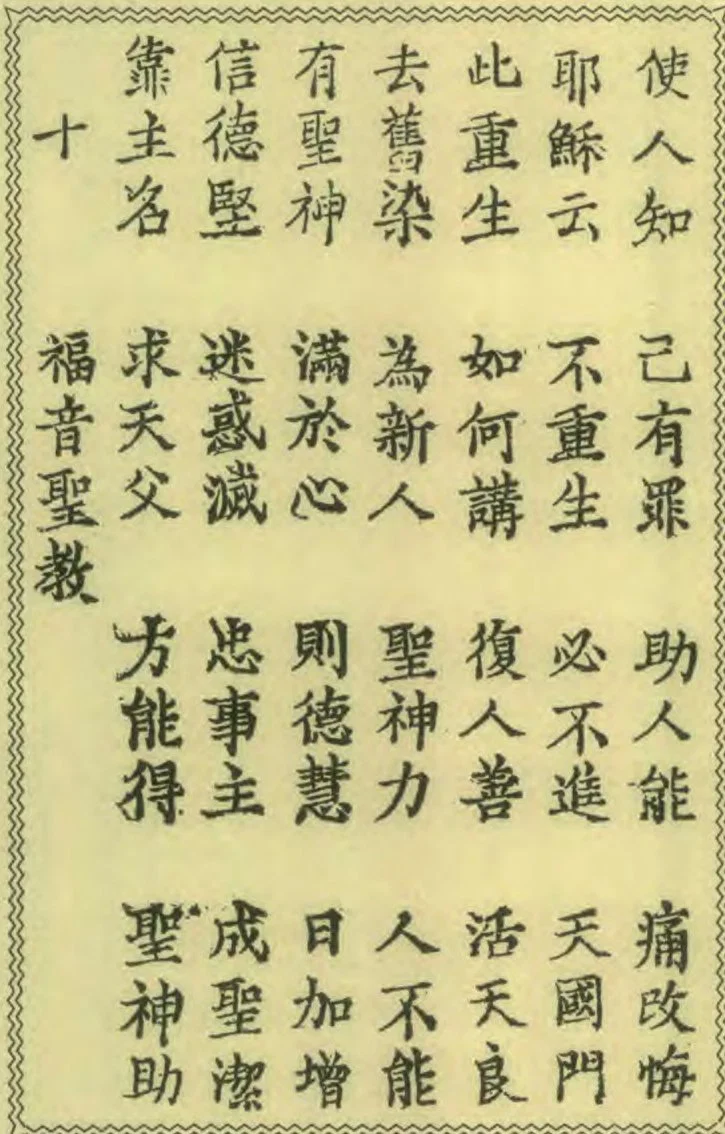
A Page from a Chinese School-Book, Printed from Black Letters, Reduced About One Third.
Printing in China.
While the art of printing was invented by the Chinese, it is not until the last few years that they have begun duplicating their literature by modern methods of printing. For many centuries the method has been that of writing the copy on very thin paper, into which the ink readily soaks, then pasting this on a smooth block of wood with the face of the copy to the surface of the block. Then they carefully carve the characters. The method of printing is also a simple one: First brushing ink over the surface of the carved block, then laying a sheet of paper on the top of this, with another brush they press down, somewhat as we in America do when hanging wall-paper. But this method of duplicating their books has answered in preserving the writings of the sages, and every year of past centuries has witnessed hundreds of thousands of students presenting themselves for the examination leading to degrees in every provincial capital and prefectural city.
Medical Book Illustrated.
The illustrations in books, when there are such, are indeed very crude. Medical books with illustrations of men simply outline their principal parts by lines; the first line bounding the periphery of the body and extremities, then another line half way between the apex of the chest and the thighs divides the body into two parts, the upper containing the heart, and the lower, the stomach. The latter is supposed to be the seat of the mind. If the abdomen is prominent or less conspicuous, the range of thought is respectively profuse or slight. Another illustration often found in these books is that of a man outlined as above, with small crosses marked in various places where it is supposed to be safe to thrust in a long needle for the cure of disease in the various parts of the body, in order to rid the parts of an evil spirit which is supposed to reside there. A few of these places are the eye, just above the elbow, thru the cheeks, the lower end of the sternum, over the stomach, in the thigh, etc. With no method but the wooden blocks with which to produce their illustrations and their superstitions relative to the dead, this has been the best they could do to indicate their ideas.
The Old and the New.
The ordinary Chinese seem to have no ability whatever along the line of illustrating anything by a drawing. This they readily learn when taught by Americans or Europeans. Their drawing is limited to their characters. I have been surprised after sending a man to see a plot of land that he could not make any kind of a drawing to show the location of same. He could write a good description of it and give the boundaries and the directions of the boundaries, also remember the length of each side, but would have no idea how to represent these by a small diagram. Their ideas of illustrating are well shown by some of the maps they have of their own empire. The outline of the empire is a large rectangle, and the13location of the provinces and prefectures of the empire are indicated by ovals in juxtaposition containing within them the Chinese characters. From these they have studied their geography. Their knowledge of locations is therefore very indefinite. They will say this city is on the south side, that on the north, the other on the west, and still another on the east side, but to give the boundary and actual distances from one to the other would be quite impossible even to some teachers who have secured their degree. Their education consists in memorizing large numbers of characters, and that man who has the best education is the one who can explain the meaning of the largest number of characters and repeat line after line of the classics.
This old system of education has been replaced by the modern, and China is largely indebted, if not entirely so, for its modern literature to the efforts of missionaries who have been active in translating and circulating the more modern books. These conditions—the Chinese being a people who have a love for literature—add respect for all printed matter, and with such an inadequate method of reproducing their literature and illustrating it, speak in loud terms of the opportunities before us with modern methods to place before the millions of this empire the Gospel in clearness and in a respectable form. Certainly this cause is worthy of the assistance of every one desiring to see this people rise from their heathen superstitions and walk in the light to which God has seen fit to call us.
Shanghai, China.