Shiloh: the Man of Sorrows

3%

Shiloh: the Man of Sorrows

Copyright, 1910, Pacific Press Publishing Association
By Mrs. L. D. Avery-Stuttle

Chapter VI. Rachel Weeping for Her Children
"Look thou, Varro," cried Achan, one of the most brutal appearing of the soldiers, "it hath been rumored that the house of Sylvanus hath concealed the carpenter of Nazareth, with the Babe whom we seek. Of a truth Herod will have the head of the centurion who returneth to Jerusalem not having fulfilled his command."
"Thou hast much wisdom, Achan," replied the centurion as he gave orders to return to the house of the shepherd. Instantly a score or more of soldiers broke down the outer gate, and forced an entrance. But the house was evidently deserted, save for little Perpetua, whom the rude soldiers found sleeping the sound, deep sleep of childhood, and Eliab, the patriarch, propped with bolsters upon his bed, his wrinkled hands clasped, and his trembling voice muttering a prayer.
Sylvanus and Bar-jona his guest, having heard the commotion, and missing Esther and the babe, had hastened into the street, hoping to be of some assistance to them and possibly to their wretched neighbors. A sickening fear for the safety of Esther and the babe Matthias haunted them, and Sylvanus rushed on and on in the semi-darkness of that awful morning, wildly calling their names; but his voice was lost amid the din and confusion, the babel and horror of the streets.
"Ho, grandsire, where is Sylvanus the shepherd?" cried a soldier brandishing a sword over the old man's head.
"Hush, you fellow," exclaimed Varro. "What cares King Herod for the shepherd? Verily, grandsire," he continued, "if thou wilt tell us where hideth the carpenter of Nazareth with the Babe, I swear to thee, we will take but Him only, and will depart."
"Whom seek ye?" questioned the old man, closing his dim eyes as the glare of the torch fell upon them.
"Have I not told thee that we seek the hiding-place of the Babe, whom the princes of the East called the King of the Jews? Hast thou knowledge of Him? Tell us, or we spare thee not — for all thy gray hairs!"
"The Babe? the Shiloh of Jacob? why seeketh King Herod the Babe? Will he come and worship Him also, as did the magi?"
"Verily, old man, thou hast a knowledge of this young King. Tell us what thou knowest, or of a truth thy gray hairs shall not protect thee."
"Go search the land of the Pharaohs, for the mother and her Babe. The magi have also turned into their own land again," replied the old man.
"Verily, I will stop thy lying tongue!" exclaimed a soldier, as he dealt the old man a savage blow with the back of his sword. "Where then hast thou hidden the Babe?"
"Said I not that He has gone into Egypt? Go tell the king, that the words of the prophets must be fulfilled; and verily, now, this voice of the weeping women which soundeth in mine ears is that spoken of by the holy seer Jeremiah, — it is even the voice of Rachel weeping for her children."
"Come, old man, wherefore pratest thou? Verily, because thou fearest Herod, thou hast hidden the young Child, and now thou sayest falsely that He has gone into Egypt," cried the centurion angrily, seizing a torch and applying it to the old man's quivering flesh. "It may be this flame will limber thy rebellious tongue."
"I would not deliver the young Child into the hand of Herod tho thou give me all the gold of the temple. And neither will I worship the gods of Rome. Jehovah alone is the true God, He who made the heavens and the earth. O Varro, centurion of Herod, Jehovah will protect His Son."
"What care we about the Son of thy God? See, Achan, how easily do I hush the prating tongue of this son of Abraham."
Still the trembling voice of the old man was heard once more: "O that I might have lived to see with mine own eyes Shiloh the Messiah, even as did Simeon the prophet of Jerusalem. But Jehovah knoweth best."
While he yet spake, one of the soldiers stood over him with a drawn sword; and even as he was uttering the last sad words of prayer, the shining sword of the assassin was crimson with the blood of the patriarch.
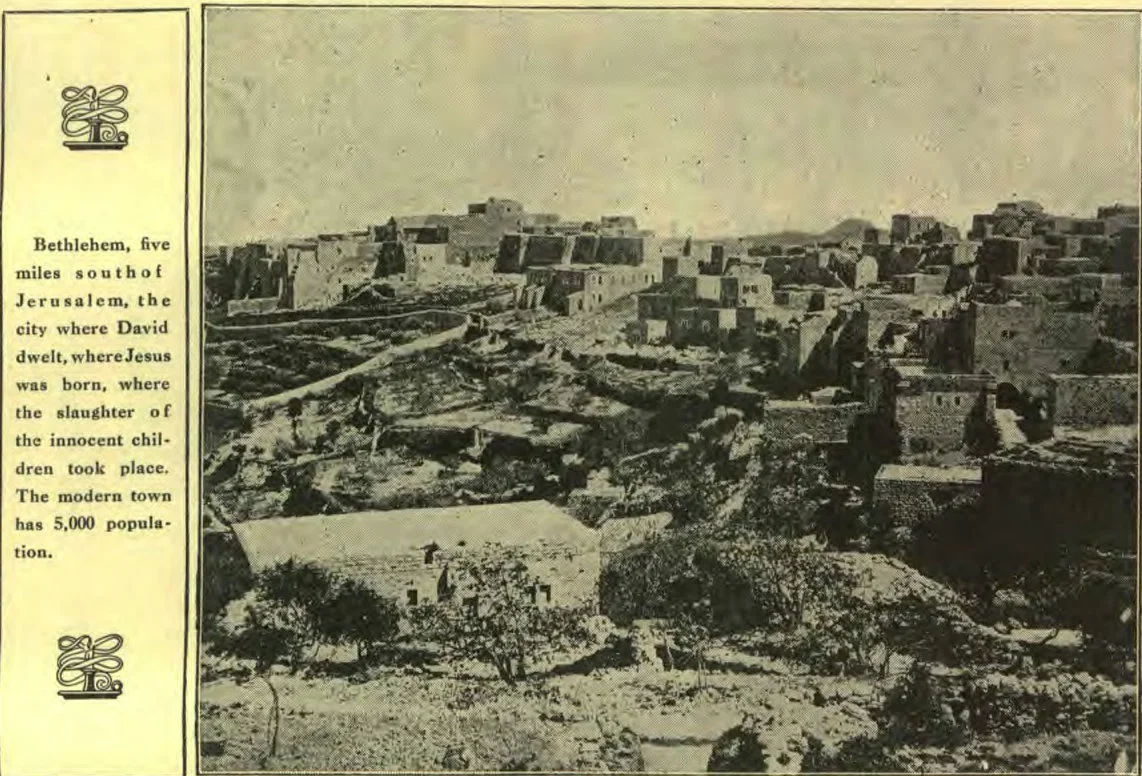
Bethlehem, five miles north of Jerusalem, the city where David Await, where Jesus was born, where the slaughter of the innocent children took place. The modern town has 5,000 population.
The rising sun glimmered faintly above the mountains of Moab and the nearer hills of Judea, as the executioners of the bloody king made their way out from the gates of Bethlehem, and hastened northward toward Jerusalem. But they had left behind them desolation and blood and agony untold. All day long little groups of white-faced women met and passed one another in dumb agony in the narrow streets, still filled with debris and confusion and awful reminders of the night of horror. Strong men moved about as if in a dream. Little children, the sad survivors of the night, ran about screaming after their mothers. The bright eyes of young men and maidens were still distended with horror. Now and again a wild shriek of a maniacal laugh rang among the hills and out over the quiet valleys.
But the aged vampire over in his palace at Jerusalem was satisfied.
From her hiding-place without the walls of Bethlehem, whither she had fled with her babe, Esther, the wife of Sylvanus, watched the soldiers disappear toward the north. But not until the last faint gleam of the burnished helmets had faded in the distance, as the morning sun shone upon them, did she venture forth.
We mark well the faces and forms of the two centurions, — Marcus, the kindly, the humane; Varro, he of the giant form, the man of blood, — for you and I, reader, will not meet them again for many days.
With a prayer of thanksgiving that her babe had been spared, Esther clasped him tenderly in her arms, and hastened homeward. Of the gruesome sights and sounds which greeted her as she entered the city, we already know. But we will follow her to her own home. At the outer gate she met Sylvanus. His garments were torn and blood-stained; and crimson drops were slowly trickling from a wound in his temple and hiding themselves in his beard.
"Everywhere have I sought thee, mine Esther; blessed be the God of our fathers that thou livest, — and the babe; else verily I should have said, 'Now hath the God of Abraham forsaken us.'"
"Nay, Sylvanus, say not so," replied the faithful woman, as they entered the silent home. "Tho He slay me, yet will I trust in Him. See, here is our sweet babe Matthias; see how he regardeth thee with his pretty brown eyes; not one brown curl from his young head hath fallen. Surely thou art a goodly child, my Matthias. And little Perpetua — thou sayest she still sleepeth? And thou too art spared to me, O mine husband!"
Without further speech, except to mention that their guest, young Bar-jona, had already started on his homeward journey toward Bethsaida, they entered the open door; for Sylvanus had not the heart to speak to her of the agony yet to come.
Anxious, first of all, doubly to assure herself of little Perpetua's safety, Esther failed to notice, in the darkened room, the quiet, blood-stained figure upon the couch. Suddenly she turned her head, and discovered the old man, Eliab, her father. With a cry of horror she approached him. Then, also, for the first time she saw the young lad, Heber, fallen prone upon the floor by the bedside, but still clasping one of the old man's hands in his own. Gently Esther raised him in her arms, and tried but vainly to pillow his dark head upon her breast. But he only shrieked and cried unintelligibly. The light of reason had fled from the gentle eyes of young Heber, the son of Sylvanus.
(To be continued)
— ✶ —