Rome's Broken Sword

3%

Pacific Press Publishing Association · Mountain View, California · Nov 7, 1916

FromSigns of the Times, November 7, 1916

Read the full edition

Rome's Broken Sword

By Percy T. Magan
"Out of the chaos and ruin and wreck which Rome expects will exist at the end of the present war, she designs to bring into existence again, if there be any possible way to do it, her temporal possessions as they existed prior to 1798."
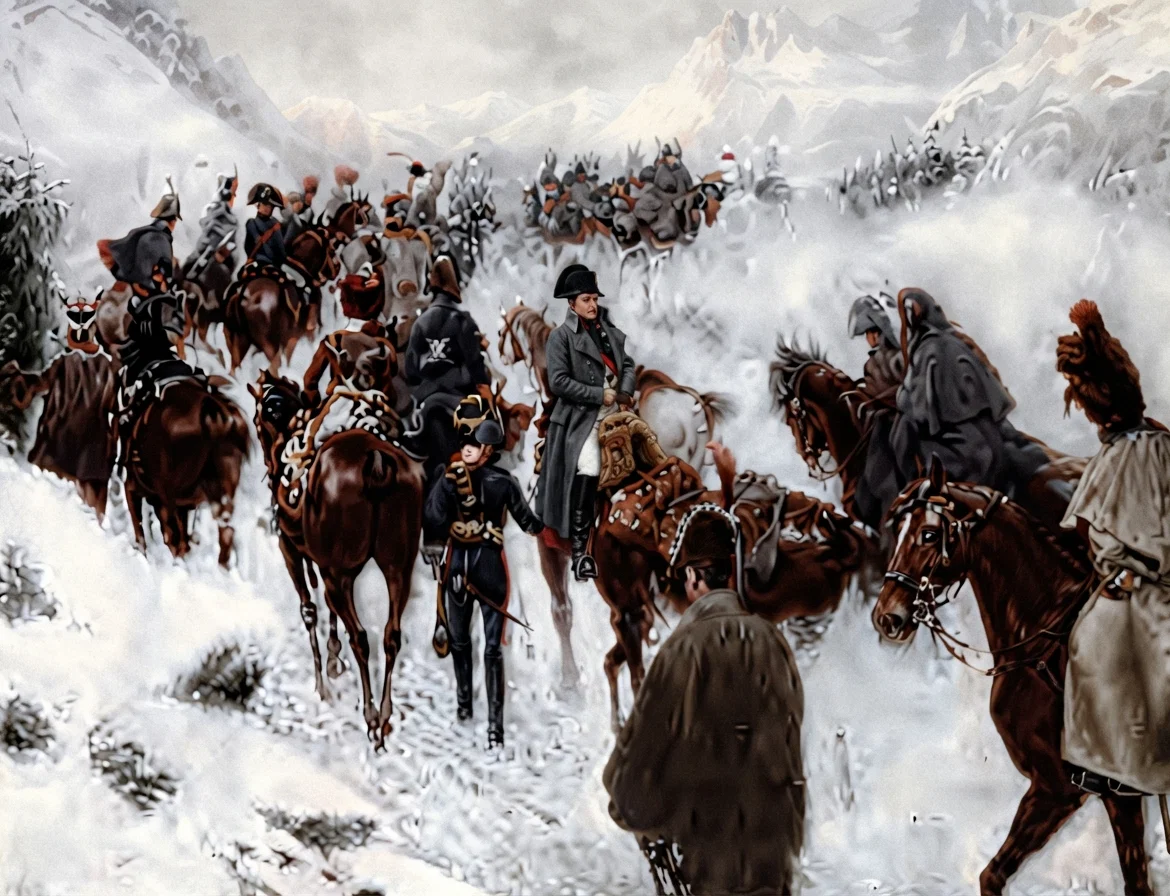
“When Napoleon and his army crossed the Alps”
EVER since the days when the generals of Napoleon Bonaparte first abolished the temporal sovereignty of the papacy, Rome has not only declaimed against her loss in terms most vindictive, but she has also striven most assiduously to regain her lost estate; and at no time more than the present have the supreme pontiff and the Curia Romana done more to bring about a reëstablishment of the Temporal States of the Church. In fact, this is one of the great objects which the papacy designs to achieve by her policy during and at the close of the present war.
This is clearly set forth in the closing paragraphs of the first encyclical letter — Ad Beatiissimi — of Pope Benedict XV, which he issued on the occasion of the Feast of All Saints, November 1, 1914. Let me give his exact words:
"And now, venerable brethren, at the end of this letter, our mind turns spontaneously to the subject with which we began; and we implore with our most earnest prayers the end of this disastrous war, for the sake of human society and for the sake of the church [italics mine]; for human society, so that when peace shall have been concluded, it may go forward in every form of true progress; for the church of Jesus Christ, that, freed at length from all impediments, it may go forth and bring comfort and salvation even to the most remote parts of the earth.

Demands a Reinstatement

"For a long time past, the church has not enjoyed that full freedom which it needs — never since the sovereign pontiff, its head, was deprived of that protection which by divine Providence had in the course of ages been set up to defend that freedom. Once that safeguard was removed, there followed, as was inevitable, considerable trouble amongst Catholics. All, from far and near, who profess themselves sons of the Roman pontiff, rightly demand a guarantee that the common father of all should be, and should be seen to be, perfectly free from all human power in the administration of his apostolic office.
"And so, while earnestly desiring that peace should soon be concluded amongst the nations, it is also our desire that there should be an end to the abnormal position of the head of the church, a position in many ways very harmful to the very peace of nations. We hereby renew, and for the same reasons, the many protests our predecessors have made against such a state of things, moved thereto not by human interest, but by the sacredness of our office, in order to defend the rights and dignity of the Apostolic See." — Encyclical Letter, Ad Beatiissimi, pages 21, 22, "Official Translation published with authority," by Burns & Oates, Ltd., London.
The "full freedom" which this pontiff claims the "church has not enjoyed," is the possession of temporal power and the Temporal States of the Church. The causes which led to the abolition of these Temporal States of the Church are of peculiar interest at the present time, because of the fact that out of the chaos and ruin and wreck which Rome expects will exist at the end of the present war, she designs to bring into existence again, if there is any possible way to do it, her temporal possessions as they existed prior to 1798.

Claims Jurisdiction over the Civil

It must be remembered that the Church of Rome has constantly and consistently advocated one-man power, both in church and in state. She has ever taught that the two swords which were given to the apostle Peter represented the spiritual and the temporal power, both of which, she claims, of right belong to her. In other words, she insists that the civil government can only obtain its power and authority from and through her, and that it is subordinate to her. Consequently any theory of civil government based upon the consent of the governed and the will of the people is of necessity opposed to her view.
In the days of the emperor Justinian, the papacy first obtained control of that territory which afterwards developed into the Papal States; and this temporal sovereignty she has ever held to be necessary to her proper power and dignity in order that she might be able to treat upon an equal footing with the great powers of earth.
At the present time, Rome is making the effort of her life to regain possession of her temporal power, and with it, if possible, possession of the territory formerly known as the Papal States. She declares that the latter is necessary to the former. Once Rome regains these two things, there will be an end of both civil and religious liberty. The story of the loss of these territories, and the abolition of the temporal power of the popes, involves the narration of some experiences that occurred between the papacy and the people of France.

The "Monstrous Right" of Liberty

In 1789, the French Revolution was formally opened by the destruction of the Bastille. The revolution itself was immediately followed by fierce denunciations from Rome. Anathema after anathema was hurled from the papal chair; for the French Revolution was a struggle for civil and religious liberty. Pius VI, in the following language, branded as infamous the aspirations for equality and political liberty as set forth in the Declaration of Rights. Here are his words:
"The necessary effect of the constitution decreed by the Assembly is to annihilate the Catholic religion, and that duty of obedience due to the laws. It is in this view that they
establish as a right of man in society this absolute liberty, which not only secures the right of not being disturbed for one's religious opinions, but it also grants the license of thinking, speaking, writing, and even of printing with impunity in the matter of religion, all that the most unregulated imagination can suggest; a monstrous right, which, nevertheless, appears to the Assembly to result from the equality and liberty natural to all men."
Pius VI treated as chimerical the liberty of thinking and acting, and he arose with energy against the refusal of the Assembly to declare Catholicism the national and dominant religion. He announced an approaching excommunication against all recalcitrants, and begged all the bishops of France to prevent the revolution from progressing.

Directed to Destroy the Monster

Next the pope began to arouse the kings of Europe against the people of France. By bulls, edicts, and encyclical letters, he warned the crowned heads that they must destroy the hydra-headed monster of civil and religious liberty which had sprung up in France.
At this time, Austria was the greatest of the Catholic powers in Europe; and she immediately turned all her strength against the struggling French. Prussia threw her weight into the balance against the revolution. Russia also declared war. For a while, England was neutral; but finally she too was drawn into the struggle. France stood absolutely alone in her struggle for liberty, denounced by the great church, and by the powers of Europe that were to a greater or less extent ruled by her.

Both Pope and King

When Napoleon and his army crossed the Alps, the northern part of Italy was largely dominated by Austrian influence. The center of the peninsula was ruled by the pope, the Papal States comprising a goodly strip of territory over which the pope ruled not only as spiritual head, but also as temporal monarch. The pope was pope, and the pope was king. Wherever Napoleon conquered in the northern part of Italy, he established small republics. There were the Cisalpine republic, the Cispadane republic, and the republic of Genoa.
The pope was angered at this beyond expression. He denounced these republics, and the French republic, whence they sprang. He did not content himself with defending the great maxims of the church, but he constituted himself chief of the reactionary movement in Europe, and boldly declared himself conjointly responsible for the ancient régime in France.
It was under this ancient régime that two thirds of the land of France belonged to the nobilityand the clergy, who, so far as numbers were concerned, formed an insignificant part of the whole population; and the remaining one third was in the hands of the common people, whose poverty was most distressing.

Seized with Frantic Fury

The Italian provinces subject to the sway of "His Holiness" were the worst governed in all Europe. Says Thiers:
"A superstitious and ferocious populace, and idle and ignorant monks, composed that population of two millions and a half of subjects.
"Reckoning upon the majesty of his person, and the persuasion of his words, which were great, the pope had formerly taken a journey to Vienna to bring back Joseph II to the doctrines of the church, and to counteract the philosophy which seemed to be taking possession of the mind of that prince. This attempt had not been successful. The pontiff, filled with horror of the French Revolution, had launched his anathema against it, and preached a crusade. He had even winked at the murder of Basseville, the French agent in Rome. Inflamed by the monks, his subjects shared his hatred against France, and were seized with frantic fury on hearing of the success of our arms." — "History of the French Revolution," volume 4, under "The Directory."

Breaking His Temporal Power

The Directory of France commanded General Bonaparte, above all things, to make Rome feel the power of the republic. All the sincere patriots in France insisted on this. The pope, who had anathematized France, and preached a crusade against her, and suffered her ambassador to be assassinated in his capital, certainly deserved chastisement.
The French government insisted that the "holy see" should revoke all the briefs issued against France since the commencement of the revolution. This severely hurt the pride of the ancient pontiff. He summoned the College of Cardinals, which decided that the revocation should not take place. The French government then and there determined to destroy the temporal power of the pope.
Next week, Dr. Magan will continue the presentation of this important question, under the title, "Breaking the Papal Yoke." EDITOR.